Reviews of the first edition:
'...a work of high seriousness...manna from rhetorical heaven for students and researchers with a lot of hard graft ahead of them... '(English Today)
'...an impressive single-author reference work... '(English)
'...Not only is this volume indispensible for anyone, students or academics, working in any field related to stylistics, it is, like all the best dictionaries, a very good read...' (Le Lingue del Mondo)
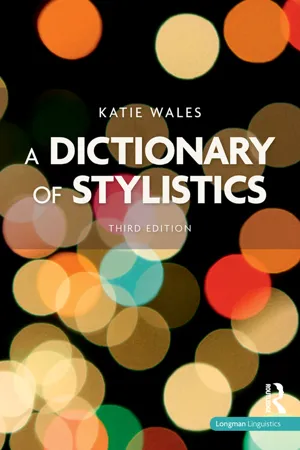
Over the past ten years there have been striking advances in stylistics. These have given rise to new terms and to revised thinking of concepts and re-definitions of terms. A Dictionary of Stylistics, 2nd Edition contains over 600 alphabeticlly listed entries: fully revised since the first and second editions, it contains many new entries.
Drawing material from stylistics and a range of related disciplines such as sociolinguistics, cognitive linguistics and traditional rhetoric, the revised Third Edition provides a valuable reference work for students and teachers of stylistics, as well as critical discourse analysis and literary criticism. At the same time it provides a general picture of the nature, insights and methodologies of stylistics. As well as explaining terminology clearly and concisely, this edition contains a subject index for further ease of use.
With numerous quotations; explanations for many basic terms from grammar and rhetoric; and a comprehensive bibliography, this is a unique reference work and handbook for stylistic and textual analysis. Students and teachers at secondary and tertiary levels of English language and literature or English as a foreign or second language, and of linguistics, will find it an invaluable source of information.
Katie Wales is Professor of Modern English Language, University of Leeds and Dean of Learning and Teaching in the Faculty of Arts.
- 496 pages
- English
- ePUB (mobile friendly)
- Available on iOS & Android
eBook - ePub
A Dictionary of Stylistics
About this book
Trusted by 375,005 students
Access to over 1 million titles for a fair monthly price.
Study more efficiently using our study tools.
Information
Subtopic
LinguisticsC
■ caesura
A classical term introduced into traditional English PROSODY to refer to a pause in the middle of a line of verse.
In English verse such pauses are determined by SYNTAX, sense or punctuation rather than METRICAL form, and so there are no ‘rules’ determining their occurrence. However, in Old and Middle English ALLITERATIVE VERSE a regular pause or caesura divides the line into two half-lines.
■ canon; canonical; canonization
(1) In LITERARY CRITICISM and TEXT STUDIES, canon is a term commonly used to refer to the collection of works which are generally regarded as being the genuine work of a particular author: hence the adjective canonical, meaning ‘accepted, authoritative, standard’.
(2) The Russian FORMALISTS and PRAGUE SCHOOL LINGUISTS used canon in a wider sense to refer to those works which are generally accepted as upholding the (main) literary or poetic tradition. Innovation comes from a reaction to this canon, which has a tendency to ‘harden’, to be AUTOMATIZED. Many innovations are linguistic (e.g. reactions against POETIC DICTION), and also generic: in the novel, for instance, so-called ‘low’ or popular sub-genres (e.g. epistle, travelogue, horror story) may become incorporated. Such innovations and others are said to be canonized, elevated to the (new) literary NORM (Viktor Shklovsky 1925).
But, ironically, the very process of canonization involves a ‘hardening’ of forms. A contemporary of the Formalists, the Russian linguist-philosopher Mikhail Bakhtin (1981), speaks of what he calls the centripetal (v. the centrifugal) forces in culture: the homogenizing v. the dispersive influences of subversive literary forms. For him the novel as a genre is not quite as subject to the pressures of canonization as poetry. By its very nature it is more alert to ‘alternative’ art forms.
(3) Canonization may be seen as the characteristic feature of a STANDARD language or dialect. Any dialect which is accepted as the authoritative speech of the nation is elevated, as it were, above other dialects; and accepted as the ‘norm’ for USAGE. So much so, that many speakers will resist, or resent changes.
(4) For some radical critics, canon and canonization carry distinct political and IDEOLOGICAL implications in studies of (English) literature. So Terry Eagleton (1996) saw the study of English in higher education as mainly based on the authority of a literary canon of texts, itself based on a mixed set of EVALUATIVE assumptions (cultural, social, moral, as well as formal) of a kind much influenced by F.R. Leavis (1948). English teaching in the colonies, and teaching for the working-classes from the end of the nineteenth century onwards, were also factors.
Inspired by cultural studies, FEMINIST CRITICISM and POSTCOLONIAL THEORY, the idea of the canon has been ‘exploded’, and a wider range of texts, both ‘high’ and ‘low’, are now taught in British schools and universities. Questions of de-canonization and canon formation have inevitably reinvigorated issues of LITERARINESS and the nature of LITERATURE.
(5) Canonical is used in linguistics as a synonym for ‘standard’ or ‘nondeviant’ or ‘ideal’. So words are given in their canonical forms in dictionaries, irrespective of how they may actually be pronounced in speech. The canonical SITUATION of utterance is a spoken encounter between two people; a non-canonical situation would be written communication, and where the participants are far away from each other, etc. In SEMIOTICS canonical orientation is spoken about: phrases like back to front and upside down reflect our intuitions about what are our (ab)normal perspectives on certain objects (see further John Lyons 1977).
■ cant
(1) In ordinary usage today this word is most likely to be derogatory, referring to insincerity or hypocrisy in language and thought.
(2) The OED suggests that the word is probably ultimately derived from Lat. cantus ‘song, chant’. In the seventeenth century, when it first appears, it was frequently applied pejoratively to the whining speech of beggars; and it has since then most usually been applied to the special languages or vocabularies used by the misfits or outcasts of society, such as thieves (see also ANTI-LANGUAGE; ARGOT); but also by religious sects like the Quakers, and by certain professions (e.g. lawyers).
(See also JARGON; SLANG.)
■ captatio benevolentiae
See EXORDIUM.
■ carnival(esque)
A term in LITERARY CRITICISM popularized through the writing of the Russian theorist Mikhail Bakhtin (1968) on Rabelais, to signal any demotic HETEROGLOSSIC or ‘multi-voiced’ counter-culture in comic or exuberant opposition to a hegemonic official culture: a kind of subversive anti-culture, often with its own ANTI-LANGUAGE: e.g. witches’ Sabbaths, Mardi Gras and present-day ‘raves’.
■ catachresis
(1) From Gk meaning ‘misuse’ or ‘abuse’, catachresis was used in RHETORIC by George Puttenham (1589) and others, as a kind of TROPE which involved unusual or far-fetched METAPHORS. So, part of the dynamism of Shakespeare’s language comes from (NONCE) applications of words outside their normal contexts to metaphorical, often compressed, uses:
… for supple knees
Feed arrogance
(Troilus and Cressida, III. iii)
… my face I’ll grime with filth,
… elf all my hairs in knots
(King Lear, II. iii)
It is also more obviously applied to what we today might call ‘mixed metaphors’, as Hamlet’s ‘I will speak daggers to her’. The satirical magazine Private Eye features regularly a collection of ‘Colemanballs’, mixed metaphors from media commentators (see also BLEND).
(2) The French philosopher Michel Foucault (1966) argued that catachresis is basic to the FIGURES of rhetoric, since so many of them depend on DEVIATIONS from ‘normal’ (non-poetic) usage, or on the play of LITERAL V. FIGURATIVE sense. Indeed, he would go so far as to maintain that all language is catachretic: literal meanings are not inherent in the SIGNIFIER–SIGNIFIED relationship, but have simply come to be conventionalized by society. Moreover, paraphrased as ‘error’, catachresis symbolizes the origin of language: the naming of the multiplicities of experience and environment under broader, single SIGNS.
(3) As definitions like ‘error’ and ‘abuse’ suggest, catachresis is also an evaluative term, part of the PRESCRIPTIVE linguistic tradition concerned with notions of CORRECTNESS with ‘right’ and ‘wrong’, ‘proper’ and ‘improper’ usages.
(4) However, catachresis/catachretic meaning ‘error’, ‘erroneous’ are terms still sometimes used in lexicography or dictionary-making as part of the usage labelling system for lexical entries (symbolized by a paragraph mark in the OED, for example).
It is certainly true that many linguistic changes and innovations are due to error and ignorance (e.g. of etymologies); but, once accepted by a majority of educated people, they become sanctioned by custom, and their origins eventually obscured (e.g. primrose from Fr. primerole; crayfish from crevisse).
(See also MALAPROPISM.)
■ cataphora; cataphoric reference
In GRAMMAR and TEXT studies, CATAPHORA as introduced by Karl Bühler (1934) denotes a kind of linguistic REFERENCE which is ‘forward-looking’ rather than ‘backward-looking’ (ANAPHORA).
(1) In particular, it is used for PERSONAL PRONOUNS and other proforms which ‘anticipate’ the NOUN PHRASES with which they co-occur, e.g. If she’s thinking of applying for that job, Kate had better apply quickly. Specific cataphoric reference like this is more common between clauses than between sentences (unlike anaphoric reference); and is, in any case, replaceable by anaphoric reference itself: cf. If Kate’s thinking of applying for that job, she had better apply quickly.
With its delay of more precise information, cataphora lends itself to stylistic exploitation in the interests of suspense; or with the pattern of (light) pronoun followed by (heavier) noun phrase, it can provide a useful FOCUSING device. Both effects can be seen in utterances favoured in journalism and broadcasting: And bounding down the stairs with his ever cheeky grin comes the man of the moment, Graham Norton.
In literature, the device of delayed NPs and the use of third person pronouns and other items of definite or familiar reference is frequently exploited at the beginning of texts in the technique known as IN MEDIAS RES. What is interesting about the opening of William Golding’s Pincher Martin, cited in the entry for ANAPHORIC reference, is that a definite NP (the man) is not found until the beginning of the third paragraph on the second page. This suggests that, from a discourse processing point of view, we are actually looking for more information about the he in the universe of discourse, not waiting for a ‘master’ or ‘coreferential’ NP to appear. So, as with anaphora, Katie Wales (1996, ch. 2) would argue that in many such examples reference is text-‘inward-looking’ rather than ‘forward-looking’ for cataphora (or ‘backward-looking’ for anaphora).
(2) Cataphora is used commonly for reference to aspects of the discourse itself, rather than specific objects or people. The pronoun it characteristically anticipates following clauses or sentences, as in: It’s a pity [that she can’t come with us]; or I don’t like it. [The cat’s gone missing for the third day running.]
(3) Superficially cataphoric reference can be found in certain ‘self-repair’ utterances in conversation, when speakers correct themselves f...
Table of contents
- Cover
- Half Title
- Title Page
- Copyright Page
- Table of Contents
- Introduction to the third edition
- Abbreviations and symbols
- Phonemic symbols
- Publisher’s acknowledgements
- A
- B
- C
- D
- E
- F
- G
- H
- I
- J
- K
- L
- M
- N
- O
- P
- Q
- R
- S
- T
- U
- V
- W
- Z
- References and further reading
- Subject index
- Author index
Frequently asked questions
Yes, you can cancel anytime from the Subscription tab in your account settings on the Perlego website. Your subscription will stay active until the end of your current billing period. Learn how to cancel your subscription
No, books cannot be downloaded as external files, such as PDFs, for use outside of Perlego. However, you can download books within the Perlego app for offline reading on mobile or tablet. Learn how to download books offline
Perlego offers two plans: Essential and Complete
- Essential is ideal for learners and professionals who enjoy exploring a wide range of subjects. Access the Essential Library with 800,000+ trusted titles and best-sellers across business, personal growth, and the humanities. Includes unlimited reading time and Standard Read Aloud voice.
- Complete: Perfect for advanced learners and researchers needing full, unrestricted access. Unlock 1.4M+ books across hundreds of subjects, including academic and specialized titles. The Complete Plan also includes advanced features like Premium Read Aloud and Research Assistant.
We are an online textbook subscription service, where you can get access to an entire online library for less than the price of a single book per month. With over 1 million books across 990+ topics, we’ve got you covered! Learn about our mission
Look out for the read-aloud symbol on your next book to see if you can listen to it. The read-aloud tool reads text aloud for you, highlighting the text as it is being read. You can pause it, speed it up and slow it down. Learn more about Read Aloud
Yes! You can use the Perlego app on both iOS and Android devices to read anytime, anywhere — even offline. Perfect for commutes or when you’re on the go.
Please note we cannot support devices running on iOS 13 and Android 7 or earlier. Learn more about using the app
Please note we cannot support devices running on iOS 13 and Android 7 or earlier. Learn more about using the app
Yes, you can access A Dictionary of Stylistics by Katie Wales in PDF and/or ePUB format. We have over one million books available in our catalogue for you to explore.