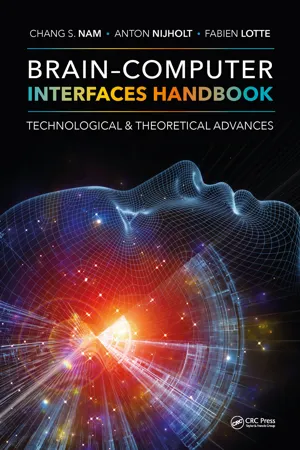
Brain–Computer Interfaces Handbook
Technological and Theoretical Advances
- 788 pages
- English
- ePUB (mobile friendly)
- Available on iOS & Android
Brain–Computer Interfaces Handbook
Technological and Theoretical Advances
About this book
Brain–Computer Interfaces Handbook: Technological and Theoretical Advances provides a tutorial and an overview of the rich and multi-faceted world of Brain–Computer Interfaces (BCIs). The authors supply readers with a contemporary presentation of fundamentals, theories, and diverse applications of BCI, creating a valuable resource for anyone involved with the improvement of people's lives by replacing, restoring, improving, supplementing or enhancing natural output from the central nervous system. It is a useful guide for readers interested in understanding how neural bases for cognitive and sensory functions, such as seeing, hearing, and remembering, relate to real-world technologies. More precisely, this handbook details clinical, therapeutic and human-computer interfaces applications of BCI and various aspects of human cognition and behavior such as perception, affect, and action. It overviews the different methods and techniques used in acquiring and pre-processing brain signals, extracting features, and classifying users' mental states and intentions. Various theories, models, and empirical findings regarding the ways in which the human brain interfaces with external systems and environments using BCI are also explored. The handbook concludes by engaging ethical considerations, open questions, and challenges that continue to face brain–computer interface research.
- Features an in-depth look at the different methods and techniques used in acquiring and pre-processing brain signals, extracting features, and classifying the user's intention
- Covers various theories, models, and empirical findings regarding ways in which the human brain can interface with the systems or external environments
- Presents applications of BCI technology to understand various aspects of human cognition and behavior such as perception, affect, action, and more
- Includes clinical trials and individual case studies of the experimental therapeutic applications of BCI
- Provides human factors and human-computer interface concerns in the design, development, and evaluation of BCIs
Overall, this handbook provides a synopsis of key technological and theoretical advances that are directly applicable to brain–computer interfacing technologies and can be readily understood and applied by individuals with no formal training in BCI research and development.
Tools to learn more effectively

Saving Books

Keyword Search

Annotating Text

Listen to it instead
Information
Table of contents
- Cover
- Half Title Page
- Title Page
- Copyright Page
- Contents
- Foreword
- Preface
- Handbook Website
- Editors
- Contributors
- Reviewers
- Introduction: Evolution of Brain–Computer Interfaces
- Part I Brain–Computer Interface Applications
- Section B Therapeutic Applications
- Section C Affective and Artistic Brain–Computer Interfaces
- Section D BCI Control of Entertainment and Multimedia
- Part II Signal Acquisition and Open Source Platform in BCI
- Part III Signal Processing, Feature Extraction, and Classification in BCI
- Part IV Brain–Computer Interface Paradigms
- Part V Human Factors, Design, and Evaluation in BCI
- Part VI Emerging Issues and Future BCIs
- Author Index
- Subject Index
Frequently asked questions
- Essential is ideal for learners and professionals who enjoy exploring a wide range of subjects. Access the Essential Library with 800,000+ trusted titles and best-sellers across business, personal growth, and the humanities. Includes unlimited reading time and Standard Read Aloud voice.
- Complete: Perfect for advanced learners and researchers needing full, unrestricted access. Unlock 1.4M+ books across hundreds of subjects, including academic and specialized titles. The Complete Plan also includes advanced features like Premium Read Aloud and Research Assistant.
Please note we cannot support devices running on iOS 13 and Android 7 or earlier. Learn more about using the app