eBook - ePub
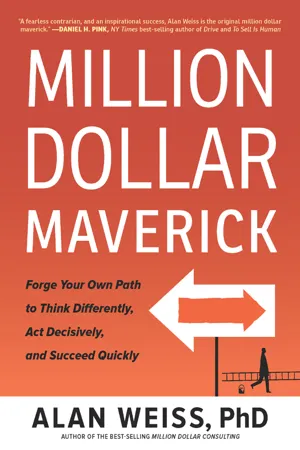
Million Dollar Maverick
Forge Your Own Path to Think Differently, Act Decisively, and Succeed Quickly
- 210 pages
- English
- ePUB (mobile friendly)
- Available on iOS & Android
eBook - ePub
Million Dollar Maverick
Forge Your Own Path to Think Differently, Act Decisively, and Succeed Quickly
About this book
When it comes to how to succeed as an entrepreneur, we are besotted with advice. According to bestselling author Alan Weiss, success is a combination of opportunism, very disciplined work, luck, timing, and ignoring most advice. In other words, it means striking out on your own, original path to success. In Million Dollar Maverick, he explains that entrepreneurs don't take advice, they create value and then monetize it. They do what they love and are great at and find a way to sell it to people. They do not--contrary to "conventional wisdom"--chase money. They attract money. And most of all they think differently, act decisively--and, if talent and timing are with them, succeed quickly. Drawing on over thirty years of experience as a consultant, speaker, and global expert, Weiss shares his story and "Million Dollar Tips," not found in any of his other books, to help entrepreneurs gain influence, build confidence, and develop the critical thinking skills they need to discover the inside track to rapid success
Trusted by 375,005 students
Access to over 1.5 million titles for a fair monthly price.
Study more efficiently using our study tools.
Information
CHAPTER 1
Leaving the Herd: Why the Lone Wolf Succeeds More Than the Lone Calf
This is the expressway to being comfortably different and uncomfortably contrarian: comfort the afflicted and afflict the comfortable. The “black hole” of convention entraps too many people in a gravity of failure they can’t escape.
How to Become a Singular Presence
It was Bizarro World. Seventeen teachers sat in classroom seats while four students took turns lecturing to them. Unlike most classrooms in Emerson High School, the occupants in this one were paying rapt attention during the five minutes allotted each speaker. The eye contact was intense enough to require sunscreen.
This thirty-minute meeting was the complete audition and final vote for the first (and only) exchange student that Emerson would ever produce. The year was 1963, and an entrepreneurial local newspaper reporter had arranged for a Finnish student he had met to spend a half-year in each of the public high schools in Union City, New Jersey, a poor city, at the time the most densely populated city in the United States (fifty thousand people in about two square miles).
The “committee of seventeen” had chosen four nominees to be the return student (who would spend six weeks touring Europe, ending in Finland over the summer, since none of us was about to learn Finnish). They chose the quarterback and captain of the football team; the president of the yearbook; the president of the class; and me, the president of the student council and editor-in-chief of the school newspaper. We were apprised of the selections (back then no one argued about fairness or gender) and asked if we would accept if chosen, our parents were consulted, and then we were told to prepare to answer a question in front of the committee. The five-minute interview would determine, by immediate majority vote thereafter, who would have his life incredibly changed.
It was the height of the Cold War, and the question was this: How would you defend the United States to people you meet in Europe when you’re asked about our foreign policy?
I had luck and pluck. Luck because my last name starts with “W,” and I was to be last in the alphabetic order. But here’s the pluck. I had an inkling that this trip would have a profound change on my life, and I knew we could not just afford any college. I also knew that my hometown of Union City—the “embroidery capital of the world” proclaimed the city’s sign as you shot by on the way to the Lincoln Tunnel and New York—held no future for me. I decided that I couldn’t risk simply giving a better but similar answer to the others.
I had to give a completely different answer to truly stand out from everybody else. My turn was approaching.
“I wouldn’t defend the United States,” I told the room of suddenly bolt-upright teachers. “I would explain who we are and how we’re more similar to their own country than dissimilar.” I went on from there.
All the way to Europe.
In those five minutes, my life was changed. I sailed on the original Queen Mary, visited nine countries, took my first airplane rides, met with the U.S. general who commanded our Berlin forces, and even dated a future Miss Finland.* My life changed from black and white to Technicolor. All because I decided that I had better stand out in a crowd, and I understood that I had a better chance of standing out not merely by being better, but by being different.
We are inculcated from youth to blend in, to be one of the crowd, to be accepted. This has a chilling effect later in our lives, as characterized by the “ticky-tacky” houses made famous in Malvina Reynolds’s 1960s’ song satirizing conformist attitudes. Normative pressure is monstrous. We point out the odd duck, scorn the free spirit, and chastise the rebel while we struggle to keep abreast of the latest lingo (as I write this it’s “bae”— before anyone else), clothing (no matter how uncomfortable), clubs, cars, and furnishings.
There is significant and conclusive research today that we tend to live where people like us live, and join what they join, and act like they act. We are not conformists at birth, but we have “sameness” drilled into us, as we saw in the frenzy to purchase baby clothes identical to those that Kate, Duchess of Cambridge, used to dress her first child, George.
We must resist this ominous gravity, even to “royal” taste.
My observations of both entrepreneurs and successful corporate executives, as well as groundbreaking organizations, are that they don’t march to the beat of a distant drummer; they create their uniquely personal music. Here are some examples:
• The U.S. Marine Corps’ branding (“a few good men”), which accentuated selectivity, scarcity, and high status for enlistment
• BMW’s “ultimate driving machine” slogan, when safety and economy were being touted by others
• Apple’s emphasis on design, which subordinated engineering and promoted aesthetics as being important in hardware
• Certain dog breeders’ choice to specialize solely in white German shepherds, which old-school dog snobs consider a freak caused by recessive genes, but which are now immensely popular with the public (as an independent breed, white shepherds would be in the top quartile)
• Rod Stewart’s move from rock to standards, with a voice barely up to it but a passion that’s unmistakable, creating an entirely new following (my wife being a devotee)
How does comfort with “being different” help us in our work? Here’s how I used my exchange student experience to gain a $250,000 project at a major life insurer.
Mindsets: It’s not the “road most traveled or less traveled.” It’s the road you create for yourself.
Case Study
An executive vice president of a major insurer, which had just gulped down a company almost equal in size, was interviewing six consultants for a “strategic communications project.” His concern was that performance would suffer while people were worrying about their jobs and status.
I sat in the reception area as four of the other consulting firms marched in with laptops and PowerPoint presentations. We had drawn lots for presentation order. I was the only solo consultant there. One of the senior managers had read a couple of my books.
When I was called in, I sat down with just my calendar in front of me. The executive was across from me, and a dozen minions surrounded us. Everyone looked exhausted. Cups with cold coffee sat like sentries all over the room. It was Mad Men without cigarettes.
“What would you create to calm people and assure they were focused on their jobs?” asked the client. “Give us an idea of what you would tell them and when, and by what means.” He sat back and placed his hands behind his head.
“I wouldn’t tell them anything,” I said.
He sat back up. So did everyone else.
“What was that again?”
“Do you know which offices you’re closing?”
“No, a committee is working on that.”
“Do you know which officers will remain to head which departments?”
“No, the board has a retreat scheduled to decide that.”
“Do you know which company’s compensation system will prevail?”
“No, our accounting firm is giving us advice.”
“You don’t know anything, so don’t tell them anything. Simply ask for their concerns, questions, and suggestions. Answer the questions you can, acknowledge those you can’t answer, and let everyone know what those inquiries are. As you get information, answer what you can reliably respond to. Let people know you’re listening, stop worrying about talking.”
At least ten seconds elapsed, which felt to me like half a day.
“That is counterintuitive,” he said, finally.
“It is,” I said, not knowing what else to say.
“Cancel the last presentation,” he said to an assistant, and later that day we had worked out a $250,000 project that required a four months’ span but only about three actual weeks of my time.
I am absolutely convinced—because I’ve done it thousands of times—that simply taking a contrarian or “one-off” view is the secret to success. When someone says to you, “We’re in California and you live in New York,” as an excuse not to hire you, you’re probably apt to say, “But there are nonstop fights, I can absorb part of the expense, Skype is a fine alternative, and I’m happy to make extended visits.”
Admit it, you do.
What I say is, “That’s exactly why you need me.”
Then the other person says, “Why is that?” NOTICE: The other person is now engaged not in explaining why you’re not a good alternative but rather in trying to understand why you are a good alternative! That’s when I say: “I bring a different perspective from the East. All of your competitors are using local help and ideas, and they all have cookie-cutter approaches. You need some fresh air. My credentials and experience are not only better, they’re different. The expense, which I’m assuming is what’s really bothering you, might be an extra $10,000 over the course of the project, but the 5 percent market share increase we’re pursuing would mean another $2 million in revenues. I’d say that’s a pretty minor issue, right?”
Bill Belichick, the New England Patriots’ head coach, who has won four Super Bowls at this writing, has created plays where people eligible to catch a pass are temporarily ineligible (they must report this to the officials, who inform the other team), and those ineligible are temporarily eligible. It, too, is counterintuitive, until you watch a 325-pound tackle (Nate Solder) who never catches passes actually catch one and rumble like a fast freight train over two defenders into the end zone for a touchdown. That’s the equivalent to my $250,000 deal. It’s counterintuitive.
And it works, because the other guys don’t expect it.
The Benefits of Contrarianism
I built my career as a “contrarian” without knowing it, and began a highly effective brand without realizing it. Sometimes it’s better to be lucky than good, but it’s best to be both.
In 1985 I was fired in the Admirals Club of American Airlines in Chicago’s O’Hare Airport by W. Clement Stone, who owned the consulting firm where I had been president for eighteen months. I had moved my family from New Jersey to Rhode Island, and I had very little savings and no prospects. Stone believed that positive mental a...
Table of contents
- Cover
- Half Title
- Title Page
- Copyright Page
- Dedication
- Acknowledgments
- Table of Contents
- Introduction
- Chapter 1 Leaving the Herd
- Chapter 2 Losing the Fear of Failure
- Chapter 3 Gaining Influence
- Chapter 4 Critical Thinking Skills
- Chapter 5 Learning the Hard Way
- Chapter 6 Pain, Not Suffering
- Chapter 7 The Art of the Setup
- Chapter 8 The Word
- Chapter 9 The “App” of Success
- Chapter 10 No Guilt, No Fear, No Peer
- Epilogue The Liberal Artist
- Appendix
- References
- Index
Frequently asked questions
Yes, you can cancel anytime from the Subscription tab in your account settings on the Perlego website. Your subscription will stay active until the end of your current billing period. Learn how to cancel your subscription
No, books cannot be downloaded as external files, such as PDFs, for use outside of Perlego. However, you can download books within the Perlego app for offline reading on mobile or tablet. Learn how to download books offline
Perlego offers two plans: Essential and Complete
- Essential is ideal for learners and professionals who enjoy exploring a wide range of subjects. Access the Essential Library with 800,000+ trusted titles and best-sellers across business, personal growth, and the humanities. Includes unlimited reading time and Standard Read Aloud voice.
- Complete: Perfect for advanced learners and researchers needing full, unrestricted access. Unlock 1.5M+ books across hundreds of subjects, including academic and specialized titles. The Complete Plan also includes advanced features like Premium Read Aloud and Research Assistant.
We are an online textbook subscription service, where you can get access to an entire online library for less than the price of a single book per month. With over 1.5 million books across 990+ topics, we’ve got you covered! Learn about our mission
Look out for the read-aloud symbol on your next book to see if you can listen to it. The read-aloud tool reads text aloud for you, highlighting the text as it is being read. You can pause it, speed it up and slow it down. Learn more about Read Aloud
Yes! You can use the Perlego app on both iOS and Android devices to read anytime, anywhere — even offline. Perfect for commutes or when you’re on the go.
Please note we cannot support devices running on iOS 13 and Android 7 or earlier. Learn more about using the app
Please note we cannot support devices running on iOS 13 and Android 7 or earlier. Learn more about using the app
Yes, you can access Million Dollar Maverick by Alan Weiss in PDF and/or ePUB format, as well as other popular books in Business & Business General. We have over 1.5 million books available in our catalogue for you to explore.