1.1 Introduction
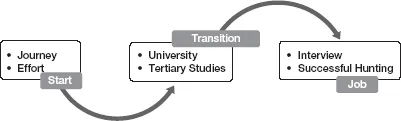
A key challenge for new graduates is making a positive transition from tertiary studies to their first career-related job. It is the first stage of finding career-related employment and building a successful career. Our aim is to help students acquire the job search preparation and job hunting skills to achieve this.
Acquiring the education provided by a degree or tertiary studies is in fact the first step in a life-long journey. The next step involves getting a job in your chosen profession.
Whose responsibility is it to equip under-graduates with the skills to acquire a job in their chosen employment? Is it the university’s or is it the student’s? The responsibility is ultimately the students to seek out these skills. Some tertiary institutions, which have the welfare and career interests of their students at heart, will encourage additional training or resources to assist prospective graduates’ transition to employment.
One of the challenges students face when enrolling in a tertiary course is the expectation of a job and career as the ultimate outcome. Economic cycles, excessive student intakes, oversupply of some courses and the varying demands of potential employers are all key factors that affect employment opportunities; they directly affect potential new graduates’ hopes for job and career opportunities.
In the book, we will cover successful strategies for job search preparation and winning techniques for job hunting and securing a job. The focus of the book is on practical help, to assist you with achieving your personal plans for your transition to employment.
Despite our best intentions, after reading a valuable book or attending a worthwhile course we can fail to implement the things we have just learnt. This is often owing to the demands of busy lives and time pressures. For this reason, the material has been structured to allow students to progressively develop their personal plans. The book has been designed to be tailored to each student’s personal needs (via the Personal Plan in the Appendix).
This introductory chapter will help you maximise your job search results. It will prepare you for the challenges and issues ahead. It teaches you to break a large task (job hunting) into smaller components and take one step at a time.
Chapter 2 on adaptable strategies will help you handle diminished work opportunities. It will outline alternate strategies to ensure your expectations are realistic and can match available job opportunities. You will learn ways to rebrand yourself and explore alternatives.
Chapter 3 on personal abilities explores ways of developing important personal skills for job hunting. These include adaptability, resilience, flexibility and endurance. The chapter provides encouragement.
Chapter 4, entitled Job hunting: key factors, will introduce you to the key considerations for job search preparation, including your achievements, job criteria, personal development, through to the role of a good resume and cover letter.
Chapter 5 is a key chapter, and will help you in locating job opportunities.
Social media is crucial in modern job searching. Four major platforms (LinkedIn, Facebook, Google Plus and Twitter) are covered in Chapters 6 to 8 to help you use these powerful options.
Good decision making is very important as you weigh up complex and often difficult options when undertaking job searching. Three decision-making tools are included to help you (Chapter 9). Through the Personal Plan you will identify your achievements. These are the “selling points” used in your job application (Chapters 10 and 11).
Progressively you will compile your Foundation Resume that contains all your achievements, qualifications, work experience and abilities (Chapters 12 and 13). It is a key resource for your job hunting. Resumes or CVs vary between countries and within regions. The book will outline the key differences (Chapter 15). This will help you select a format that is appropriate and culturally right. You will be guided through the creation of your job application Targeted Resume and cover letter.
Job interviews are a critical part of winning a job (Chapter 17). The key tips to succeed are included.
The Appendices: Resources provide valuable resources to assist your job search preparation.
The Appendices: Personal Plan is a key part. They help you convert the contents of the book into your personal action plan and produce key job application materials you will need.
eResources – the book’s digital web resource – is a valuable source of digital resources to assist you.