![]()
p.6
1 Basic elements of grammatical structure
1.0 Structure
The term structure is used in this book to cover the following:
• any kind of morphological feature: plural/singular of nouns, verb categories like tense, aspect or person, verb forms like gerund/infinitive, etc., adjective features like comparative/superlative, and so on. (This is just a small selection of examples.)
• any kind of syntactic construction: the of-genitive, do-support, negation, declarative, the interrogative, the imperative, the passive, relative clauses, cleft sentences, extraposition, etc.
• grammatical categories of words known as word-classes or parts of speech: nouns, verbs, adjectives, prepositions, etc.
All this concerns grammatical characteristics of words and groups of words that are permanent and individual, and do not depend on particular sentences. What contrasts with structure is the idea of function (subject, object, etc.), which, as we will see later, is a sentence-dependent concept. For the moment we will stay with structure. Function is discussed in the next chapter. The aspect of structure that we want to look at more closely now is the word-class, which needs some detailed explanation.
1.1 What are word-classes or ‘parts of speech’?
Word-classes are a good example of how morphology, syntax and semantics interact with each other. The basis in this case is morphology. Words of the same class have the same grammatical forms. Verbs, for instance, change according to the type of subject they have (= person: I am, you are, he is), and the time they refer to (= tense: present tense, I am; past tense, I was). Nouns have number, i.e. singular and plural forms (woman → women), Adjectives and adverbs have the category of comparison: slow → slower → slowest; slowly → more slowly → most slowly. And so on. Many members of particular word-classes also show typical endings, e.g. -ive, -ible/-able for adjectives (massive, respectable), -ion and -ity for nouns (station, integrity), -ise and -ate for verbs (realise, compensate), -ly for adverbs (slowly, quickly), etc. This means that members of one word-class can be converted into members of another (a morphological process called derivation): sensitive (adjective) → sensitivity (noun), nation (noun) → nationalise (verb), etc.
p.7
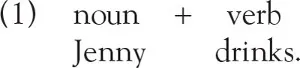
However, although the external features of word-classes are morphological, it is syntax that shows their real purpose. A word-class comprises members that do the same job syntactically. Members of the same class occur in the same places in a sentence and have similar relationships to members of other word-classes. For instance, we typically start a declarative sentence with a noun or pronoun and follow it with a verb. Sometimes, depending on the verb, this is enough:
To say more, we might follow this with another noun and extend this further with an adverb:
But the options are restricted. The second noun cannot swap positions with the verb (*Jenny tea drinks regularly)1 and an adjective could not replace the adverb (*Jenny drinks tea regular). On the other hand, there is nothing to be said against putting adjectives before the nouns:
This is not just about position. Some word-classes are more closely associated than others. Adjectives, we can see here, relate typically to nouns, whereas adverbs relate to verbs and verb sequences. Further examples of close neighbours are articles and nouns, and prepositions and nouns. Conjunctions, on the other hand, combine the larger parts of sentences that we call phrases and clauses (see 1.4 below for a detailed discussion of these terms).
So we can see that word-classes tell us a great deal about what goes where in a sentence.
Finally, semantics also plays a large role in the character of word-classes. Traditionally, in fact, it is meaning, rather than syntax or morphology, that is used to define word-classes, especially in the teaching of children. This is not surprising, as meaning is more easily understood by young learners than grammar. In this approach, nouns, e.g. are said to refer to things and people, verbs are labelled ‘doing words’, signifying actions, and adjectives are thought of as ‘describing nouns’. Linguists have often criticised descriptions of this kind as vague and unreliable. And it is true that they can easily be contradicted. For instance, abstract nouns (such as love and hate) do not really mean ‘things’. Words like action and movement refer, obviously, to ‘actions’, yet they are not verbs. On the other hand, verbs are not just ‘doing words’: they can mean states (Vanessa strongly resembles her sister) or experiences (Alan caught a cold).
p.8
Nevertheless, there is a lot of truth in semantic characterisation. It is not enough for a full definition, but gives us a good indication of typical cases or prototypes. Not all nouns refer to ‘things’ or people, certainly. But the reverse is usually true, i.e. that almost all words referring to things or people do belong to the class of nouns. Similarly, the typical meaning of a verb is that it refers to an event or state, even though a few nouns do the same thing. Furthermore, verbs always link other elements in the sentence together as participants in the event or state. This is not only a grammatical relationship, but a semantic one. For instance, in
the verb tells us that John and Mary became involved with each ...