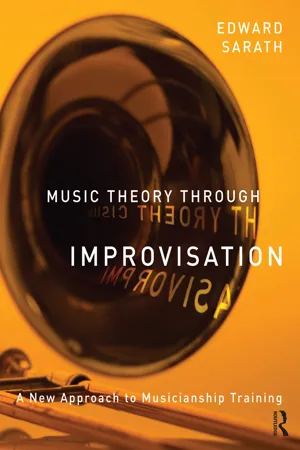
Designed for Music Theory courses, Music Theory Through Improvisation presents a unique approach to basic theory and musicianship training that examines the study of traditional theory through the art of improvisation. The book follows the same general progression of diatonic to non-diatonic harmony in conventional approaches, but integrates improvisation, composition, keyboard harmony, analysis, and rhythm. Conventional approaches to basic musicianship have largely been oriented toward study of common practice harmony from the Euroclassical tradition, with a heavy emphasis in four-part chorale writing. The author's entirely new pathway places the study of harmony within improvisation and composition in stylistically diverse format, with jazz and popular music serving as important stylistic sources. Supplemental materials include a play-along audio in the downloadable resources for improvisation and a companion website with resources for students and instructors.
- 392 pages
- English
- ePUB (mobile friendly)
- Available on iOS & Android
eBook - ePub
About this book
Trusted by 375,005 students
Access to over 1.5 million titles for a fair monthly price.
Study more efficiently using our study tools.
Information
Subtopic
Musica chapter 1
Improvisation Across Boundaries:
A Trans-stylistic Approach
In this chapter, we:
- Improvise with a trans-stylistic approach.
- Create with basic elements such as density, dynamics, duration, tessitura, ostinato, motive, sequence, pulse, form, and silence.
- Examine basic concepts such as tension and repose and non-syntactic elements.
- Consider new perspectives on listening and the inner dimensions of the creative process.
- Set the stage for systematic acquisition of music theory skills.
Improvisation has been central to most of the world’s music traditions and has begun to assume even greater prominence in today’s cross-cultural musical melding. In response to this emergent eclecticism, as well as for pedagogical reasons, Music Theory Through Improvisation begins with a “trans-stylistic” system of improvisation practice. Trans-stylistic simply means that instead of specifying style elements in advance—such as jazz chord changes or Baroque figured bass lines or Hindustani raga-tala cycles—we allow style elements to manifest as a byproduct of the creative process. This not only helps foster in our classrooms the very syncretism that prevails in the overall musical world, it also lays important groundwork for the acquisition of musicianship skills.
A central feature of the trans-stylistic approach is its “user-friendly” entryway for musicians who are new to improvisation. The very thought of making music apart from the printed page can be intimidating for many musicians, and this challenge may be exacerbated when style-specific constraints are imposed at the outset. By contrast, the trans-stylistic approach seeks first to elicit a creative flow that extends from each musician’s unique background in order that they can gain a glimpse of the expressive power of improvisation early on in their journeys. Everyone has an inner reservoir of influences and imagery that is shaped by the totality of their musical exposure and life experience. When we tap intothis reservoir and begin to experience music as a means for personalized, creative expression, we establish a new and more meaningful relationship with music and the quest for musicianship skills. Music theory is a common example of a knowledge area from which many musicians feel disconnected due to the lack of an outlet for creative application. The trans-stylistic approach plants the seeds for this connection between theory and practice, craft and creativity, and skills and artistry, to flourish.
The trans-stylistic approach also provides tools for expanding the horizons of experienced, style-specific improvisers. This occurs through the use of “non-syntactic” catalysts, which are introduced in this opening chapter, that expose musicians to new ways of generating and organizing ideas. Having transcended familiar style terrain, musicians can now return to it with a newfound appreciation and understanding. Here it should be emphasized that the aim of the trans-stylistic approach is not to replace style-specific engagement but to lay groundwork that enables musicians to move freely between both worlds. While the music of many of today’s leading innovators cuts across wide-ranging style boundaries, rigorous immersion in style-specific training has in most cases been central to their development. At a single stroke, the trans-stylistic approach lays groundwork for beginning and experienced improvisers to engage directly in the style-specific and cross-stylistic synthesis that will enable them to forge their unique pathways through the vast possibilities of the contemporary musical landscape.
Getting Started
The following exercises may be used in a variety of formats—from private lessons, to classroom formats, and some may even, with a little creative adaptation, be applied to large-ensemble rehearsal settings involving 30 or more musicians. They are intended to be done using the principal instrument or voice, unless otherwise indicated. The exercises need not necessarily be done in the sequence given, although the very first exercises are particularly geared to new improvisers. While the formats generally proceed from minimal constraints to gradually more involved parameters, they should not be thought of as mere stepping stones along a linear course of growth. Rather, they are intended as stimulating vehicles that can yield compelling results at all stages of musical development. I often return to these very first exercises with even my most advanced students as they have the capacity to elicit an infinite range of musical responses.
Reminder: The exercises in this chapter are to be done using the principal instrument or voice, unless otherwise indicated.
Long tone exercise
Sit in a circle if possible. Select a scale that everyone knows. It could be anything from a C major scale to something more exotic, such as an octatonic scale. Each musician is toplay only long tones, selecting notes only from the designated scale. Listen carefully to the collective sonority as you enter and try to hear in advance how your tone will fit in; it is permissible, upon entering with a tone that you feel clashes excessively with the sonority of the moment, to shift to another tone. Generally, this will be resolved by playing a tone a half or whole step above or below the first note attempted. The duration of the tones should be determined by what is comfortable on one’s instrument. You may rest between entrances.
- Variation A: Do the long tone exercise without designating a scale. Musicians can thus play any pitch as they add to the collective sonority. As in the above exercise, attentive listening is essential.
- Variation B: Have individuals take turns improvising short solos, involving more florid passages (faster notes), atop the long tone texture. Soloists should make every effort to stand out atop the collective texture. Ensemble must make every effort to play softly enough so that soloists stand out.
Exercise 1 a
The above exercise and its variations provide an inviting beginning format for musicians who are intimated by the idea of making music apart from the printed page. They also call for heightened listening from new and advanced improvisers alike. The following questions will stimulate reflection and dialogue regarding creative decision-making that these exercises involved: Were there times when you felt the need to change your note or your volume, or had to decide whether or not to play? What were the criteria by which these decisions were made? Were there moments when you felt that the piece really worked? Others that were less compelling? Why?
The following exercises provide more creative latitude.
Wheel of duets
Sit in a circle if possible. Each student pairs with the student directly across from him or her in the circle. Each pair improvises a short duet—perhaps 30–60 seconds—with no parameters (e.g. key area, style) delineated in advance. The importance is listening as intently as possible to what is happening. The pieces can follow one another without pause (applause is allowed, though!) unless the instructor wishes to break the sequence in order to comment.
Exercise1 b
After one full cycle (one rotation of the wheel) of duets, discuss the results. What was particularly interesting? What were some of the limitations? Might some tendencies be identified—such as limited dynamic range, lack of clarity of ideas, all pieces ending up sounding the same? How might these problems be rectified?
Play another cycle or partial cycle of duets with the intention of addressing the ideas that have been expressed in the feedback session, or trying out new possibilities. Perhaps simply striving to make each piece as contrasting as possible from the one before it may yield significant results.
Non-syntactic Catalysts
The theorist Leonard Meyer identified two categories of basic musical elements. Syntactic parameters include harmony melody and rhythm. Non-syntactic parameters include dynamics (volume), density (amount of note activity—from highly sparse to highly dense— in a given passage), tessitura (high or low range), duration, timbre, and silence. Now that we have initiated a creative flow we can begin to refine our playing through the use of non-syntactic parameters as improvisatory catalysts. This will help us improve the clarity and variety in our ideas. Later in this chapter we will begin to explore the syntactic domain, which will assume center stage beginning in Chapter 2. In the meantime, it will be helpful to observe the syntactic elements that spontaneously emerge as by-products of our improvisations with non-syntactic catalysts.
Dynamics
Improvise a short piece—20–30 seconds—that includes the loudest sound you can make comfortably and musically, without reaching a decibel level that is uncomfortable or harmful (e.g. in the case of trumpet players or electric guitarists) to anyone present. Then do the same with your softest extreme: play a note or short phrase at your softest volume. At first, there will be tendency to not broach the outer boundaries, and so it is important to be vigilant in actually reaching your extremes.
Exercise 1 c
Density
Density pertains to the amount of note activity in a given unit of time. Higher-density passages comprise faster note activity than sparse, lower density passages, where slower note activity and rests predominate. Play a short piece that juxtaposes high-density music with low-density music.
Exercise 1 d
Do not be concerned if your high-density playing stretches the boundaries of your technique to the point where you may not feel in total control of what you are playing. The main point here is the effect and experience of high-density music and going beyond ourordinary boundaries. Often we stop short of the high-density texture we are capable of because it means risking the precision we work so ardently to develop. While these are admirable ideals, the purpose of this brief exercise is to move outside of our comfort zone. Hence a different kind of vigilance is called for; instead of the usual attention we might pay to issues such as tone quality and precision of execution, now our challenge is to temporarily let go to a degree we may not be accustomed to. Occasional forays of this kind can be highly beneficial to our creative as well as technical development.
Registral variety
The same exercise may be applied to registral or tessitura variety. Improvise brief passages that traverse the highest and then the lowest range of the instrument.
Exercise 1 e
Combinations of non-syntactic elements
Play improvisations that combine the various parameters—e.g. density and dynamic variety; dynamic and registral variety; and dynamics, density, and registral variety.
Exercise 1 f
Tension and Release, Variety and Unity, Motion and Stability
The goal of the above and forthcoming exercises is to develop the tools to create interesting improvisations. An important factor in creating musical interest is the ba...
Table of contents
- Cover
- Title Page
- Copyright Page
- Table of Contents
- Preface
- Acknowledgments
- Chapter 1 Improvisation Across Boundaries: A Trans-stylistic Approach
- Chapter 2 Music Fundamentals
- Chapter 3 Modality and Rhythm I: Time Feels
- Chapter 4 Modality and Rhythm II: Small Group Framework
- Chapter 5 Basic Tonal Materials: Triads and Seventh Chords
- Chapter 6 Harmonic Functions
- Chapter 7 Swing: Global Rhythmic Gateway
- Chapter 8 Melodic Line Construction and Harmonization
- Chapter 9 Chord Inversion Present and Past
- Chapter 10 Non-diatonic Harmony I: Applied Chords
- Chapter 11 Non-diatonic Harmony II: Modal Mixture
- Chapter 12 Figured Bass Realization at the Keyboard
- Chapter 13 Extended Chords
- Chapter 14 Altered Extensions
- Chapter 15 Diverse Approaches to Analysis
- Chapter 16 Fine-tuning and Expanding the Jazz Palette
- Appendix 1 Introduction to Species Counterpoint
- Appendix 2 Overtone Series and Equal Temperament
- Appendix 3 Rhythmic Exercises
- Appendix 4 Jazz Etudes
- Appendix 5 Additional Keyboard Exercises
- Appendix 6 Instrument Ranges, Transposition, and Score Excerpts
- Appendix 7 Aural Transposition
- Appendix 8 Sample Syllabus
- Appendix 9 CD and Web Audio Tracks
- Index
Frequently asked questions
Yes, you can cancel anytime from the Subscription tab in your account settings on the Perlego website. Your subscription will stay active until the end of your current billing period. Learn how to cancel your subscription
No, books cannot be downloaded as external files, such as PDFs, for use outside of Perlego. However, you can download books within the Perlego app for offline reading on mobile or tablet. Learn how to download books offline
Perlego offers two plans: Essential and Complete
- Essential is ideal for learners and professionals who enjoy exploring a wide range of subjects. Access the Essential Library with 800,000+ trusted titles and best-sellers across business, personal growth, and the humanities. Includes unlimited reading time and Standard Read Aloud voice.
- Complete: Perfect for advanced learners and researchers needing full, unrestricted access. Unlock 1.5M+ books across hundreds of subjects, including academic and specialized titles. The Complete Plan also includes advanced features like Premium Read Aloud and Research Assistant.
We are an online textbook subscription service, where you can get access to an entire online library for less than the price of a single book per month. With over 1.5 million books across 990+ topics, we’ve got you covered! Learn about our mission
Look out for the read-aloud symbol on your next book to see if you can listen to it. The read-aloud tool reads text aloud for you, highlighting the text as it is being read. You can pause it, speed it up and slow it down. Learn more about Read Aloud
Yes! You can use the Perlego app on both iOS and Android devices to read anytime, anywhere — even offline. Perfect for commutes or when you’re on the go.
Please note we cannot support devices running on iOS 13 and Android 7 or earlier. Learn more about using the app
Please note we cannot support devices running on iOS 13 and Android 7 or earlier. Learn more about using the app
Yes, you can access Music Theory Through Improvisation by Ed Sarath in PDF and/or ePUB format, as well as other popular books in Mezzi di comunicazione e arti performative & Musica. We have over 1.5 million books available in our catalogue for you to explore.