- 308 pages
- English
- ePUB (mobile friendly)
- Available on iOS & Android
eBook - ePub
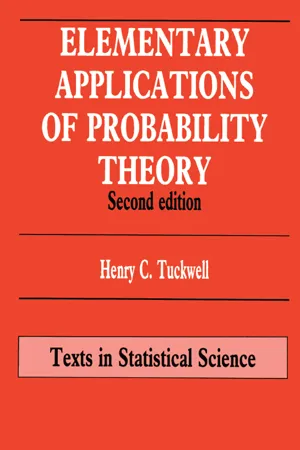
Elementary Applications of Probability Theory
About this book
This book provides a clear and straightforward introduction to applications of probability theory with examples given in the biological sciences and engineering.
The first chapter contains a summary of basic probability theory. Chapters two to five deal with random variables and their applications. Topics covered include geometric probability, estimation of animal and plant populations, reliability theory and computer simulation. Chapter six contains a lucid account of the convergence of sequences of random variables, with emphasis on the central limit theorem and the weak law of numbers. The next four chapters introduce random processes, including random walks and Markov chains illustrated by examples in population genetics and population growth.
This edition also includes two chapters which introduce, in a manifestly readable fashion, the topic of stochastic differential equations and their applications.
Tools to learn more effectively

Saving Books

Keyword Search

Annotating Text

Listen to it instead
Information
1
A review of basic probability theory
This is a book about the applications of probability. It is hoped to convey that this subject is both a fascinating and important one. The examples are drawn mainly from the biological sciences but some originate in the engineering, physical, social and statistical sciences. Furthermore, the techniques are not limited to any one area.
The reader is assumed to be familiar with the elements of probability or to be studying it concomitantly. In this chapter we will briefly review some of this basic material. This will establish notation and provide a convenient reference place for some formulas and theorems which are needed later at various points.
1.1 PROBABILITY AND RANDOM VARIABLES
When an experiment is performed whose outcome is uncertain, the collection of possible elementary outcomes is called a sample space, often denoted by Ω. Points in Ω, denoted in the discrete case by ωi, i = 1, 2, … have an associated probability P{ωi}. This enables the probability of any subset A of Ω, called an event, to be ascertained by finding the total probability associated with all the points in the given subset:
We always have
and in particular P{Ω} = 1 and P{∅} = 0, where ∅ is the empty set relative to Ω.
A random variable is a real-valued function defined on the elements of a sample space. Roughly speaking it is an observable which takes on numerical values with certain...
Table of contents
- Cover
- Half Title
- Title Page
- Copyright Page
- Dedication
- Table of Contents
- Preface
- Preface to the first edition
- 1 A review of basic probability theory
- 2 Geometric probability
- 3 Some applications of the hypergeometric and Poisson distributions
- 4 Reliability theory
- 5 Simulation and random numbers
- 6 Convergence of sequences of random variables: the central limit theorem and the laws of large numbers
- 7 Simple random walks
- 8 Population genetics and Markov chains
- 9 Population growth I: birth and death processes
- 10 Population growth II: branching processes
- 11 Stochastic processes and an introduction to stochastic differential equations
- 12 Diffusion processes, stochastic differential equations and applications
- Appendix Table of critical values of the χ2 distribution
- Index
Frequently asked questions
Yes, you can cancel anytime from the Subscription tab in your account settings on the Perlego website. Your subscription will stay active until the end of your current billing period. Learn how to cancel your subscription
No, books cannot be downloaded as external files, such as PDFs, for use outside of Perlego. However, you can download books within the Perlego app for offline reading on mobile or tablet. Learn how to download books offline
Perlego offers two plans: Essential and Complete
- Essential is ideal for learners and professionals who enjoy exploring a wide range of subjects. Access the Essential Library with 800,000+ trusted titles and best-sellers across business, personal growth, and the humanities. Includes unlimited reading time and Standard Read Aloud voice.
- Complete: Perfect for advanced learners and researchers needing full, unrestricted access. Unlock 1.4M+ books across hundreds of subjects, including academic and specialized titles. The Complete Plan also includes advanced features like Premium Read Aloud and Research Assistant.
We are an online textbook subscription service, where you can get access to an entire online library for less than the price of a single book per month. With over 1 million books across 990+ topics, we’ve got you covered! Learn about our mission
Look out for the read-aloud symbol on your next book to see if you can listen to it. The read-aloud tool reads text aloud for you, highlighting the text as it is being read. You can pause it, speed it up and slow it down. Learn more about Read Aloud
Yes! You can use the Perlego app on both iOS and Android devices to read anytime, anywhere — even offline. Perfect for commutes or when you’re on the go.
Please note we cannot support devices running on iOS 13 and Android 7 or earlier. Learn more about using the app
Please note we cannot support devices running on iOS 13 and Android 7 or earlier. Learn more about using the app
Yes, you can access Elementary Applications of Probability Theory by Henry C. Tuckwell in PDF and/or ePUB format, as well as other popular books in Mathematics & Probability & Statistics. We have over one million books available in our catalogue for you to explore.