- 256 pages
- English
- ePUB (mobile friendly)
- Available on iOS & Android
eBook - ePub
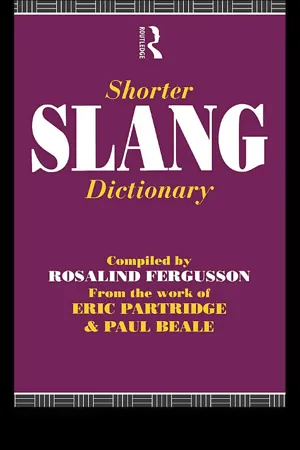
Shorter Slang Dictionary
About this book
From abdabs to zit
From pillock (14th century) to couch potato (20th century)
From She'll be apples (Australia) to the pits (USA)
This new collection brings together some 5,000 contemporary slang expressions originating in all parts of the English-speaking world. It gives clear and concise definitions of each word, supplemented by examples of their use and information about where and when they came into being. This entertaining reference work will be of use to students of English at all levels and a source of fascination to word-lovers throughout the world.
Tools to learn more effectively

Saving Books

Keyword Search

Annotating Text

Listen to it instead
Information
S
Sadie and Maisie (the practice of) sadomasochism. Used in the USA since the 1970s.
sad sack a spoilsport or wet blanket; a blundering, unlikeable or pitiable person. Adopted from US servicemen in 1943.
safe or safety a condom. Mainly used in the USA, Canada and Australia. Since around 1925.
sag 1 to be illicitly absent from work. Liverpool slang. Late 19th–20th centuries. 2 to play truant, as in to sag off. Merseyside slang. Since around 1930.
saga a small job that develops into a major one. From the jocular use of the noun saga for any never-ending story, series of events, etc.
sags, have the to lack energy. Used by racing cyclists since around 1930.
sail close to the wind to take risks, esp. with the law; to conduct operations that are close to (or over) the line of illegality. Late 19th– 20th centuries.
sailor’s farewell the attitude of love ’em and leave ’em. Since World War II.
sainted aunt !, my ajocular expletive. Since around 1905. See also giddy aunt !, my.
salaams ! my compliments (to you, him, her, etc.)! Anglo-Indian slang. From the Arabic phrase salam ‘alaikum, meaning ‘peace be upon you’.
salad oil hair oil. Since before 1923.
salami fraud fraud that is so called because interest due to investors is sliced off a bit at a time and paid into the fraudulent operator’s own false account. Later 20th century.
Sally or Sally Ann 1 the Salvation Army. 2 a Salvation Army hostel or canteen.
salted drunk. From before 1931.
samey monotonous; much-of-a-muchness, as in all his films are a bit samey. From around 1920.
san sanatorium. Originally public-school slang. From 1913 or earlier. See also sanny 1.
san fairy Ann it doesn’t matter; it’s all the same. Since World War I. A perversion of the French phrase ça ne fait rien, it doesn’t matter.
sanny 1 sanatorium. Public-school slang. See also san. 2 a sanitary towel or tampon. Mid-20th century.
Santa Claus a synonym of sugar daddy. Since around 1920.
sap a fool or simpleton. Since 1815 or earlier.
sarge sergeant. Mostly used as a term of address.
sarky sarcastic. Late 19th–20th centuries.
sarnie a sandwich. Since the early 20th century.
sashay to go; to stroll; to move smoothly or mincingly, as in he sashayed over to the bar. A perversion of chassé, a term used in dancing.
sauce in on the sauce, drinking (alcohol).
saus (pronounced, and often spelt, soss) a sausage. Mostly juvenile slang.
sausage, n. 1 money, cash, as in I haven’t got a sausage, I’m penniless. Rhyming slang (short for sausage and mash). Since around 1870. 2 in not a sausage, nothing at all, as in ‘Did you get anything?’ ‘Not a sausage.’ 3 a jocular or affectionate term of reproof, as in you silly sausage!
sausage, v. to cash, as in to sausage a goose’s, to cash a cheque (from goose’s neck, rhyming slang for ‘cheque’). From around 1920. See also sausage, n. 1.
sausage dog a dachshund. Since World War I or earlier.
sawn-off (of a person) short or small in stature. Since around 1920.
sax a saxophone. From around 1910.
say ‘cheese’ ! a jocular command used by people taking photographs of friends and relations, in an effort to get at least a semblance of a smile for the picture. Possibly since the early 20th century.
say (one’s) piece to say what one wants to say, or what one has planned or intended to say; to express one’s opinion or point of view. Since around 1910.
say-so authority; the right, privilege or power to make decisions, as in on whose say-so? Since before 1885.
SBD silent but deadly (or dangerous); referring to a noiseless but pungent fart.
scads much, a lot, a great deal, as in scads of money. Adopted from the USA around 1935.
scag or skag heroin. Drug users’ slang. Adopted from the USA around 1970.
scallie a scallywag; a street urchin; a young criminal or delinquent; any young person, esp. male. Liverpool slang.
scam a fraud or swindle; a risky or dubious scheme. Later 20th century.
scanties women’s panties or briefs. From around 1930.
scared shitless very much afraid. Since the late 1930s. See also scare the living daylights out of.
scaredy or scaredy-cat a timorous or frightened person. Often used as a taunt for cowards, esp. by children. Since around 1910.
scare (or frighten) the living daylights out of to scare or frighten badly. 19th–20th centuries. Probably a euphemistic variant of the phrase to scare (or frighten) the shit out of (see also scared shitless).
scarper to run away; to decamp in a hurry. From the Italian scappare, to escape. Since before 1844.
scat ! go away! Since the 19th century.
scatter-gun a shotgun. Used in the USA since around 1870 and in the UK from around 1920.
scatty crazy; slightly mad; feather-brained. Perhaps from scatter-brained.
scavenge to cadge money; to thieve in a petty way. Used in Australia since around 1925.
scene the favoured setting or activity of an individual or group of people, as in ballroom dancing isn’t my scene. Adopted from the USA around 1966.
sceney up-to-the-minute in appearance, habits, practices, etc., as in it was all very trendy and sceney at Theo’s. From the mid-1960s.
schimpf to complain, to grouse. Hence, to be schimpfed, to be peeved or irritated. Originally used by troops stationed in Germany. Probably since 1945. From the German schimpfen, to revile or abuse.
schizo, n. and adj. schizophrenic. Since around 1925.
schlep or shlep, v. to move or travel laboriously; to carry or transport laboriously. From the Yiddish schlep (or schlepen), to drag.
schlep or shlep, n. a clumsy or inept person.
schlock shoddy or overpriced goods. From Yiddish.
schlocky shoddy, inferior, trashy. From Yiddish.
schmaltz or schmalz excessive sentimentality; anything (such as music, a song, a performance, a story, etc.)...
Table of contents
- Cover Page
- Title Page
- Copyright Page
- Forword
- A
- B
- C
- D
- E
- F
- G
- H
- I
- J
- K
- L
- M
- N
- O
- P
- Q
- R
- S
- T
- U
- V
- W
- X
- Y
- Z
Frequently asked questions
Yes, you can cancel anytime from the Subscription tab in your account settings on the Perlego website. Your subscription will stay active until the end of your current billing period. Learn how to cancel your subscription
No, books cannot be downloaded as external files, such as PDFs, for use outside of Perlego. However, you can download books within the Perlego app for offline reading on mobile or tablet. Learn how to download books offline
Perlego offers two plans: Essential and Complete
- Essential is ideal for learners and professionals who enjoy exploring a wide range of subjects. Access the Essential Library with 800,000+ trusted titles and best-sellers across business, personal growth, and the humanities. Includes unlimited reading time and Standard Read Aloud voice.
- Complete: Perfect for advanced learners and researchers needing full, unrestricted access. Unlock 1.4M+ books across hundreds of subjects, including academic and specialized titles. The Complete Plan also includes advanced features like Premium Read Aloud and Research Assistant.
We are an online textbook subscription service, where you can get access to an entire online library for less than the price of a single book per month. With over 1 million books across 990+ topics, we’ve got you covered! Learn about our mission
Look out for the read-aloud symbol on your next book to see if you can listen to it. The read-aloud tool reads text aloud for you, highlighting the text as it is being read. You can pause it, speed it up and slow it down. Learn more about Read Aloud
Yes! You can use the Perlego app on both iOS and Android devices to read anytime, anywhere — even offline. Perfect for commutes or when you’re on the go.
Please note we cannot support devices running on iOS 13 and Android 7 or earlier. Learn more about using the app
Please note we cannot support devices running on iOS 13 and Android 7 or earlier. Learn more about using the app
Yes, you can access Shorter Slang Dictionary by Paul Beale,Eric Partridge, Rosalind Fergusson in PDF and/or ePUB format, as well as other popular books in Languages & Linguistics & Languages. We have over one million books available in our catalogue for you to explore.