![]()
chapter one
CHARACTERISTICS AND CLASSIFICATION OF SKILLS IN SPORT
the learned ability to bring about predetermined results with maximum certainty often with the minimum outlay of time or energy or both.
Knapp (1963)
Characteristics of skill and skilful performance
The word skill is often used in sport and can be used to describe movements such as dribbling a football. However, the word skilful is used to describe the motor movements of someone who has achieved excellence in their activity.
A sports performer who is deemed to be skilful often possesses the qualities of co-ordination, fluency, control, economy and efficiency of movement. Skills in sport when fully learned have an aesthetic quality because of the fluidity of the movement shown. Even professional boxers demonstrate a beauty of movement because of the speed and flow of technically accurate motor skills related to footwork and combinations of punches.
Skills that are fully learned are pre-planned and are directed towards a predetermined goal. For example, a skilful netball player will have worked out a plan of movement – often called a motor plan. This motor plan will have been formulated by referring to previous experiences of using that particular skill or movement that are held in the long-term memory.
All preparatory movements and subsequent execution of that skill would then be directed towards fulfilling the aims planned by the performer.
The following is another well known definition of skill:
There are three main types of skill in sport: (1) cognitive skills, (2) perceptual skills, (3) fundamental motor skills.
Cognitive skills
These are the intellectual/mental skills of the sports performer. These skills affect perception. They are essential for effective decision-making and problem solving.
In order to perform skills, we need certain underlying factors such as strength and hand–eye co-ordination. These factors are known as abilities and are different from skills. This is because abilities are largely determined genetically; in other words they are naturally occurring and enduring characteristics. Skills, on the other hand, are learned through practice.
A rugby player makes the decision to kick rather than pass in a ‘pressure situation’. This decision is based on a cognitive assessment.
Perceptual skills
These involve the interpretation of information received so that a motor plan can be formulated. Perception is affected by previous experiences and attentional control.
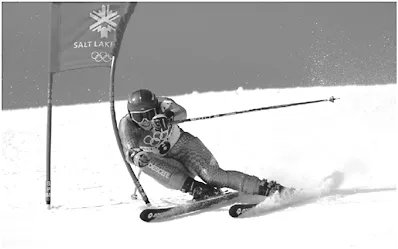
A slalom skier assesses the timing of a turn by taking into account (perceiving) his own position and the position of the gate in relation to his downhill speed.
Skills that require a great deal of interpretation of the sensory input are known as complex skills. Skills that do not have many perceptual demands are known as simple skills.
Motor skills
These are physical limb movements that are directed towards the achievement of a particular goal.
A basketball player uses the motor skills involved in passing the ball to move it accurately and effectively f...