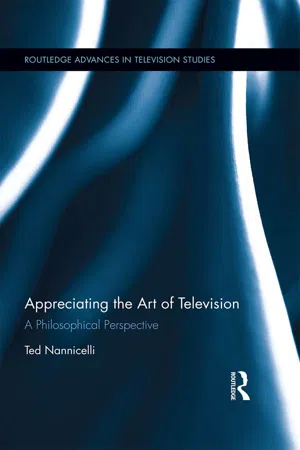
Contemporary television has been marked by such exceptional programming that it is now common to hear claims that TV has finally become an art. In Appreciating the Art of Television, Nannicelli contends that televisual art is not a recent development, but has in fact existed for a long time. Yet despite the flourishing of two relevant academic subfields—the philosophy of film and television aesthetics—there is little scholarship on television, in general, as an art form. This book aims to provide scholars active in television aesthetics with a critical overview of the relevant philosophical literature, while also giving philosophers of film a particular account of the art of television that will hopefully spur further interest and debate. It offers the first sustained theoretical examination of what is involved in appreciating television as an art and how this bears on the practical business of television scholars, critics, students, and fans—namely the comprehension, interpretation, and evaluation of specific televisual artworks.
- 228 pages
- English
- ePUB (mobile friendly)
- Available on iOS & Android
eBook - ePub
About this book
Trusted by 375,005 students
Access to over 1.5 million titles for a fair monthly price.
Study more efficiently using our study tools.
Information
Topic
PhilosophySubtopic
Television1 Authorship and Agency
Introduction
My aim in this chapter is twofold: I want to argue for a number of conditions that should be met by any successful account of television authorship. However, through the analysis of authorship that I develop in arguing for these conditions, I aim to show that what is really central to our appreciation of television as an art is not authorship per se, but agency. Thus, my aim is to make do with agency in a sense to be explained presently. This chapter constitutes the groundwork for an “agential” approach to the appreciation of television.
“Authorship” is, of course, an ambiguous term that connotes various things in different contexts. To give just one simple example, anyone at all familiar with the history of writing for the screen will agree that authorship in a legal sense (i.e., who gets credited as a writer) often does not correspond with authorship as we commonly use the term (i.e., to indicate who has contributed to the creation of screenplay, book, and so forth). In analyzing the concept of authorship as it is relevant to the appreciation of television as an art, I think we ought to be somewhat less legislative than in legal contexts, yet somewhat more stipulative and technical than we are in common usage.
The question is: What sort of concept of authorship do we need to account for our appreciative practices? Our appreciative practices are not entirely uniform, of course, but I assume they at least include activities such as attributing praise for achievements and blame for failures. When the achievements of an artwork, taken as a whole, are significant, it is often the authors who receive awards. When the failures of an artwork, taken as a whole, are significant, it is often the authors who bear responsibility—sometimes financial, sometimes even legal. In the context of artistic appreciation, then, authorship is a causal concept, which centrally involves control over the work as a whole and, in relation, responsibility. Or so I shall argue, building upon plausible proposals along these lines that have been advanced by film theorists such as V. F. Perkins and philosophers of art like Paisley Livingston.
The difficulty is that television complicates things in a number of ways. Given the collaborative, industrial context in which television is produced over an extended duration, control and responsibility are usually dispersed across multiple agents and across time. If we consider a long-running soap opera, for example, it is not clear that anyone has control over the work as a whole. Of course, the field of television studies has devised a number of strategies to accommodate such challenges, but none, I believe, that sufficiently accommodates our needs as appreciators of television as an art form.
What I have in mind here are various authorship constructs ranging from implied authors to author functions.1 Borrowing Livingston’s term, we can think of these as attributional conceptions of authorship, distinct from the sort of causal conception of authorship that I am advocating here.2 I am happy to accept that such constructs serve a variety of useful purposes in myriad contexts. For example, it seems plausible, as Jason Mittell claims, that many of us casually infer a single authorial force, such as that of Chris Carter, Jill Soloway, or Louis C. K., when watching an episode of The X-Files (Fox 1993–2002; 2016), Transparent (Amazon 2014–), or Louie (FX 2010–).3 Even if such inferences are empirically wrong, say because the episode has multiple authors, they can be useful psychological short cuts for viewers.
However, it seems to me that viewers also can (and do) make use of such psychological short cuts without inferring a specific author (hence students’ ubiquitous use of the pronoun “they” to describe what has been done in a work of television); on the contrary, the real necessity here, and in many other cases, is simply agency.4 Furthermore, my contention is that in cases when we do need to make reference to authorship for the purpose of appreciating the artistic achievements (or failures) of an instance of television, the conception of authorship we require is a causal one. This is because, in the context of appreciation, we are interested in what has been done in the creation of the work—that is, how the work came to be just as it is and who is responsible.5 Another way of putting it is that, in the context of appreciation, the sort of authorship in which we are interested necessarily involves real agents.6 Therefore, this chapter will simply set to the side the various attributionist accounts of authorship prevalent in television studies.7
My attempt at an intervention acknowledges that, in the context of television appreciation, there are some cases in which authorship obtains, but there are many in which it does not. In the latter cases, I claim, appreciation can get by with reference to agency more broadly—a category in which authorship is a specific subset. That is, when we want to assign praise or blame for the achievements or failures of a particular instance of television, we can do so by identifying the responsible agents, even if those individuals are not the work’s authors in the sense glossed above. However, I also want to claim something stronger and, I hope, more original. Even in cases in which we can identify the author(s) of a television artwork, there are some appreciative contexts in which our focus still needs to be on agency more generally—that is, on agents who are not the same as the work’s author(s). In these cases, which I will outline in due course, focusing on agency more broadly allows us to more accurately assign praise and blame where they are deserved. In short, I will argue that, in the context of television appreciation, authorship is best conceived as involving control over the work as a whole, so it will usually be limited to a few individuals or simply not obtain at all. As such, the broader category of agency is much more useful for the practical purposes of lauding or holding responsible key creative contributors who, in most cases, are not authors.
Agency and Intentions
Before beginning in earnest, I want to gloss two terms that I will be using in this and subsequent chapters, both for the purposes of clarity and of keeping the flow of my arguments moving. By “agency,” I mean in particular, “individual human agency,” unless I explicitly speak of “group agency,” “collective agency,” or “shared agency.”8 There is a vast philosophical literature on the nature of agency, but for the purposes of clarity, I will simply stipulate what I take to be a plausible account of individual, human agency—one that is intended to be noncontroversial. In the present context, we can think of “agency” as, roughly, an exercised capacity for acting or causing things to happen, which is underwritten by rational reflection upon one’s own mental states—that is, by deliberative reasoning about one’s own beliefs, desires, and intentions.9
Of such mental states, the one that is most salient in the present context is “intention.” As with authorship, which I discuss presently, intention is a concept that has engendered a good deal of controversy and suspicion in the humanities in general and in literary, film, and television studies in particular.10 My view is that much of the wariness of intentions is overstated. This is not to deny that appeal to intentions in our appreciative engagement with art raises some difficult philosophical questions—particularly in the context of collaborative, commercially produced art like television series.
It might be assumed, for example, that the vicissitudes of film and television production fundamentally undermine our ability to offer intentionalist explanations of the presence of particular artistic properties or effects. For example, it may be the case that a scene in a series like Friday Night Lights (NBC 2006–11) looks a certain way because the actors improvised a moment and, perhaps, the hand-held camera operator had to make a sudden, unorthodox move to capture it. It seems implausible, so the argument goes, that such moments and the properties of film and television works in which they result have any intention behind them.
I am happy to acknowledge that, in fact, many things that happen on film and television sets are indeed unplanned, thus resulting in finished works having certain features that are also unplanned. But preliminarily, at least, perhaps some of the skeptical worries about intention can be diffused by being clear about the sense(s) in which one uses the term. Drawing on the literature in philosophy of action, one preliminary distinction we can make is between what Michael Bratman calls “present-directed intentions” and “future-directed intentions.”11 In cases like the one described above from Friday Night Lights, there is an important kind of intention that is significantly diluted or, perhaps, even absent—to wit, future-directed intention.
But it does not follow that, in such contexts, talk of intentions is illicit or misguided. This claim erroneously assumes that future-directed intentions are completely constitutive of intentional action. On the contrary, we can avail ourselves of the literature in action theory and point out that while such “off-the-cuff” moments derail intentions characterized by planning, the actors’ improvised behavior, and the camera operator’s reaction are not merely happy accidents either. Rather, they are the results of a different kind of intention—namely, present-directed intention. This sort of intention is successfully realized in the execution of the action itself and, furthermore, does not require conscious awareness of it on the part of the agent.12 For example, I have, undoubtedly, been typing intentionally for the past few minutes, but until just now I was not consciously intending to type.
The distinction between present-directed and future-directed intentions is an important step towards reinserting intentions in the analysis of television production and appreciation. Still, I suspect that much, if not most, television production is marked by future-directed intentions—that is, by intentions characterized as planning states. Although researchers of production know this well, it bears emphasizing that television (and film) production are so time- and labor-intensive, so expensive, so financially risky, that it is hard to think of many instances or moments of commercial television—even live television—that are plausibly not the result of successfully executed intentions (understood as planning states).13 So, henceforth, unless I am specifically discussing present-directed intentions, I will follow Michael Bratman in understanding intentions (distinguished from intentional actions) as “plan states”: “They are embedded in forms of planning central to our internally organized temporally extended agency and to our associated abilities to achieve complex goals across time.”14 Furthermore, according to Bratman, “as elements in such partial plans, future-directed intentions play important roles as inputs to further reasoning aimed at filling in or modifying these plans, as well as in the more direct motivation of action when the time comes.”15 It is this sort of future-directed intention we typically have in mind when invoking intentions in our appreciation of television artworks—that is, for example, when we say of a television series something such as “the creators intended Deadwood (HBO 2004–06) to be four seasons, but HBO cancelled it after three” or “the brilliance of Breaking Bad (AMC 2008–13) is that Walt is intended to be both sympathetic but also deeply morally flawed.”
One final preliminary point about intention that I hope will at least temporarily assuage skeptical concerns: Oftentimes anti-intentionalists appeal to the putatively inaccessible nature of intentions in order to discount the relevance of intentions to the appreciation of a work. But this is among the least convincing of the anti-intentionalist’s various arguments. For one thing, this claim typically underestimates the extent to which successfully realized intentions are manifest in the work and can justifiably be inferred from a careful inspection of it. In relation, the anti-intentionalist’s insistence that the relevant intentions cannot be known with certainty sets an unreasonable standard to meet. As E. D. Hirsch points out, it is a simple truism that certainty about relevant creative intentions is impossible (in the absence of some sort of Vulcan mind-meld, that is). But why should that matter? As Hirsh writes, “this obvious fact should not be allowed to sanction the overly hasty conclusion that the author’s intended meaning is inaccessible and therefore useless as an object of interpretation.”16 That is, the anti-intentionalist unfairly sets up a false either/or dynamic. In the absence of certainty, we can and often do avail ourselves of concepts like “reasonable inference,” “plausible hypothesis,” and “warrant,” to advance well-supported hypotheses approximating creators’ actual intentions. As Hirsch observes, “It is a logical mistake to confuse the impossibility of certainty in understanding with the impossibility of understanding. It is a similar, though more subtle, mistake to identify knowledge with certainty.”17
To Hirsch’s points, I would add one more, which is that it is also a logical mistake to conflate metaphysical questions regarding the nature and function of intentions with epistemological questions about how we can know “for sure” what various agents actually intend or what collectively held intention agents jointly realize in the production process. Even if actual artistic intentions were epistemologically inaccessible, this would not show that that they do not figure into the creation of works of television in various ways. The epistemic claim that intentions may, as a matter of fact, be inaccessible, is compatible with various metaphysical claims—for example, that intentions determine the category (e.g., genre or mode) of a work, what is fictionally true of a work, or what a work means (where this is distinct from what significance it has for particular socially situated viewers, as I will explain presently). Furthermore, the anti-intentionalist’s “inaccessibility argument” is also compatible with at least one specific intentionalist account of interpretation—namely, hypothetical intentionalism, which, as the name indicates, takes the meaning of a work to be constituted by the most plausible hypothesis about what its creator(s) intended. I will have more to say about this, not to mention both intention and agency more generally, in what follows, but hopefully this is sufficient as a starting point.
The Material Conditions of Television Production and the Place of Production Studies
The first condition for which I want to argue is that any account of television authorship needs to respect the material conditions of television production. By this I simply mean that a plausible characterization of television authorship must be consistent with how television is actually made—that is, with the industrial, social, cultural, and economic factors that shape production practices. Burgeoning research in production studies has already begun to give us a valuable sense of what the material conditions of television production look like.18 This subfield is currently thriv...
Table of contents
- Cover
- Half Title
- Title Page
- Copyright Page
- Table of Contents
- List of Figures
- Acknowledgments
- Introduction: Appreciating the Art of Television
- 1 Authorship and Agency
- 2 The Medium
- 3 Ontology
- 4 Interpretation I
- 5 Interpretation II
- 6 Evaluation
- Bibliography
- Index
Frequently asked questions
Yes, you can cancel anytime from the Subscription tab in your account settings on the Perlego website. Your subscription will stay active until the end of your current billing period. Learn how to cancel your subscription
No, books cannot be downloaded as external files, such as PDFs, for use outside of Perlego. However, you can download books within the Perlego app for offline reading on mobile or tablet. Learn how to download books offline
Perlego offers two plans: Essential and Complete
- Essential is ideal for learners and professionals who enjoy exploring a wide range of subjects. Access the Essential Library with 800,000+ trusted titles and best-sellers across business, personal growth, and the humanities. Includes unlimited reading time and Standard Read Aloud voice.
- Complete: Perfect for advanced learners and researchers needing full, unrestricted access. Unlock 1.5M+ books across hundreds of subjects, including academic and specialized titles. The Complete Plan also includes advanced features like Premium Read Aloud and Research Assistant.
We are an online textbook subscription service, where you can get access to an entire online library for less than the price of a single book per month. With over 1.5 million books across 990+ topics, we’ve got you covered! Learn about our mission
Look out for the read-aloud symbol on your next book to see if you can listen to it. The read-aloud tool reads text aloud for you, highlighting the text as it is being read. You can pause it, speed it up and slow it down. Learn more about Read Aloud
Yes! You can use the Perlego app on both iOS and Android devices to read anytime, anywhere — even offline. Perfect for commutes or when you’re on the go.
Please note we cannot support devices running on iOS 13 and Android 7 or earlier. Learn more about using the app
Please note we cannot support devices running on iOS 13 and Android 7 or earlier. Learn more about using the app
Yes, you can access Appreciating the Art of Television by Ted Nannicelli in PDF and/or ePUB format, as well as other popular books in Philosophy & Television. We have over 1.5 million books available in our catalogue for you to explore.