eBook - ePub
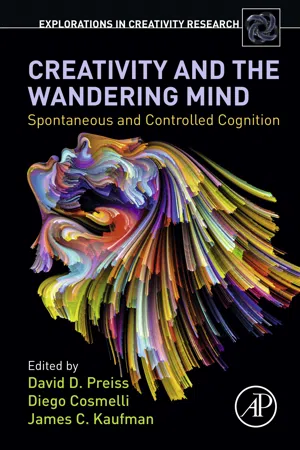
Creativity and the Wandering Mind
Spontaneous and Controlled Cognition
- 366 pages
- English
- ePUB (mobile friendly)
- Available on iOS & Android
eBook - ePub
Creativity and the Wandering Mind
Spontaneous and Controlled Cognition
About this book
Creativity and the Wandering Mind: Spontaneous and Controlled Cognition summarizes research on the impact of mind wandering and cognitive control on creativity, including imagination, fantasy and play. Most coverage in this area has either focused on the negative consequences of mind wandering on focused problem solving or the positive effect of mindfulness, but not on the positive consequences of mind wandering. This volume bridges that gap. Research indicates that most people experience mind wandering during a large percentage of their waking time, and that it is a baseline default mode of brain function during the awake but resting state. This volume explores the different kinds of mind wandering and its positive impact on imagination, play, problem-solving, and creative production.
- Discusses spontaneous and controlled processes in creativity
- Examines the relationship between mind wandering, consciousness, and imagination
- Reviews research on problem-solving, imagination, play, and learning
- Highlights the positive impact of mind wandering on creative thought and output
Trusted by 375,005 students
Access to over 1.5 million titles for a fair monthly price.
Study more efficiently using our study tools.
Information
Part I
Spontaneous and controlled processes in creativity
Chapter 1
Mind wandering
framework of a lexicon and musings on creativity
Paul Joseph Barnett, and James C. Kaufman Department of Educational Psychology, Neag School of Education, University of Connecticut, Storrs, CT, United States
Abstract
This chapter addresses some of the confusion and inconsistencies of language in the field of mind wandering. It emphasizes the importance of consistent terminology, referencing the field of creativity as an example of an area of study that faced a similar problem. In an attempt to unify past and present research, a framework of terms is proposed that identifies the general components of mind wandering. The proposed framework is then used to describe a real-world example of deliberate mind wandering as a tool for designing and problem-solving. Finely, one possible method of deliberate mind wandering is outlined as an example of how some components of mind wandering can be beneficial in everyday life.
Keywords
Creativity; Daydreaming; Deliberate; Intentional; Lexicon; Mind wandering; Spontaneous; Terminology
Introduction
The field of creativity has faced many challenges with language as it has developed as an area of research. Identifying the various components and related constructs of creativity (such as innovation and imagination) and determining how to define them and what to call them has been a process requiring deliberate work and professional collaboration (e.g., Reiter-Palmon, Beghetto, & Kaufman, 2014). There are areas that necessitate further refinement, but the most fundamental elements about creativity—what it is and what it is not—have been established with enough clarity and consistency to allow it to be a focus of study and facilitate discussion between researchers.
For whatever complications have been faced by those within creativity, the problems are even worse when one looks outside of the field. Researchers that work in other areas sometimes reference creativity, but often they do not fully understand the elements they are referencing and may misspeak or misrepresent the findings of a study. Occasionally, an article or chapter purportedly claiming to be about creativity will incorrectly state in the first paragraph that no one agrees on what creativity is (see Cropley, 2015) or that creativity cannot be defined. The media is even worse in its misunderstanding and misrepresentations. The number of words used as synonyms for creativity that represent quite different concepts is extensive. In the same article discussing creativity, one might see the terms imagination, genius, artistic, innovation, or entrepreneur used interchangeably with creativity. All of these concepts are different and have a specific definition within psychology. Creativity is traditionally defined as being both novel and task appropriate (Plucker, Beghetto, & Dow, 2004). Innovation is creativity with the additional requirement of application (West, 2002; West, Hirst, Richter, & Shipton, 2004). One can have a creative idea, but for it to be innovative, it must also be implemented. Entrepreneurship, like innovation, requires not only creativity but also the formation of an entity such as a business (Low & MacMillan, 1988). Art can be creative, but not all art is creative. A student painting a copy of a classic Vermeer has arguably produced a work of art, though not necessarily a creative one. Copying a craft project from the Internet may be task appropriate, but if the copy is exactly accurate and does not deviate from the original, then it has no novelty and therefore is not considered creative (Simonton, 2012). Genius involves individuals who are highly accomplished in intelligence, creativity, or leadership (Simonton, 2009); they often are creative, but at an exceptionally elite level. Imagination is an internal process, and it does not explicitly require novelty or task appropriateness (Markman, Klein, & Suhr, 2009). Though many of these concepts are related to creativity, some overlapping significantly, they are still separate constructs. The color orange significantly overlaps with red and yellow but is its own unique color despite this shared content.
All these difficulties combine such that a scholar not in the field may be confused about what creativity is and how it can be studied. Worse, they may think it is an entirely subjective entity that cannot be defined or studied. This confusion may hinder the potential of creativity to reduce inequities in standardized testing (Kaufman, 2015; Sternberg, 2010), help companies make better hiring decisions (Hunter, Cushenbery, & Friedrich, 2012), or give more accurate and complete assessments of students for acceptance into gifted programs or university (Kaufman, 2010; Luria, O'Brien, & Kaufman, 2016). This is an issue of significance not just for the individuals involved in these situations but also for the progress and advancement of society as a whole. If the average person (or policy maker) does not understand what creativity is or that it can be measured, they will be unlikely to support it being included as part of standardized tests, hiring practices, or intelligence testing, let alone approve research funding.
There are many reasons why those who study creativity have faced so many challenges. First, creativity is not a simple concrete thing that can be directly observed. It is a complex multifaceted cognitive concept that inextricably relates to numerous other complex concepts. Another reason is that the field is relatively young, having only been solidified as an area of study in the 1950s when the president of the American Psychological Association, J.P. Guilford, argued that creativity was an important, but understudied, area of psychology (Guilford, 1950). Since then, the topic of creativity has been researched and explored such that through much effort, many of the complex components have been identified, labeled, and defined. It is precisely because creativity and some of the related concepts are so difficult to define that doing so was such a high priority for the field. Establishing a common language facilitates more robust and accurate communication and reduces confusion caused by simple semantic misunderstandings.
Mind wandering history
Mind wandering research is quite comparable with that of creativity, from having a core construct that is complex and cannot be directly observed to being closely tied to other fields to being a relatively young field (see McCraven, Singer, & Wilensky, 1956; Singer, 1955; Singer & Opler, 1956). One of the main points of distinction between the two fields, however, is that creativity developed as a direct response to Guilford pointing out the importance of creativity and the need to study it. Mind wandering had no such call to action. Guilford's speech could be considered a moment of coalescence for the field of creativity, whereas the field of mind wandering experienced a slower growth that was more organic and fragmented. In the 1950s, Jerome L. Singer started researching daydreaming, and his work became the foundation upon which the bulk of current mind wandering research is built (see McMillan, Kaufman, & Singer, 2013). It could be because the field grew slowly, it was perceived as less of a priority, or communication within the field was less centralized, but regardless the cause, the field of mind wandering continues to face challenges associated with disorganized and imprecise language, a point that has been lamented by the field: “This proliferation of terminology has obscured the common features of the phenomena under discussion and made it more difficult for current researchers to connect their work with the work of scholars who trod similar paths before them” (McMillan et al., 2013, p. 1).
This chapter is not intended to offer a comprehensive solution to this problem. Truthfully, it may not even reach a partial one. Instead, the goal of this chapter is to explore and identify the various elements of mind wandering that have been discussed in the literature and bring them all together. From there, we will develop a rough taxonomy of the various elements and propose a linguistic framework. Whether this structure is built upon or torn down by others in the future (or, perhaps, simply ignored), it is intended to be a benchmark or starting point that aims for common ground and to encourage conversation and growth within the field. The latter half of the chapter addresses the positive aspects of mind wandering and some methods for using deliberate mind wandering as a tool to support incubation, creativity, and problem-solving.
Mind wandering
What is mind wandering?
Mind wandering is ubiquitous to the human experience and may be the brain's default process (Buckner, Andrews-Hanna, & Schacter, 2008; Christoff, Gordon, Smallwood, Smith, & Schooler, 2009; Mason et al., 2007; Raichle et al., 2001). It is an occurrence that 96% of American adults say they ...
Table of contents
- Cover image
- Title page
- Table of Contents
- Explorations in Creativity Research
- Copyright
- Dedications
- Contributors
- Acknowledgments
- An Introduction to Creativity and the Wandering Mind
- Part I. Spontaneous and controlled processes in creativity
- Part II. Mind wandering, consciousness, and imagination
- Part III. Imagination, play, and learning
- Part IV. Mind wandering and creative production
- Part V. Conclusion
- Index
Frequently asked questions
Yes, you can cancel anytime from the Subscription tab in your account settings on the Perlego website. Your subscription will stay active until the end of your current billing period. Learn how to cancel your subscription
No, books cannot be downloaded as external files, such as PDFs, for use outside of Perlego. However, you can download books within the Perlego app for offline reading on mobile or tablet. Learn how to download books offline
Perlego offers two plans: Essential and Complete
- Essential is ideal for learners and professionals who enjoy exploring a wide range of subjects. Access the Essential Library with 800,000+ trusted titles and best-sellers across business, personal growth, and the humanities. Includes unlimited reading time and Standard Read Aloud voice.
- Complete: Perfect for advanced learners and researchers needing full, unrestricted access. Unlock 1.5M+ books across hundreds of subjects, including academic and specialized titles. The Complete Plan also includes advanced features like Premium Read Aloud and Research Assistant.
We are an online textbook subscription service, where you can get access to an entire online library for less than the price of a single book per month. With over 1.5 million books across 990+ topics, we’ve got you covered! Learn about our mission
Look out for the read-aloud symbol on your next book to see if you can listen to it. The read-aloud tool reads text aloud for you, highlighting the text as it is being read. You can pause it, speed it up and slow it down. Learn more about Read Aloud
Yes! You can use the Perlego app on both iOS and Android devices to read anytime, anywhere — even offline. Perfect for commutes or when you’re on the go.
Please note we cannot support devices running on iOS 13 and Android 7 or earlier. Learn more about using the app
Please note we cannot support devices running on iOS 13 and Android 7 or earlier. Learn more about using the app
Yes, you can access Creativity and the Wandering Mind by David D. Preiss,Diego Cosmelli,James C. Kaufman in PDF and/or ePUB format, as well as other popular books in Psychology & Cognitive Psychology & Cognition. We have over 1.5 million books available in our catalogue for you to explore.