- 288 pages
- English
- ePUB (mobile friendly)
- Available on iOS & Android
eBook - ePub
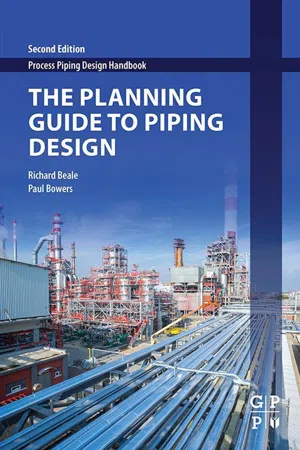
The Planning Guide to Piping Design
About this book
The Planning Guide to Piping Design, Second Edition, covers the entire process of managing and executing project piping designs, from conceptual to mechanical completion, also explaining what roles and responsibilities are required of the piping lead during the process. The book explains proven piping design methods in step-by-step processes that cover the increasing use of new technologies and software. Extended coverage is provided for the piping lead to manage piping design activities, which include supervising, planning, scheduling, evaluating manpower, monitoring progress and communicating the piping design.
With newly revised chapters and the addition of a chapter on CAD software, the book provides the mentorship for piping leads, engineers and designers to grasp the requirements of piping supervision in the modern age.
- Provides essential standards, specifications and checklists and their importance in the initial set-up phase of piping project's execution
- Explains and provides real-world examples of key procedures that the piping lead can use to monitor progress
- Describes project deliverables for both small and complex size projects
- Offers newly revised chapters including a new chapter on CAD software
Trusted by 375,005 students
Access to over 1 million titles for a fair monthly price.
Study more efficiently using our study tools.
Information
Topic
DesignSubtopic
Industrial DesignChapter One
Before You Begin
Abstract
This chapter sets the tone for the purpose of the book. It begins by creating an awareness of the importance of an initial piping design set-up and moves to introducing in summary the topics that are covered in more detail in the following chapters. Summarization begins with a review of the common aspects of piping design set-up known to all piping designers; these being standards, specifications, and procedures. The chapter moves to discussing the often overlooked project management documentation, such as the Design Basis Memorandum and Project Execution Plan, of which the piping lead must inform themselves due to there being information contained in this documentation that can impact set-up decisions. The chapter is concluded by emphasizing that the piping lead is accountable for the piping set-up on the project.
Keywords
Standards; specifications; procedures; drawings; piping classes; charts; CAD; design basis memorandum; DBM; Project Execution Plan; PEP
1.1 Introduction
In order to execute the piping designs of a project efficiently, it is essential that you initially identify and address all of the prerequisites that must be in place for the piping designers to start work. In order to do this you must first recognize all the questions that must be asked and answered, assemble all the needed tools, and make decisions accordingly. As you progress in your career you will find that this ability is required for any project, and that the best piping leads are those who can create missing tools when the need arises.
The intent of this chapter is to provoke your thought process: it focuses on the questions to ask and the tools required in order to begin a project. Do you have everything you need to proceed?
A first step is to assemble and then make yourself familiar with the engineering company and/or client standards, specifications, and procedures to be used on the project. Larger clients will have certain requirements in place and mandate that those requirements be used on the project, whereas smaller clients will likely default entirely to the engineering company. Generally speaking, all projects will use a combination of engineering company and client standards, specifications, and procedures. You must ensure that you know which you are using and where they come from. As a piping lead it is doubly important to familiarize yourself with these requirements, not just so you can guide your team, but because you will likely have to explain your design basis to other departments and sometimes even to the client themselves. It is also up to you to insist that they be respected and adhered to, or that a formal deviation be approved by the client. On this note, you must inform yourself of the deviation procedure to be used on the project.
• Examples of standards are as follows:
• Standard fabrication and installation details/drawings such as shoe design and base ell supports.
• Drawing standards such as layering, text heights, and drawing symbols.
• Charts such as line spacing within racks.
• Examples of specifications are piping classes, equipment spacing requirements, and egress and ingress requirements (walkways, platforms, and ladders).
• Examples of procedures are drawing reviews, model reviews, checking, and as-builting.
Below are some brief explanations of standards, specifications, and procedures, and their most likely sources. There are no guarantees, so you will have to investigate each in turn. As we progress into further chapters we will highlight these in more detail, discuss the importance of decision making at an early stage, and discuss the links between the topics. Once you have investigated, assembled, and made all your decisions, you are ready to go, and you have set yourself on a path toward a successful piping execution. By the time you have completed your initial set-up you will have a greater understanding of the project, the expectations, and how you will achieve those expectations. Knowing the reasons behind all of the decisions you have made or helped to make will put you in a position to recognize when things are going wrong, and will aid greatly later in correcting them.
1.2 Standards
To determine whether the standards to be used are going to come from your own company or your client, you must consult with your project management team and the client.
Standards include the following:
• Standard drawings
• Charts
• Drawing templates and drawing standards
• Drawing numbering
• 3D model numbering
• Material commodity codes
1.2.1 Standard drawings
Standard drawings are typical fabrication and installation details of commonly encountered items. These are assigned a tag number for easy reference on the piping arrangements and isometrics. The use of a standard avoids detailing the same thing time after time. Commonly, standard drawings are as follows:
• Shoes
• Anchors: fixed and directional
• Guides
• Base ell supports
• Dummy legs
• Trunnions
• Field supports
• Reinforcing pads
• Slide plates
• Tracing details
• Insulation details
• Instrument connection details
• Orifice tap orientations
• Block and bleed details
• Vents and drains
• Utility Stations
• Heat Trace Manifolds
Where suitable, a standard will cover more than one Nominal Pipe Size (NPS), so that one fit for purpose design may be used on a range of pipe sizes. For instance, all companies will have shoe designs that will cover a range similar to the ones below:
• NPS 6 and under
• NPS 8 to NPS 12
• NPS 14 to NPS 18
• NPS 20 to NPS 24
You will find that companies mercilessly plagiarize from each other, and most likely you will recognize standards that you have used before as you move from one company to another. You may even see ...
Table of contents
- Cover image
- Title page
- Table of Contents
- Copyright
- Dedications
- List of Figures
- List of Tables
- Preface
- Acknowledgments
- Chapter One. Before You Begin
- Chapter Two. CAD and Design Automation in Piping Design
- Chapter Three. Procedures
- Chapter Four. Deliverables
- Chapter Five. Detailed Design
- Chapter Six. Shop Fabrication
- Chapter Seven. Field Construction
- Appendix A. Abbreviations
- Index
Frequently asked questions
Yes, you can cancel anytime from the Subscription tab in your account settings on the Perlego website. Your subscription will stay active until the end of your current billing period. Learn how to cancel your subscription
No, books cannot be downloaded as external files, such as PDFs, for use outside of Perlego. However, you can download books within the Perlego app for offline reading on mobile or tablet. Learn how to download books offline
Perlego offers two plans: Essential and Complete
- Essential is ideal for learners and professionals who enjoy exploring a wide range of subjects. Access the Essential Library with 800,000+ trusted titles and best-sellers across business, personal growth, and the humanities. Includes unlimited reading time and Standard Read Aloud voice.
- Complete: Perfect for advanced learners and researchers needing full, unrestricted access. Unlock 1.4M+ books across hundreds of subjects, including academic and specialized titles. The Complete Plan also includes advanced features like Premium Read Aloud and Research Assistant.
We are an online textbook subscription service, where you can get access to an entire online library for less than the price of a single book per month. With over 1 million books across 990+ topics, we’ve got you covered! Learn about our mission
Look out for the read-aloud symbol on your next book to see if you can listen to it. The read-aloud tool reads text aloud for you, highlighting the text as it is being read. You can pause it, speed it up and slow it down. Learn more about Read Aloud
Yes! You can use the Perlego app on both iOS and Android devices to read anytime, anywhere — even offline. Perfect for commutes or when you’re on the go.
Please note we cannot support devices running on iOS 13 and Android 7 or earlier. Learn more about using the app
Please note we cannot support devices running on iOS 13 and Android 7 or earlier. Learn more about using the app
Yes, you can access The Planning Guide to Piping Design by Richard Beale,Paul Bowers,Peter Smith in PDF and/or ePUB format, as well as other popular books in Design & Industrial Design. We have over one million books available in our catalogue for you to explore.