
eBook - ePub
Biophysical Measurement in Experimental Social Science Research
Theory and Practice
- 359 pages
- English
- ePUB (mobile friendly)
- Available on iOS & Android
eBook - ePub
About this book
Biophysical Measurement in Experimental Social Science Research is an ideal primer for the experimental social scientist wishing to update their knowledge and skillset in the area of laboratory-based biophysical measurement. Many behavioral laboratories across the globe have acquired increasingly sophisticated biophysical measurement equipment, sometimes for particular research projects or for financial or institutional reasons. Yet the expertise required to use this technology and integrate the measures it can generate on human subjects into successful social science research endeavors is often scarce and concentrated amongst a small minority of researchers. This book aims to open the door to wider and more productive use of biophysical measurement in laboratory-based experimental social science research. Suitable for doctoral students through to established researchers, the volume presents examples of the successful integration of biophysical measures into analyses of human behavior, discussions of the academic and practical limitations of laboratory-based biophysical measurement, and hands-on guidance about how different biophysical measurement devices are used. A foreword and concluding chapters comprehensively synthesize and compare biophysical measurement options, address academic, ethical and practical matters, and address the broader historical and scientific context. Research chapters demonstrate the academic potential of biophysical measurement ranging fully across galvanic skin response, heart rate monitoring, eye tracking and direct neurological measurements. An extended Appendix showcases specific examples of device adoption in experimental social science lab settings.
- Demonstrates the strengths and limitations of different tools, in terms of both research objectives and practicality
- Provides hands-on guidance for device usage and data integration and assessment
- Compares and contrasts the use of different biophysical data options for different research objectives and in different disciplines
Trusted by 375,005 students
Access to over 1.5 million titles for a fair monthly price.
Study more efficiently using our study tools.
Information
Chapter 1
Eye Tracking as a Tool for Examining Cognitive Processes
Tom Beesley⁎; Daniel Pearson†; Mike Le Pelley† ⁎ Department of Psychology, Lancaster University, Lancaster, United Kingdom
† School of Psychology, UNSW Sydney, Sydney, NSW, Australia
† School of Psychology, UNSW Sydney, Sydney, NSW, Australia
Abstract
Eye tracking tools are now commonplace in the laboratories of experimental psychologists. Recording the position of a person's gaze, often several hundred times per second, can provide rich and precise data on the mechanisms and time course of cognitive processing. This approach has transformed cognitive psychology from the fields of language processing and reading, to categorization, cognitive development, and many more. In this chapter we discuss briefly the history of eye tracking research, when the technology is likely to benefit researchers, and the types of advantages it offers over traditional behavioral measures. We then present a selective review of areas of behavioral research in which eye tracking has had a significant impact, before providing a more detailed discussion of its use within the field of associative learning and attention.
Keywords
Eye tracking; Eye movements; Attention; Experimental psychology
Introduction
Our eyes are the window to the surrounding visual world and our sight is one of our most precious senses. Indeed, we experience a more intimate connection with vision than with our other senses—for example, our consciousness seems to reside behind our eyes (rather than in our ears, mouth, or fingertips). We carry out visual processing seemingly without significant effort, and typically feel as if we are in total control of how we choose to direct our vision from one moment to the next. Yet the complexities involved in our eye movements are largely opaque to introspection, and only truly reveal themselves through detailed measurement and analysis. Eye tracking tools are now commonplace in the laboratories of experimental psychologists. Recording the position of a person's gaze, often hundreds or thousands of times per second, can provide rich and precise data on the mechanisms and time course of cognitive processing. The analysis of eye movements in modern experimental research provides a surreptitious window into human sensitivities, desires, and biases. These tools have transformed cognitive psychology from the fields of visual perception, language processing and reading, to cognitive development, and many more. Here we describe the basic components of eye movements, the environmental factors, and internal cognitions that control these eye movements and why they occur. Through examples from empirical research, we demonstrate how the different components of eye movements can be used to make important inferences regarding cognitive function, exemplifying the benefit these methods can have for experimental psychology.
History and Measurement
The ophthalmologist Louis Émile Javal (1839–1909) is widely credited with being the first to undertake a detailed, scientific analysis of eye movements. By closely examining the eyes of people reading text, Javal noticed that their eye movements had a characteristic stop-start pattern of motion. The movement of the eyes would not sweep continually along the lines of text, but instead would flit seemingly from word to word as the text was read. This characteristic pattern of eye movements was later confirmed with the use of primitive “eye tracking’ devices, first by Edmund Huey (1870–1913), and later in the pioneering work of the Russian psychologist Alfred Yarbus (1914–1986). Yarbus and colleagues developed some of the very first methods for precisely measuring eye movements. These extremely invasive systems involved anesthetizing the eye and placing a suction cup directly onto the surface. A mirror, attached to the suction cup, moved in concert with the eye, and by tracking a light reflected off the mirror, Yarbus could observe a rich display of the eye's movements across a scene. Examples of his famous demonstrations of the eye's “scan paths” across a visual scene are shown in Fig. 1, where the observer is given the same scene but with different instructions as to what information has to be gathered. Yarbus began to explore eye movements that were made when people viewed various visual stimuli (such as pictures of social scenes, or individual faces), examining the correspondence between movements elicited on repeated observations of the same image by a single observer, and the clear individual differences in eye movements between observers. Not only did Yarbus pioneer a successful technique for tracking the movement of the eyes, but he began to make the first notable connection between the patterns in these scan paths and the underlying psychological processes that gave rise to them.
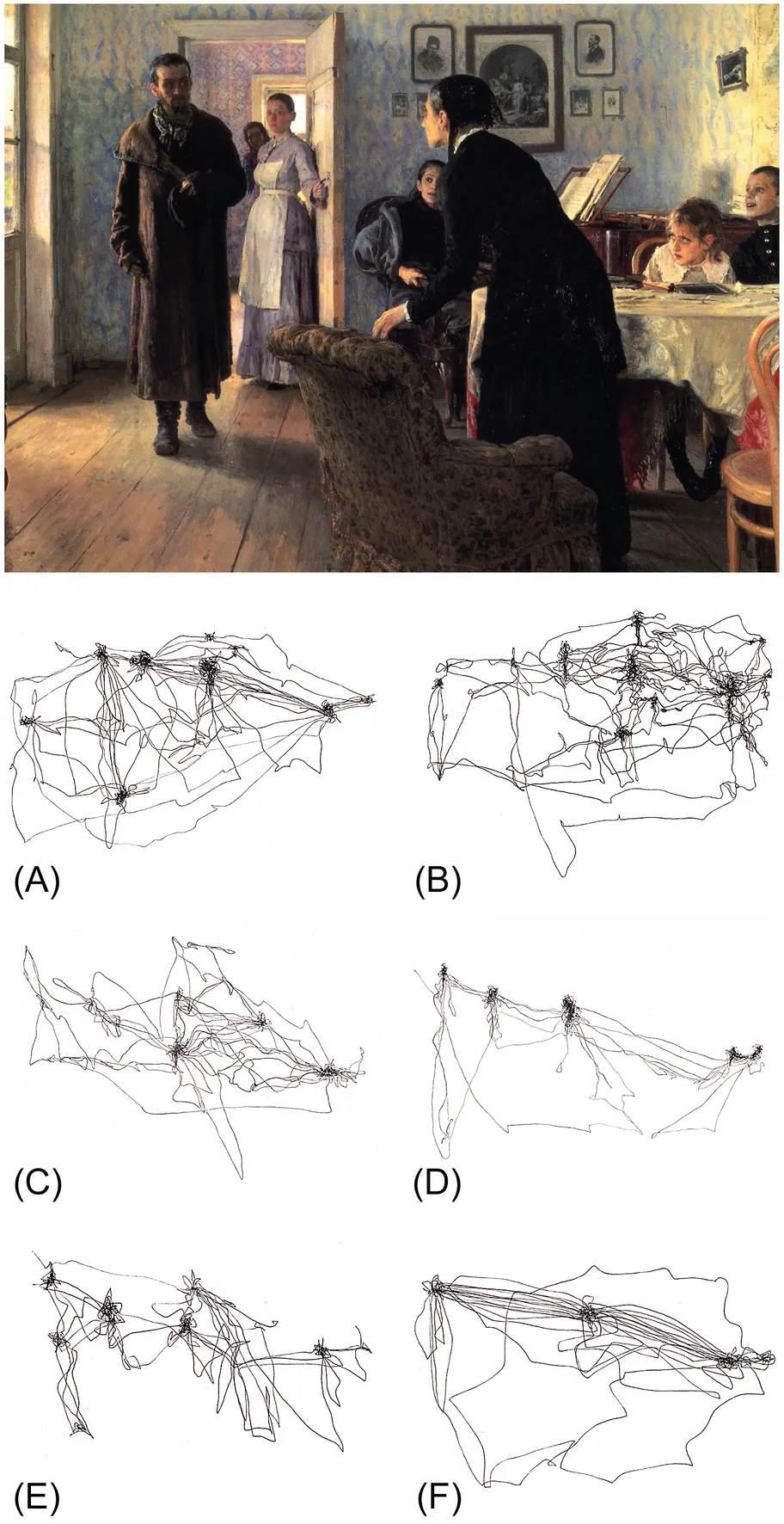
Eye tracking techniques and equipment have continued to be developed and refined up to the present day. Modern systems provide rich and accurate data on eye movements with remarkable temporal resolution, and little or no discomfort to the participant (indeed, participants may not even be aware that their eyes are being tracked). These advances in technology, both in terms of the hardware used for recording gaze and the software for processing and analyzing the resulting data, have led to an explosion of interest in eye tracking for both research and commercial use. Even an experience as mundane as ordering a pizza in a restaurant can now be (supposedly) enhanced with the aid of eye tracking technology, with claims that gaze patterns can be used to deduce customers’ topping-preferences before customers are even consciously aware of them (Henderson, 2014).
Modern eye trackers come in a variety of forms, but typically involve illuminating the eye using infrared light and recording it with an infrared camera. Computerized image analysis is then used to provide an accurate assessment of the changes in the orientation of the eye in space, and from this, the location of gaze on (for example) a computer monitor can be extrapolated. Eye tracking products differ in terms of how they are used in practice. Some trackers need to be mounted to the head (see Fig. 2 for an illustration of such a device), with cameras filming the eye from below the lower eyelid, while others have recording devices embedded into a computer monitor. The latest technology has now been miniaturized to the point that eye tracking systems can be embedded into laptop screens and even virtual reality headsets. As well as these practical differences, eye trackers vary in their technical abilities, such as how fast they sample the eye, the precision of recording measurements, and how quickly they send and receive data from a computer processing system. Appendix 1 contains a more detailed discussion of eye tracking hardware.

Before we review the benefits of eye trackers for social science research, we first discuss reasons why someone might not want to begin an eye tracking project. Eye trackers are still relatively expensive pieces of equipment for laboratories to purchase. The average computer workstation might set a researcher back $1000. With this workstation, a researcher can accurately measure manual responses made to visual stimuli. Combined with appropriate experimental procedures, this limited hardware allows the researcher to investigate all sorts of interesting questions about the processing of those stimuli to be investigated (e.g., by looking at the relative speed of one response compared to another). Eye trackers simply provide another way of studying visual processing by measuring the location of gaze, but they do so at a price; an eye tracking system suitable for research can cost anywhere from $15,000 to $100,000. In addition, using an eye tracker can require some expertise in computer programming. While many eye tracking systems will come with software that allows for the recording and analysis of eye movements “straight out of the box,” most researchers will require a greater degree of flexibility, particularly in terms of the analysis of the resulting data (e.g., the data may require recalibration to stimulus positions, see Vadillo, Street, Beesley, & Shanks, 2015). Given that today's trackers can record eye movements at up to 2000 times per second, the resulting data files can be very large and often require custom analysis software to be written to parse the data. The financial cost of eye trackers may also lead to a cost in terms of time. For the price of a single eye tracker, a researcher may be able to instead buy 10 or more standard workstations. The resulting trade-off is between running 10 or more participants at a time on a study that does not require eye tracking (which may be finished in a week) or running one participant at a time on an eye tracking version of the same study (which may therefore take months to complete). These realities should be kept in mind when deciding if it will be useful to collect eye movement data in a particular study.
From Eye Tracking to Cognitive Science
What are the advantages of running an eye tracking study? Why is data on eye movements so important to experimental psychologists? Most psychology experiments measure behavior through recording overt intentional responses. Most commonly, these are keyboard responses made with the fingers, but could include written text or vocalizations by a participant. As an example, let us consider a visual search task in which participants have been given a target to search for (say, a letter “T”) that is positioned within a scene that also contains several other objects that look similar to this target (say, a number of “L,” “F,” and “E” letters, known as distractors). In such a task, participants will be asked to press one response key if they detect the target in the search display, and another response key if the target is absent. The two critical components of the response are its type and its timing. We can use the response type to determine how accurately the participant was responding in the task, evaluating the proportion of times the “target present” key was pressed when the target was indeed present compared to when it was absent (i.e., hits versus false alarms). The timing of the response might also tell us something important about the underlying cognitive processes. For example, imagine that we increase the number of similar-looking distractor objects in the scene and we observe that the participant's response time increases. We might infer from this that perhaps more letters are being searched before the target is detected. This seems a natural conclusion, and is almost certainly right, but it cannot be inferred with certainty from the data collected. This is because response time, like response choice, represents a measurement at the terminal point of the psychological process. It comprises the accumulated time of all of the cognitive processing that precedes it, which may include (at least) the perception of the array of stimuli on the screen, the sequence of eye movements across the scene, the detection of the target, the decision about which response to make, and the execution of that response. An increase in response time might be attributed to a change in the time taken to complete any one of these steps in the chain of cognitive processes.
Due to these severe limitations in more traditional measurement of human behavior, eye movements can play a particularly important role in understanding cognitive processes. The recording of eye movements provides a continuous, real-time measure of stimulus processing throughout a series of cognitive processes. Eye tracking data provide moment-to-moment mea...
Table of contents
- Cover image
- Title page
- Table of Contents
- Copyright
- Dedication
- Contributors
- Foreword
- Acknowledgments
- Chapter 1: Eye Tracking as a Tool for Examining Cognitive Processes
- Chapter 2: Brain Morphometry for Economists: How do Brain Volume Constraints Affect Our Choices?
- Chapter 3: fMRI in Economics: What Functional Imaging of the Brain Can Add to Behavioral Economics Experiments
- Chapter 4: Skin Conductance in the Study of Politics and Communication
- Chapter 5: Steroid Hormones in Social Science Research
- Chapter 6: An Interoceptive Walk Down Wall Street
- Chapter 7: Mind, Body, Bubble! Psychological and Biophysical Dimensions of Behavior in Experimental Asset Markets
- Chapter 8: Opportunities and Challenges of Portable Biological, Social, and Behavioral Sensing Systems for the Social Sciences
- Chapter 9: Can Social Scientists Use Molecular Genetic Data to Explain Individual Differences and Inform Public Policy?
- Chapter 10: Conclusion
- Appendix 1: Getting Started With Eye Tracking
- Appendix 2: Using Heart Rate Variability Measures in Social Science Research
- Index
Frequently asked questions
Yes, you can cancel anytime from the Subscription tab in your account settings on the Perlego website. Your subscription will stay active until the end of your current billing period. Learn how to cancel your subscription
No, books cannot be downloaded as external files, such as PDFs, for use outside of Perlego. However, you can download books within the Perlego app for offline reading on mobile or tablet. Learn how to download books offline
Perlego offers two plans: Essential and Complete
- Essential is ideal for learners and professionals who enjoy exploring a wide range of subjects. Access the Essential Library with 800,000+ trusted titles and best-sellers across business, personal growth, and the humanities. Includes unlimited reading time and Standard Read Aloud voice.
- Complete: Perfect for advanced learners and researchers needing full, unrestricted access. Unlock 1.5M+ books across hundreds of subjects, including academic and specialized titles. The Complete Plan also includes advanced features like Premium Read Aloud and Research Assistant.
We are an online textbook subscription service, where you can get access to an entire online library for less than the price of a single book per month. With over 1.5 million books across 990+ topics, we’ve got you covered! Learn about our mission
Look out for the read-aloud symbol on your next book to see if you can listen to it. The read-aloud tool reads text aloud for you, highlighting the text as it is being read. You can pause it, speed it up and slow it down. Learn more about Read Aloud
Yes! You can use the Perlego app on both iOS and Android devices to read anytime, anywhere — even offline. Perfect for commutes or when you’re on the go.
Please note we cannot support devices running on iOS 13 and Android 7 or earlier. Learn more about using the app
Please note we cannot support devices running on iOS 13 and Android 7 or earlier. Learn more about using the app
Yes, you can access Biophysical Measurement in Experimental Social Science Research by Gigi Foster in PDF and/or ePUB format, as well as other popular books in Business & Pharmaceutical, Biotechnology & Healthcare Industry. We have over 1.5 million books available in our catalogue for you to explore.