- 348 pages
- English
- ePUB (mobile friendly)
- Available on iOS & Android
eBook - ePub
Highway Bridge Maintenance Planning and Scheduling
About this book
Highway Bridge Maintenance Planning and Scheduling provides new tactics for highway departments around the world that are faced with the dilemma of providing improved operations on a shoestring budget. Even after the much needed infrastructure funding is received, the question of which project comes first must be answered. Written by a 20-year veteran with the Kansas Department Of Transportation Bridge Office in design and in maintenance, this book provides Senior Bridge Maintenance Engineers with practical advice on how to create an effective maintenance program that will allow them to not only plan, schedule, direct, and monitor highway bridge repair and rehabilitation projects, but also evaluate all completed work for technical acceptability, productivity, and unit-cost standards.- Provides the tools and methods for building, maintaining, planning, and scheduling effective maintenance- Presents experience-based suggestions for evaluating highway bridges to determine maintenance priorities- Includes methods for evaluating all completed work for technical acceptability, productivity, and unit-cost standards
Tools to learn more effectively

Saving Books

Keyword Search

Annotating Text

Listen to it instead
Information
Chapter 1
Introduction
Abstract
The chapter introduces the basic bridge elements and materials. The typical modes of deterioration experienced by those elements and inspection with the aim of maintenance have been discussed in detail. The bridge preservation practices as well as bridge failures have also been discussed with relevant data and illustrations. As an example of a contemporary collapse that resulted in changes in practice, the collapse of the I-35W Bridge in Minneapolis is reviewed. It has been noticed that scheduling maintenance actions requires knowledge of typical service lives and deterioration rates for bridge components. Such rates are functions of the materials used, type of construction, environmental conditions, and usage characteristics. The study is concluded with current practices in the management of bridge information considering all costing aspects for allocating resources.
Keywords
bridge preservation process
bridge management systems (BMS)
maintenance
highway
structure
obsolete
“A bridge is to a road as a diamond is to a ring.”
– Anonymous
Overview
The inventory of bridges on public roads in the United States is discussed. The bridge preservation process is introduced. Bridge preservation practices before the establishment of the National Bridge Inspection Standards (NBIS) are examined through the case of such practice in the state of Kansas. The development of the NBIS is presented. The nature of ongoing development in bridge inspection and evaluation practices is illustrated by the case of the I-35W Bridge collapse. The implementation of bridge management systems (BMS) to manage bridge inspection and condition data, and the growth of BMS are discussed. An overview of the layout of the book is provided.
1.1. Bridges in the United States
The previous statement may appeal to the vanity of those who work with bridges, but it also reflects a truth: bridges are critical assets that provide important value, but at a cost. Value, in that each highway bridge is a solution to a problem of how to carry traffic across a river or gorge or other obstacle such as conflicting lanes of traffic. Cost, in that the solution comes at a price, each section of a bridge deck costs several times more than an equivalent area of roadway both to construct and to maintain over the life of the bridge.
According to the Federal Highway Administration (FHWA), in 2010 the road network of the United States included over 4,083,768 miles of public roads and more than 604,493 bridges [1]. A bridge is defined by the FHWA as, “a structure including supports erected over a depression or an obstruction, such as water, highway, or railway, and having a track or passageway for carrying traffic or other moving loads, and having an opening measured along the center of the roadway of more than 20 feet.” (Figure 1.1)
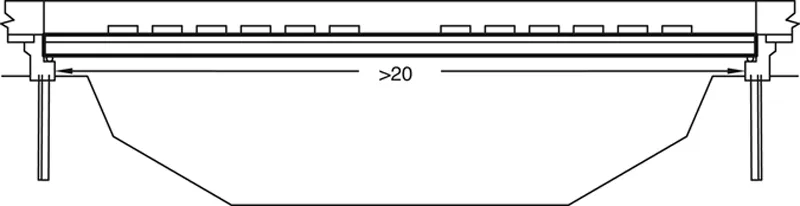
Figure 1.1 Bridge Opening.
The total length of those bridges is 16,349.5 miles [2], less than 0.5% of the total miles of public road. The amount expended by all levels of government in the United States in 2010 on public roads and bridges was $205.3 billion. Of this, $60 billion was spent on system rehabilitation, which is defined as, “capital improvements on existing roads and bridges that are intended to preserve the existing pavement and bridge infrastructure.” Twenty-eight and half percent, $17.1 billion, of the system rehabilitation expenditures were for bridge-sized structures. This does not include the system rehabilitation funds spent on highway structures with an opening of 20 ft. or less. These small spans and culvert structures are used most often to convey drainage or sometimes to provide a single lane underpass through a roadway berm. These structures are more numerous than bridge-sized structures and are subject to most of the same maintenance issues as the larger structures. The cost of work on structures with an opening of less than 20 ft. conducted under system rehabilitation projects is captured in the $42.9 billion in highway expenditures. Rehabilitating structures for preservation is considerably more expensive than rehabilitating an equal length of roadway.
Part of the cost of bridges is also the acceptance of risk. A study of bridge failures in the United States over the period of 1989–2000, by Wardhana and Hadipriono of Ohio State University, found cases of 503 failures [3]. Failure was defined as the incapacity of a bridge or its components to perform as specified in the design and construction requirements. Conditions of either collapse (total or partial) or distress constitute failure of a bridge and result in its removal from service until either repair or replacement. A distressed bridge is one with one or more components in such condition that the facility is rendered unserviceable. An example would be excessive deflections in the superstructure resulting in a dip in the bridge deck that would render the bridge unusable for traffic. Almost all of the failures with identified conditions were either partial or total collapse. The consequences of the collapse of a bridge can be quite severe and, in the worst case, result in fatalities. In the cases studied, there were 76 fatalities and 161 people injured.
To characterize a bridge as having failed in the study, it was not only implied that it became unserviceable, but that it became unserviceable suddenly and unexpectedly. Of the 503 bridge failures studied by Wardhana and Hadipriono, 266 failed due to high-water events, 103 failed due to either overloading or vehicular impacts, and 45 failed due to other events such as fire or earthquakes. The failures of only 48 bridges were attributed to either deterioration or fatigue. The most common way for a bridge to fail was to be subjected to an extreme event.
A far more common end to the life of a bridge is deterioration that accumulates and results in a progressively less serviceable structure. Under the wear of traffic loads and exposure to the weather and to agents such as salts used to melt snow and ice on roadways, steel corrodes, and concrete cracks and spalls. The wearing surface of the bridge deck may become rough enough to require slowing traffic. The supporting members of the structure may lose enough material that their ability to bear load is reduced, requiring the restriction of heavy trucks from the bridge. Thankfully, slow deterioration rarely results in a sudden failure with the attending risk of injury to bridge users; however, it may still result in significant economic impact by disrupting traffic. This is particularly true for the movement of commercial freight by heavy trucks.
The cost of bridges makes them a significant investment for owners and operators of highways. The risks and consequences of bridge failure require owners and operators to act to maintain their bridges in good repair. In the United States, these actions have come to be classified as bridge preservation. The FHWA defines bridge preservation “as actions or strategies that prevent, delay or reduce deterioration of bridges or bridge elements, restore the function of existing bridges, keep bridges in good condition and extend their life” [4].
Bridge preservation has become increasingly important to the owners and operators of highway bridges in the United States due the age and numbers of bridges in their inventories. According to data from the National Bridge Inventory (NBI) maintained by the FHWA, as of 2013 the average age of bridges carrying traffic on public roads in the United States was 43 years [5]. This is due to the rapid expansion of the highway system and public roads in general after World War II. Figure 1.2 shows the decade of construction for bridges on public roads in the United States constructed between 1910 and 2010. For bridges constructed in the post-World War II period and prior to adaption of the American Association of State Highway and Transportation Officials (AASHTO) Load and Resistance Factor Design (LRFD) Bridge Design Specification, the anticipated service life was 50 years.
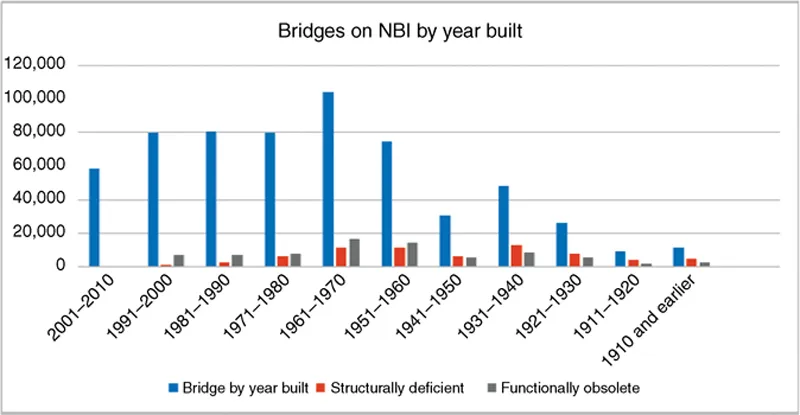
Figure 1.2 Bridges by Decade of Construction.
Over 11% of the bridges on the NBI in 2013 are categorized as structurally deficient [6]. A bridge is categorized as structurally deficient when one of its major components – the deck, superstructure, or substructure – is rated as poor during a bridge inspection, or when it is evaluated to be inadequate either for load-carrying capacity or for its waterway opening. Structural deficiency does not automatically imply an imminent danger to the traveling public using the bridge. It does imply impairment to the operation of the bridge in that some heavy truck traffic will not be allowed to use the bridge. And it also implies that work is required to restore the condition of the bridge. The poor rating of one or more bridge components is almost always due to deterioration. Deterioration comes about as a fu...
Table of contents
- Cover
- Title page
- Table of Contents
- Copyright
- Acknowledgment
- Chapter 1: Introduction
- Chapter 2: Bridge Elements and Materials
- Chapter 3: Bridge Inspection and Evaluation
- Chapter 4: Preventative Maintenance
- Chapter 5: Substantial Maintenance and Rehabilitation
- Chapter 6: Bridge Life Cycle Costing
- Chapter 7: Bridge Management
- Appendix 1: Delay Calculation for Undercapacity Flow at a Typical Signalized Work Zone for Bridge Deck Repair Work
- Appendix 2: Economic Impact Analysis of Deferring Maintenance on K-10 Bridges Near Desoto, Kansas
- Subject Index
Frequently asked questions
Yes, you can cancel anytime from the Subscription tab in your account settings on the Perlego website. Your subscription will stay active until the end of your current billing period. Learn how to cancel your subscription
No, books cannot be downloaded as external files, such as PDFs, for use outside of Perlego. However, you can download books within the Perlego app for offline reading on mobile or tablet. Learn how to download books offline
Perlego offers two plans: Essential and Complete
- Essential is ideal for learners and professionals who enjoy exploring a wide range of subjects. Access the Essential Library with 800,000+ trusted titles and best-sellers across business, personal growth, and the humanities. Includes unlimited reading time and Standard Read Aloud voice.
- Complete: Perfect for advanced learners and researchers needing full, unrestricted access. Unlock 1.4M+ books across hundreds of subjects, including academic and specialized titles. The Complete Plan also includes advanced features like Premium Read Aloud and Research Assistant.
We are an online textbook subscription service, where you can get access to an entire online library for less than the price of a single book per month. With over 1 million books across 990+ topics, we’ve got you covered! Learn about our mission
Look out for the read-aloud symbol on your next book to see if you can listen to it. The read-aloud tool reads text aloud for you, highlighting the text as it is being read. You can pause it, speed it up and slow it down. Learn more about Read Aloud
Yes! You can use the Perlego app on both iOS and Android devices to read anytime, anywhere — even offline. Perfect for commutes or when you’re on the go.
Please note we cannot support devices running on iOS 13 and Android 7 or earlier. Learn more about using the app
Please note we cannot support devices running on iOS 13 and Android 7 or earlier. Learn more about using the app
Yes, you can access Highway Bridge Maintenance Planning and Scheduling by Mark A. Hurt,Steven D Schrock in PDF and/or ePUB format, as well as other popular books in Technology & Engineering & Civil Engineering. We have over one million books available in our catalogue for you to explore.