- 704 pages
- English
- ePUB (mobile friendly)
- Available on iOS & Android
eBook - ePub
Theory of Aerospace Propulsion
About this book
Theory of Aerospace Propulsion provides excellent coverage of aerospace propulsion systems, including propellers, nuclear rockets, and space propulsion. The book's in-depth, quantitative treatment of the components of jet propulsion engines provides the tools for evaluation and component matching for optimal system performance. Worked examples and end of chapter exercises provide practice for analysis, preliminary design, and systems integration.
Readers of this book will be able to utilize the fundamental principles of fluid mechanics and thermodynamics to analyze aircraft engines; understand the common gas turbine aircraft propulsion systems and be able to determine the applicability of each; perform system studies of aircraft engine systems for specified flight conditions; perform preliminary aerothermal design of turbomachinery components; conceive, analyze, and optimize competing preliminary designs for conventional and unconventional missions. The book is organized into 15 chapters covering a wide array of topics such as idealized flow machines; quasi-one-dimensional flow equations; idealized cycle analysis of jet engines; combustion chambers for airbreathing engines; nozzles and inlets; turbomachinery; blade element analysis of axial flow turbomachines; turbine engine performance and component integration; propellers; liquid rockets; solid propellant rockets; nuclear rockets; space propulsion; and propulsion aspects of high-speed flight.
This book will appeal to aerospace or mechanical engineers working in gas turbines, turbomachinery, aircraft propulsion and rocket propulsion, and to undergraduate and graduate level students in aerospace or mechanical engineering studying aerospace propulsion or turbomachinery.
- Early coverage of cycle analysis provides a systems perspective, and offers context for the chapters on turbomachinery and components
- Broader coverage than found in most other books - including coverage of propellers, nuclear rockets, and space propulsion - allows analysis and design of more types of propulsion systems
- In depth, quantitative treatments of the components of jet propulsion engines provides the tools for evaluation and component matching for optimal system performance
- Worked examples and end of chapter exercises provide practice for analysis, preliminary design, and systems integration
Trusted by 375,005 students
Access to over 1.5 million titles for a fair monthly price.
Study more efficiently using our study tools.
Information
Chapter 1. Idealized Flow Machines
Outline
1.1 Conservation Equations1
1.1.1 Conservation of mass2
1.1.2 Conservation of momentum3
1.1.3 Conservation of energy3
1.2 Flow Machines with No Heat Addition: The Propeller3
1.2.1 Zero heat addition with Ve >V03
1.2.2 Zero heat addition with Ve < V04
1.2.3 Zero heat addition with P = constant > 04
1.2.4 Propulsive efficiency4
1.3 Flow Machines with P = 0 and Q = Constant: The Turbojet, Ramjet, and Scramjet5
1.3.1 Heat addition, Q > 05
1.3.2 Constant heat addition, Q = constant > 07
1.3.3 Overall efficiency8
1.3.4 Fuel efficiency8
1.4 Flow Machines with P = 0, Q = Constant, and A0 = 0: The Rocket11
1.5 The Special Case of Combined Heat and Power: The Turbofan12
1.5.1 Very small bypass ratio, β ≪ 1, the turbojet15
1.5.2 Very large bypass ratio, β ≫ 1, the turboprop15
1.5.3 Finite β, the turbofan16
1.6 Force Field for Air-Breathing Engines16
1.7 Conditions for Maximum Thrust22
1.8 Example: Jet and Rocket Engine Performance25
1.8.1 Jet engine performance25
1.8.2 Rocket engine performance26
1.9 Nomenclature27
1.9.1 Subscripts28
1.10 Exercises29
Reference34
Gas dynamic conservation equations in quasi-one dimensional form are introduced and used to classify the different types of jet propulsion engines and their performance. These are considered to be flow machines in which a fluid enters and has work and/or heat added to it prior to its exit from the machine as a jet. The propeller, in which work is done on the fluid passing through it but no heat is added, is shown to be efficient but speed limited. Conversely, the turbojet, ramjet, and scramjet, in which no work is done on the fluid passing through it, but heat is added, are shown to be less efficient but capable of good high-speed performance. The rocket, a variant of this case, carries onboard all the fluid to which heat is added and subsequently ejected as a jet. The rocket is able to operate in the vacuum of space but has lower efficiency than the others. The turbofan, in which both heat and work are added to the fluid, is a hybrid that derives some of the special benefits of the propeller and the turbojet. After illustrating the different engine types that use the principle of jet propulsion, attention is focused on the force field generated and the conditions for which maximum thrust is produced and developed.
1.1. Conservation Equations
A flow machine is one that ingests a stream of fluid, processes it internally in some fashion, and then ejects the processed fluid back into the ambient surroundings. An idealization of such a generalized flow machine is depicted schematically in Figure 1.1
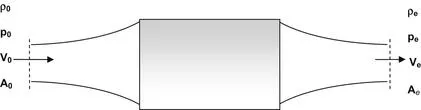 |
| FIGURE 1.1 Schematic diagram of idealized flow machine and associated streamtube control volume. |
In order to develop the basic features of operation of the idealized flow machine ...
Table of contents
- Cover image
- Table of Contents
- Front Matter
- Copyright
- Preface
- Chapter 1. Idealized Flow Machines
- Chapter 2. Quasi-One-Dimensional Flow Equations
- Chapter 3. Idealized Cycle Analysis of Jet Propulsion Engines
- Chapter 4. Combustion Chambers for Air-Breathing Engines
- Chapter 5. Nozzles
- Chapter 6. Inlets
- Chapter 7. Turbomachinery
- Chapter 8. Blade Element Theory for Axial Flow Turbomachines
- Chapter 9. Turbine Engine Performance and Component Integration
- Chapter 10. Propellers
- Chapter 11. Liquid Rockets
- Chapter 12. Solid Propellant Rockets
- Chapter 13. Nuclear Rockets
- Chapter 14. Space Propulsion
- Chapter 15. Propulsion Aspects of High-Speed Flight
- Appendix A. Shock Waves, Expansions, Tables and Charts
- Appendix B. Properties of Hydrocarbon Fuel Combustion
- Appendix C. Earth's Atmosphere
- Appendix D. Boost Phase and Staging of Rockets
- Appendix E. Safety, Reliability, and Risk Assessment
- Appendix F. Aircraft Performance
- Appendix G. Thermodynamic Properties of Selected Species
- Index
Frequently asked questions
Yes, you can cancel anytime from the Subscription tab in your account settings on the Perlego website. Your subscription will stay active until the end of your current billing period. Learn how to cancel your subscription
No, books cannot be downloaded as external files, such as PDFs, for use outside of Perlego. However, you can download books within the Perlego app for offline reading on mobile or tablet. Learn how to download books offline
We are an online textbook subscription service, where you can get access to an entire online library for less than the price of a single book per month. With over 1.5 million books across 990+ topics, we’ve got you covered! Learn about our mission
Look out for the read-aloud symbol on your next book to see if you can listen to it. The read-aloud tool reads text aloud for you, highlighting the text as it is being read. You can pause it, speed it up and slow it down. Learn more about Read Aloud
Yes! You can use the Perlego app on both iOS and Android devices to read anytime, anywhere — even offline. Perfect for commutes or when you’re on the go.
Please note we cannot support devices running on iOS 13 and Android 7 or earlier. Learn more about using the app
Please note we cannot support devices running on iOS 13 and Android 7 or earlier. Learn more about using the app
Yes, you can access Theory of Aerospace Propulsion by Pasquale M. Sforza,Pasquale M Sforza in PDF and/or ePUB format, as well as other popular books in Technology & Engineering & Aeronautic & Astronautic Engineering. We have over 1.5 million books available in our catalogue for you to explore.