eBook - ePub
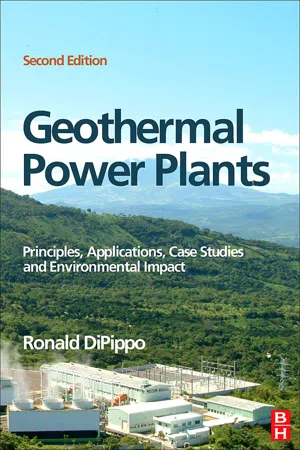
Geothermal Power Plants
Principles, Applications, Case Studies and Environmental Impact
- 520 pages
- English
- ePUB (mobile friendly)
- Available on iOS & Android
eBook - ePub
Geothermal Power Plants
Principles, Applications, Case Studies and Environmental Impact
About this book
Ron DiPippo, Professor Emeritus at the University of Massachusetts Dartmouth, is a world-regarded geothermal expert. This single resource covers all aspects of the utilization of geothermal energy for power generation from fundamental scientific and engineering principles. The thermodynamic basis for the design of geothermal power plants is at the heart of the book and readers are clearly guided on the process of designing and analysing the key types of geothermal energy conversion systems. Its practical emphasis is enhanced by the use of case studies from real plants that increase the reader's understanding of geothermal energy conversion and provide a unique compilation of hard-to-obtain data and experience. An important new chapter covers Environmental Impact and Abatement Technologies, including gaseous and solid emissions; water, noise and thermal pollutions; land usage; disturbance of natural hydrothermal manifestations, habitats and vegetation; minimisation of CO2 emissions and environmental impact assessment.The book is illustrated with over 240 photographs and drawings. Nine chapters include practice problems, with solutions, which enable the book to be used as a course text. Also includes a definitive worldwide compilation of every geothermal power plant that has operated, unit by unit, plus a concise primer on the applicable thermodynamics.* Engineering principles are at the heart of the book, with complete coverage of the thermodynamic basis for the design of geothermal power systems* Practical applications are backed up by an extensive selection of case studies that show how geothermal energy conversion systems have been designed, applied and exploited in practice* World renowned geothermal expert DiPippo has including a new chapter on Environmental Impact and Abatement Technology in this new edition
Trusted by 375,005 students
Access to over 1.5 million titles for a fair monthly price.
Study more efficiently using our study tools.
Information
Part 1 Resource Identification and Development
- Geology of Geothermal Regions
- Exploration Strategies and Techniques
- Geothermal Well Drilling
- Reservoir Engineering
“A man must stand in fear of just those things that truly have the power to do us harm, of nothing else, for nothing else is fearsome.”
Dante Alighieri, The Divine Comedy: The Inferno – 1306–1321
The first part of the book deals with the geological aspects of geothermal resources – how the forces of nature shaped the earth in a way to create reservoirs capable of supplying energy for geothermal power plants. We discuss the means to identify and characterize geothermal prospects, and the techniques for drilling wells into geothermal formations to extract the hot fluids for use in power stations. The last part of this section of the book examines the physical principles of fluid flow through the porous rocks that constitute the reservoir, and the modern computer simulation methods that are used to model the behavior of the reservoirs.

Volcan Rincon de la Vieja, Guanacaste province, Costa Rica. Location: 10.8N, 85.3W Elevation: 6,286 feet (1,916 m) Photo by Federico Chavarria Kopper, published by Smithsonian Inst. Global Volcanism Program website: http://www.volcano.si.edu/world/volcano.cfm?vnum=1405-02=[WWW].

Volcan Pacaya (foreground) Location: 14.38N, 90.60W Elevation: 8,371 feet (2,552 meters), and Volcan Aqua (background), Location: 14.5N, 90.7W Elevation: 12,333 feet (3,760 m), Guatemala. Ref: Volcano World, U. of N. Dakota. http://volcano.und.nodak.edu/vwdocs/volcimages/south_america/guat/pacaya.html[WWW].
Chapter 1 Geology of Geothermal Regions
1.1 Introduction
1.2 The earth and its atmosphere
1.3 Active geothermal regions
1.4 Model of a hydrothermal geothermal resource
1.5 Other types of geothermal resources
1.5.1 Hot dry rock, HDR
1.5.2 Geopressure
1.5.3 Magma energy
References
Problems
“Birth and death. Like us, geothermal features begin and end, moving through cycles of their own. We draw towards them, lured by change, beauty, and an unusual cast of the familiar – water, rocks, and heat. We search them for answers to mysteries in our own lives, like birth and death.”
Susan F. Hodgson – 1995
1.1 Introduction
Geothermal energy – earth heat – can be found anywhere in the world. But the high-temperature energy that is needed to drive electric generation stations is found in relatively few places. The purpose of this opening chapter is to provide the geologic framework within which high-temperature geothermal resources can be understood, both with regard to their occurrence and their nature.
Readers who are unfamiliar with the rudiments of earth science may wish to consult any of the standard texts on the subject, e.g., Refs. [1–4]. Those interested in the history of geologic thought, dramatic geological events, and of ancient geothermal energy usage will find fascinating reading in Refs. [5–8]. W.A. Duffield provides an excellent, brief introduction to modern geologic theory of volcanoes in a beautifully illustrated book [9]. In selecting general texts on geology, one must be aware that any book written before 1970 will not include the most recent thinking on the structure of the earth and the dynamic mechanisms that give it its life. We refer to the theory of plate tectonics, now universally accepted, and which provides us with the basic tools to understand the origins of high-temperature geothermal resources.
1.2 The earth and its atmosphere
In 1915 A.L. Wegener (1880–1930) put forth a highly controversial theory of continental drift in the first edition of his book The Origin of Continents and Oceans [10]. Although he elaborated on it in later editions of his book in 1920, 1922 and 1929, the controversy persisted. His theory was motivated by the observation that the continents, particularly South America and Africa, seemed to be pieces of a global jig-saw puzzle that had somehow been pulled apart. He reasoned that all land masses were once connected in a gigantic supercontinent he named “Pangaea”. He posited that the now separated continents floated and drifted through a highly viscous sea floor. This part of his theory was later proved incorrect but the basic notion of drifting continents was right. Wegener’s problem was in identifying correctly the forces that ripped apart the pieces and in fact keeps them moving.
Studies that began in the 1950s and continued into the 1960s matched the ages of rocks found along the northeastern coast of South America and the northwestern coast of Africa [11]. The correlation of rock ages ran from Recife in Brazil to Trinidad off the coast of Venezuela on the South American side, and from Luanda to Sierra Leone on the African side. Oceanic research also showed that new land was being created on either side of the mid-Atlantic ridge, the so-called “sea-floor spreading” phenomenon [12]. By dating these deposits, earth scientists were able to confirm the movement of the vast plates that constitute the crust of the earth. Continents are part of the crust and have been in constant motion since the beginning of the earth some 4.5 billion years ago.
An excellent animation of this motion starting about 740 million years ago can be viewed at the web site of the University of California at Berkeley’s Museum of Paleontology [13]. From this animation it is clear that Pangaea existed as a supercontinent for only a blink of geological time, around 200 million years ago, having itself been formed from the collision of several land masses beginning in the Precambrian era.
While there is no controversy today over the theory of plate tectonics, there remains much uncertainty about the detailed structure of the inner earth. A great deal of research has gone into exploring and characterizing the earth’s atmosphere but only one or two projects have aimed at probing the depths of the earth. One of them, Project Moho, intended to drill through the thinnest part of the oceanic crust (about 5 km thickness) to enter the mantle. In 1909 Croatian scientist A. Mohorovičic (1857–1936) had observed, at a certain depth, a discontinuity in the velocity of seismic waves caused by earthquakes. He deduced that this represented a boundary between the generally solid crust and the generally molten mantle. This interface has become known as the Mohorovičic Discontinuity (or simply the Moho) in his honor [1]. However, Project Moho was halted in 1966 apparently for lack of funds and produced no results.
Another deep drilling effort, the Salton Sea Deep Dr...
Table of contents
- Cover
- Title Page
- Copyright
- Dedication
- Preface and Acknowledgements to the Second Edition
- Preface to the First Edition
- Acknowledgements to the First Edition
- Table of Contents
- Part 1: Resource Indentification and Development
- Part 2: Geothermal Power Generating Systems
- Part 3: Geothermal Power Plant Case Studies
- Appendix A: Worldwide State of Geothermal Power Plant Development as of May 2007
- Appendix B: Units Conversions
- Appendix C: Energy Equivalents
- Appendix D: Elements of Thermodynamics
- Appendix E: Answers to Selected Practice Problems
- Appendix F: Supplementary Problems
- Appendix G: Answers to Selected Supplementary Problems
- Index
- Instructions for online access
Frequently asked questions
Yes, you can cancel anytime from the Subscription tab in your account settings on the Perlego website. Your subscription will stay active until the end of your current billing period. Learn how to cancel your subscription
No, books cannot be downloaded as external files, such as PDFs, for use outside of Perlego. However, you can download books within the Perlego app for offline reading on mobile or tablet. Learn how to download books offline
Perlego offers two plans: Essential and Complete
- Essential is ideal for learners and professionals who enjoy exploring a wide range of subjects. Access the Essential Library with 800,000+ trusted titles and best-sellers across business, personal growth, and the humanities. Includes unlimited reading time and Standard Read Aloud voice.
- Complete: Perfect for advanced learners and researchers needing full, unrestricted access. Unlock 1.5M+ books across hundreds of subjects, including academic and specialized titles. The Complete Plan also includes advanced features like Premium Read Aloud and Research Assistant.
We are an online textbook subscription service, where you can get access to an entire online library for less than the price of a single book per month. With over 1.5 million books across 990+ topics, we’ve got you covered! Learn about our mission
Look out for the read-aloud symbol on your next book to see if you can listen to it. The read-aloud tool reads text aloud for you, highlighting the text as it is being read. You can pause it, speed it up and slow it down. Learn more about Read Aloud
Yes! You can use the Perlego app on both iOS and Android devices to read anytime, anywhere — even offline. Perfect for commutes or when you’re on the go.
Please note we cannot support devices running on iOS 13 and Android 7 or earlier. Learn more about using the app
Please note we cannot support devices running on iOS 13 and Android 7 or earlier. Learn more about using the app
Yes, you can access Geothermal Power Plants by Ronald DiPippo in PDF and/or ePUB format, as well as other popular books in Technik & Maschinenbau & Energie. We have over 1.5 million books available in our catalogue for you to explore.