![]()
1
From French Canada to Québec
An Introduction
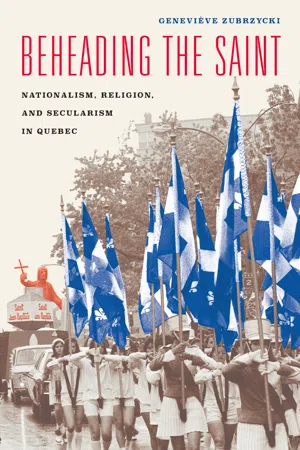
JUNE 24, 1969, A CROWD OF YOUTHFUL PROTESTERS FOLLOWING the traditional St-Jean-Baptiste Day parade in Montréal seized and overturned the float dedicated to the patron saint of French Canadians. The large statue of St. John the Baptist fell to the ground, its head breaking off from the body. In the following days, the violent gesture was interpreted and narrated following the biblical story of the saint: it was described in the media and referred to in the public sphere as the “Beheading of the Baptist.” With this symbolic death of the saint, the parades disappeared, and new modes of national celebrations were institutionalized.
The attack could have been interpreted at the time as an offensive yet ultimately inconsequential act of vandalism by agitated youth, but as the destruction of the float and the saint were called in the media a “beheading”—with photojournalistic images supporting that interpretation—the incident became an “event” with transformative consequences (Sewell 1996). The attack could be analyzed today by social scientists as “merely symbolic.” Yet this proverbial coup de grâce can also be seen as the last constitutive action in the articulation of a new secular, Québécois national identity, a process in which verbal and physical attacks on the patron saint’s icon throughout the 1960s played an intrinsic role. The debates about, and reshaping of, the national icon were part and parcel of the Quiet Revolution, a period of far-reaching social, political, economic, and cultural transformations that significantly restructured Québec society and the identity of its French-speaking members.
Once called “the priest-ridden province” by its Protestant neighbors, during the Quiet Revolution of the 1960s, the Québécois rid themselves of Catholicism, amputating what a new generation of social activists and political figures viewed as a gangrenous limb poisoning the national body. The building of a modern provincial welfare state allowed the secularization of social services, including education, health care, and social welfare, which were until then provided and controlled by the Catholic Church. The decade was marked by aggressive criticism of the Church in the public sphere, a wholesale decline in religious practice, and a large number of priests and nuns who renounced their vows and reentered secular society.1 Many Québécois today, as heirs of the Quiet Revolution, perceive religion as an atavistic residue of the past, surviving only at the margins of society, or else as a foreign concept imported by recent waves of immigrants.
Still, religion is far from being merely an import. To continue with the metaphor of the nation as body, we might say that religion is a skeleton in Québec’s closet, or a palpable absence, like phantom limb pain. Its lingering presence became apparent in heated debates over the “reasonable accommodation” of cultural minorities’ religious practices, a matter that caused the creation of a special public commission to address the issue in 2006. And the question of religion’s place in a secular Québec reemerged in 2013 in a much-contested proposal for a “Charter of Québec Values” (referred to simply as the Charter of Values or the Charter of Secularism). Although framed in the media and certain political circles as contests between the secular majority and religious minorities, these debates revealed that Québec’s religious past is still very much a feature of its present religious landscape and the challenges it poses for a self-avowed secular society. The debate about the increasing visibility of religion in the public sphere became a deliberation about the very identity of Québec, which reinvented itself over half a century ago with the drastic rejection of Catholicism.
Beheading the Saint is about this shifting relationship between nationalism, religion, and secularism in a society which was, until the late 1960s, exemplary of what Charles Taylor calls the “neo-Durkheimian” link between national identity and religion, wherein “the sense of belonging to the group and confession are fused and the moral issues of the group’s history tend to be coded in religious categories” (2007, 458). I examine how the relationship between French Canadianness and Catholicism was configured in the nineteenth century, how it was reconfigured as Québécois and secular in the 1960s, and why and how that transition informs recent debates over secularism in Québec. The secularization of national identity during the Quiet Revolution remains the key to understanding the role and place of religion in the public sphere in today’s Québec.
Nationalism, Religion, and Secularism in Québec
In the nineteenth and twentieth centuries, Catholicism played a central role in defining the French Canadians’ national identity against the Anglo-Protestants surrounding them on the North American continent. After New France was ceded to England in 1763, colonial domination by this powerful, ever-present Other further reinforced Catholicism’s ability to shape and sharpen French Canadian ethno-national identity and strengthened the role played by the Catholic Church in nationalist politics. National and religious identities were tightly linked at the cultural and institutional levels, with Catholicism serving as a robust ethno-national marker and the Catholic Church performing many functions usually carried out by the state, such as providing education, health, and social welfare services (Dumont 1986, 1993; Bouchard 1999; Ferretti 1999).
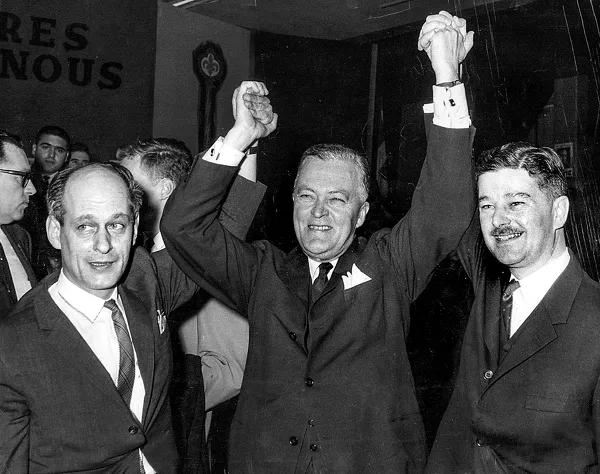
This state of affairs was radically disrupted following the death of Premier Maurice Duplessis in September 1959. Duplessis had ruled the Province of Québec for almost a quarter of a century, his political tenure characterized by rabid corruption, quid pro quo relationships with the Catholic Church, and shady dealings with big business—specifically with Anglo-Canadian and American firms that owned and controlled most of the province’s natural resources, like mining and minerals, forestry, and hydropower (Keating 1996, 93). Duplessis managed to remain in office for as long as he did thanks to his unscrupulous, Chicago-style, electoral-machine tactics and strong pressure from the Catholic Church, which urged the population to “vote blue,” the color of his party. Priests reminded their parishioners that “the heavens are blue, and hell is red” (red being the color of the opposition). With his passing in 1959, the political landscape was leveled, and a new, progressive political elite took advantage of the change to seize power. In June 1960 the Liberal Party was elected after campaigning with the slogans “It’s Time for a Change,” “Now or Never,” and “Masters in our own house.”2 These were more than empty slogans: they proposed an ambitious program of reform that Premier Jean Lesage’s “thunder team” (l’équipe du tonnerre) brought to fruition.
The Quiet Revolution: Structural Pivot and Narrative Turning Point
Lesage’s election marked the beginning of a decade of profound political, economic, social, and cultural transformations that not only brought Québec out of the Duplessis era, commonly referred to as the Great Darkness (Grande noirceur), but also effected a significant rupture with a traditional past.3
Chief among the structural changes was the building of a modern provincial welfare state and the secularization of social services previously controlled by the Church. The Lesage government created a rational bureaucracy and several ministries that not only modernized and democratized Québec, but also created jobs for Francophone Québécois, whose professional advancement had been stalled because of lack of opportunity (except for members of the clergy), insufficient qualifications, or linguistic discrimination.4 The state took over significant sectors of the provincial economy, buying out private companies and nationalizing them. The nationalization of private electrical companies and their consolidation in 1962 as the large state-owned company Hydro-Québec is a prime example. Hydro-Québec became a major actor in Québec’s economy not only because it offered subsidized prices for entrepreneurs and standardized prices to its customers, but also because it provided jobs for Francophone workers. Soon it was the largest employer in the province, and by 1977 it was the second-largest public utility enterprise in North America (McRoberts, 1993, 174).
In addition, the creation of economic and financial institutions such as the Société générale de financement (1962), the Société de Sidérurgie du Québec (1964), the Société québécoise d’exploitation minière (1965), and the Caisse de dépôt et de placement (1965) rendered the Québec state the key agent in the development of the province’s economy, creating thousands of jobs.5 This gave concrete backing to Lesage’s slogan “Masters in our own house.” Between 1960 and 1966, new ministries, consultative councils, regulatory bodies, and public enterprises were created. The number of personnel employed in the civil service grew by 42.6%, rising from 29,298 to 41,847. Those employed in public enterprises (excluding Hydro-Québec and the Société des Alcools) nearly doubled between 1960 and 1965, from 7,468 to 14, 411 (McRoberts 1993, 126).
These transformations are especially significant in light of their linguistic aspect. In 1961, Francophone-controlled businesses and institutions accounted for only 47% of all jobs in Québec (Linteau et al. 1991, 213). While employment in the agrarian sector remained largely unaffected by the Quiet Revolution—92% of jobs in that sector were provided by Francophone-controlled establishments in 1961, and this figure was unchanged 20 years later—the percentage of jobs accounted for by Francophone-controlled financial institutions rose from 25.8% to 44.8% (332). The Quiet Revolution, therefore, opened up fields of employment that had previously been closed to Francophones, including public service, business, and finance. It also initiated a significant reversal in which Francophones gradually began to assume positions of leadership in the workplace.6 Whereas in 1959 Anglophones were overrepresented in management, holding almost two-thirds of leadership positions despite constituting only 13% of Québec’s total population, by 1988 they held about 25% of managerial positions, while Francophones had assumed over 50% (Simard 2000). The same trend was evident with white-collar jobs: in 1961, nearly 50% of Anglophones occupied white-collar positions, while not even 25% of Francophones did. Thirty years later, the proportion of Francophones in those positions had doubled (Simard 2000, 57–59). There is no question that the Quiet Revolution had a significant impact on Québec’s economic development, particularly in increasing the opportunities for employment and advancement for French-speaking workers.7
These structural transformations took place alongside a cultural revolution. National history began to follow a new narrative arc, shifting the framework of identification and affiliation from a pan–North American, ethnic French Canadian identity based on language and religion to one circumscribed by the territory of Québec and a civic and secular identity centered on language. The institutional marginalization of the Catholic Church and the cultural rejection of its national ideology was accompanied by an unusually rapid process of what Martin Riesebrodt, building from Max Weber’s key word Entzauberung, calls religious “disenchantment,” the rationalization of consciousness. In the space of just ten years, churches that had been thronged with people several days a week now sat quiet and empty.8 In Montréal, participation of the population over fifteen years of age in Sunday mass dropped from 88% in 1957 to 30% in 1971 (Hamelin 1984, 277; Christiano 2007, 31). Without parishioners to support the local churches financially, many churches fell into disrepair. Some were bulldozed; others were sold to developers who transformed them into condominiums or hotels. Some surviving church buildings were rededicated as sites of “cultural heritage” years later or converted to places of worship for other, often “ethnic,” denominations (Baum 1991; Seljak 1996; Lemieux 2006; Christiano 2007; Zubrzycki 2012a).9
As religious participation tumbled, so did fertility rates: on the eve of the Quiet Revolution, in 1959, Québec had the highest birthrate of all the provinces in Canada. The average French Canadian woman gave birth to four children. By 1972, Québec had the lowest birthrate in the country, dropping to 2.09 children per woman, below the 2.1 level required for population replacement (Christiano 2007, 34; Langlois 1999, 136).
These various sociopolitical, cultural, and demographic trends were not unique among industrialized societies in that period, but the degree and rapidity at which they occurred in Québec was indeed revolutionary. The Quiet Revolution should not, of course, be viewed in isolation from social movements, political developments, and cultural transformations elsewhere in the world, such as student rebellions against entrenched social hierarchies and conservative political authority in the United States, Europe, and South America; the civil rights movement in the U.S.; anticolonial protests in metropoles and the overthrowing of colonial régimes in Africa and Asia; the women’s liberation movement and the sexual revolution; and, last but not least, the Second Vatican Council reforms and the emergence of Catholic “liberation theologies.” In Québec, however, these movements were entwined with the rejection of the Church’s moral authority and its exercise of tight social control on the one hand, and with nationalism on the other. In their nationalist discourse, French Canadians in Québec adopted the language of civil rights movements, Marxism, and postcolonialism: The “white niggers of North America,” to take an expression from an influential manifesto by the journalist and activist Pierre Vallières in 1968, were to be emancipated from English Canadian colonial ascendancy and freed from the oppression of the Catholic Church by the new government’s modern state and its nationalist political project.10 On June 30, 1961, Québec’s first political group for the sovereignty of Québec, the Rassemblement pour l’indépendance nationale (RIN), took out an advertisement in Le Devoir that read: “In 1951 . . . Dahomey (pop. 1,700,000) was a colony, and French Canada was asking for bilingual checks [for benefits distributed by the federal government]. In 1961 . . . Dahomey is an independent Republic [Bénin], and French Canada is still asking for bilingual checks. The only solution: INDEPENDENCE.” Feminism was conceived and articulated within the same broad nationalist framework; women’s individual emancipation from patriarchal structures would be achieved through Québec’s ideological emancipation from the Church and its national liberation from Ottawa’s federal control (Lamoureux 1983; De Sève 1998). According to a slogan of feminist groups, there would be “No women’s Liberation without a Free Québec, no Free Québec without women’s Liberation” (Lamoureux 1983).
The early 1960s therefore marked the rise of modern Québécois nationalism on multiple institutional and cultural fronts. The new nation was defined and created in opposition to the old Catholic narrative of the nation and the entire ideological and institutional edifice that had supported it. They were replaced with a secular identification based on language and territory, soon to be mobilized by the prospect of political independence (Breton 1988; Mann 1988; Balthazar 1986; Dumont 1993). Yet the new national configuration still very much depended on Catholicism to serve as its foil. One of the principal challenges this book undertakes is to trace and document this ghostly presence as it haunts new social projects, from “cultural heritage” to “reasonable accommodation” to the Charter of Values.
Secularizing French Canadians, Building Québécois Identity
Although its radical nature and significance have been disputed, the Quiet Revolution has a quasi-sacred status in Québec (see Létourneau 1997). If it occupies such a central place in the Québécois national narrative, it is not merely because it brought about Québec’s modernization and created its welfare state—as significant as those transformations were—but also because it marked a shift in the way French Canadians conceived of themselves an...