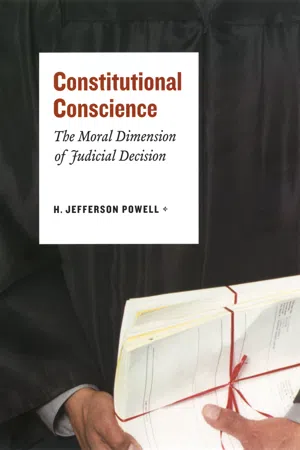
While many recent observers have accused American judges—especially Supreme Court justices—of being too driven by politics and ideology, others have argued that judges are justified in using their positions to advance personal views. Advocating a different approach—one that eschews ideology but still values personal perspective—H. Jefferson Powell makes a compelling case for the centrality of individual conscience in constitutional decision making.
Powell argues that almost every controversial decision has more than one constitutionally defensible resolution. In such cases, he goes on to contend, the language and ideals of the Constitution require judges to decide in good faith, exercising what Powell calls the constitutional virtues: candor, intellectual honesty, humility about the limits of constitutional adjudication, and willingness to admit that they do not have all the answers. Constitutional Conscience concludes that the need for these qualities in judges—as well as lawyers and citizens—is implicit in our constitutional practices, and that without them judicial review would forfeit both its own integrity and the credibility of the courts themselves.
Powell argues that almost every controversial decision has more than one constitutionally defensible resolution. In such cases, he goes on to contend, the language and ideals of the Constitution require judges to decide in good faith, exercising what Powell calls the constitutional virtues: candor, intellectual honesty, humility about the limits of constitutional adjudication, and willingness to admit that they do not have all the answers. Constitutional Conscience concludes that the need for these qualities in judges—as well as lawyers and citizens—is implicit in our constitutional practices, and that without them judicial review would forfeit both its own integrity and the credibility of the courts themselves.