Imaging from Cells to Animals In Vivo offers an overview of optical imaging techniques developed over the past two decades to investigate biological processes in live cells and tissues. It comprehensively covers the main imaging approaches used as well as the application of those techniques to biological investigations in preclinical models. Among the areas covered are cell metabolism, receptor-ligand interactions, membrane trafficking, cell signaling, cell migration, cell adhesion, cytoskeleton and other processes using various molecular optical imaging techniques in living organisms, such as mice and zebrafish.
Features
Brings together biology and advanced optical imaging techniques to provide an overview of progress and modern methods from microscopy to whole body imaging.
Fills the need for a comprehensive view of application-driven development and use of new tools to ask new biological questions in the context of a living system.
Includes basic chapters on key methods and instrumentation, from fluorescence microscopy and imaging to endoscopy, optical coherence tomography and super-resolution imaging.
Discusses approaches at different length scales and biomedical applications to the study of single cell, whole organ, and whole organism behavior.
Addresses the impact on discovery, such as cellular function as implicated in human disease and translational medicine, for example in cancer diagnosis.
Trusted by 375,005 students
Access to over 1.5 million titles for a fair monthly price.
1.2.2 Effects of the Host Environment on Fluorescent Molecules
1.2.3 Effects of Fluorescent Molecules on Host Environment
1.2.4 Fluorophore Types
1.2.5 Endogenous Fluorophores (EnF)
1.2.6 Exogenous Fluorophores (ExF)
1.2.6.1 Fluorescent Dyes
1.2.6.2 Quantum Dots
1.2.6.3 Fluorescence Indicators
1.3 Principles of Microscopy
1.3.1 Image Formation and Magnification
1.3.2 Numerical Aperture and Spatial Resolution
1.3.3 Fluorescence Microscopy Techniques for In Vivo Studies
1.3.3.1 Deconvolution
1.3.3.2 Confocal Microscopy
1.3.3.3 Light Sheet Microscopy
1.3.3.4 Multiphoton Microscopy
1.4 Summary
References
1.1 Introduction
Fluorescence microscopy has been a quintessential and enabling tool for life scientists for more than a century and, as such, a source of major discoveries in biology. These days, advanced imaging techniques based on fluorescence dyes and proteins are routinely used to visualize subtle processes in living cells at a subcellular resolution and often with molecular specificity. These microscopes have changed our visual perception as well as our understanding of cellular mechanisms. They allow us to learn from direct observation and thereby come to a mechanistic understanding of how complex, multicellular living systems operate. In this chapter, we will introduce the reader to the basic principles in fluorescence microscopy, starting with the photophysics of fluorescence molecules. Here, we are purposely focusing on fluorescent markers suitable for in vivo imaging and discussing their relevant parameters, which influence their function and respective applications. The remainder of this chapter, then, is dedicated to a technical discussion and review of various fluorescence microscopy techniques that are relevant for in vivo studies.
1.2 Principles of Fluorescence Imaging
1.2.1 Photophysics of Fluorescence
A fluorescence molecule has to fulfill many requirements in order to be most useful for a particular in vivo study. Thus, it is helpful to understand the basic principles underlying fluorescence signal generation. In this section, we will introduce the mechanism and parameters relevant for fluorescent imaging. While today there exists an extensive library of available fluorophores with well-documented parameters, environmental conditions can often affect those parameters positively or negatively. Therefore, we will also briefly discuss and, where possible, quantify these effects.
Inherent Parameters of Fluorophores
Quantum Electronic Behavior: Fluorescence is an incoherent light emission phenomenon that stems from the quantum mechanical behavior of electrons within a molecule. Even in the case of a coherent (light) source excitation, the resulting emission will be incoherent, i.e. not in phase with the excitation light, because of the vibrational relaxation within the molecule (Wang, Lihong, and Wu, 2007).
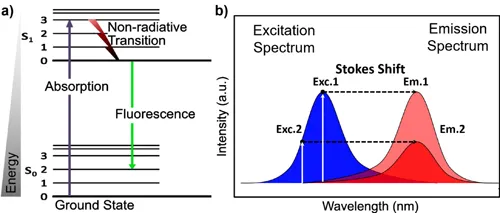
The underlying mechanism works as follows. An incoming (excitation) photon is absorbed by the molecule, residing in the ground state (S0). Thus, one of the electrons makes a transition to an excited state (S0–S1). The excited electron dwells in the excited state for an average time (fluorescence lifetime), during which it experiences a series of nonradiative transitions (e.g. internal conversion, intersystem crossing, etc.), before spontaneously returning to the S0 state (S1–S0) by radiative transition. The energy difference between the excited and ground state is radiated in the form of visible/near infrared (VIS/NIR) light (Figure 1.1).
FIGURE 1.1 (a) Joblonski diagram of quantum electronic behavior of electrons, indicating the various stages of the fluorescence cycle. (b) Illustration of excitation and emission spectra. Excitation at the peak of the absorption spectra (Exc.1) leads to optimal emission (Em.1), excitations away from the peak (Exc.2) result in correspondingly less emission intensity. Note that the spectra display a mirror-like symmetry.
Because some of the energy is effectively lost to vibrational relaxation of the molecule, the fluorescence emission results in less energetic, i.e. longer wavelength (red-shifted), photons. This energy difference is called Stokes shift (Figure 1.1b). Note that the excitation and emission spectra often display some symmetry. This “mirror spectrum” is due to the similarity of vibrational levels for the ground state (S0) and the excited state (S1) (Sauer, Hofkens, and Enderlein, 2011).
The excitation rate (kex), i.e. the rate at which electrons make a transition from the ground state to the excited state, is directly proportional to the excitation light intensity (Iex) and the molecular absorption cross section (σ), kex = Iexσ. To illustrate the fluorescence working principle quantitatively, let us assume a generic fluorophore with a molecular cross section (σ) of 3 × 10⁻¹⁶ cm2. If our molecule is illuminated by a 1mW light source (560 nm) with a beam radius of 0.5 µm, the power density will be ~1.3 × 10⁵ W/cm2, which corresponds to 3.1 × 10²³ photons/cm2sec (according to ). Therefore, the excitation rate of a single molecule within the focus will be kex = 9.58 × 10⁷ photons/sec. All the excited electrons will experience a de-excitation at a rate of kdex, which is the sum of radiative (kr) and nonradiative (knr) de-excitation processes, kdex = kr + knr. Next, we establish a relationship between the fraction of excited state electrons (x) and de-excited electrons (1–x), which is (e.g. x = 0.75) (Panula, 2003). Then, kdex becomes 3.2 × 10⁷ photons/sec. The aim is here to identify the radiative relaxation rate (kr), for which we need to know the so-called quantum yield (Φ). The quantum yield is the ratio of electrons that undergo radiative relaxation (kr) compared to all excited electrons undergoing both radiative and nonradiative de-excitation processes (kr+ knr),
For simplicity, let us assume a quantum yield (Φ) of 1/3, which results in a radiative relaxation rate kr of 1,07 × 10⁷ photons/sec, approximately.
The expected fluorescence intensity (If) of a single molecule at the detector further depends on the overall efficiency of the imaging system, η (a composite metric that includes light collection efficiency of optics and the quantum efficiency of the detector), or If = kdexΦη. A realistic value for η is ~10%, which leaves us with 1.07 × 10⁶ photon/sec of fluorescence from a molecule. Typical exposure times of detectors span from µsec for a confocal or multiphoton microscope to msec for camera-based microscopes such as a wide-field or light sheet; therefore, this fluorescence yield will result in between 1 photon (exposure time 1 µsec) to 103 photons (exposure time 1 ms). Eventually, the total number of photons will depend on the number of molecules that are simultaneously excited by the focused light. For our illustration purpose, let us assume a fluorophore concentration of 1 µM, which translates to ~2,520 molecules inside a spherical focal volume of 1 µm radius (M = N × n/V), where M is the molar concentration, N is the Avogadro’s Number (6.02 × 10²³), n is the amount of mol, and V is the volume (1L = 1015 µL). Thus, we end up with a range of 103–106 photons per detector pixel in our example calculation, which also resembles typical values for bright fluorescence sam...
Table of contents
Cover
Half-Title
Series
Title
Copyright
Contents
Preface
The Editors
List of Contributors
Section I Overview of Imaging Methods and Instrumentation
Section II Imaging Cellular Behavior
Section III Whole-Organ and Whole-Organism Imaging
Index
Frequently asked questions
Yes, you can cancel anytime from the Subscription tab in your account settings on the Perlego website. Your subscription will stay active until the end of your current billing period. Learn how to cancel your subscription
No, books cannot be downloaded as external files, such as PDFs, for use outside of Perlego. However, you can download books within the Perlego app for offline reading on mobile or tablet. Learn how to download books offline
Perlego offers two plans: Essential and Complete
Essential is ideal for learners and professionals who enjoy exploring a wide range of subjects. Access the Essential Library with 800,000+ trusted titles and best-sellers across business, personal growth, and the humanities. Includes unlimited reading time and Standard Read Aloud voice.
Complete: Perfect for advanced learners and researchers needing full, unrestricted access. Unlock 1.5M+ books across hundreds of subjects, including academic and specialized titles. The Complete Plan also includes advanced features like Premium Read Aloud and Research Assistant.
Both plans are available with monthly, semester, or annual billing cycles.
We are an online textbook subscription service, where you can get access to an entire online library for less than the price of a single book per month. With over 1.5 million books across 990+ topics, we’ve got you covered! Learn about our mission
Look out for the read-aloud symbol on your next book to see if you can listen to it. The read-aloud tool reads text aloud for you, highlighting the text as it is being read. You can pause it, speed it up and slow it down. Learn more about Read Aloud
Yes! You can use the Perlego app on both iOS and Android devices to read anytime, anywhere — even offline. Perfect for commutes or when you’re on the go. Please note we cannot support devices running on iOS 13 and Android 7 or earlier. Learn more about using the app
Yes, you can access Imaging from Cells to Animals In Vivo by Margarida Barroso, Xavier Intes, Margarida Barroso,Xavier Intes in PDF and/or ePUB format, as well as other popular books in Medicine & Cell Biology. We have over 1.5 million books available in our catalogue for you to explore.