![]()
1
What is user experience design?
In this chapter, we explore the idea that human experience of the modern world is almost entirely influenced by human design. We expand on that idea and apply it to the field of interactive design, explaining how designers have adopted roles, built teams and applied multiple methods to improve their work. Modern UX Design practice is compared with other approaches and in the second activity we demonstrate how the focus for design can be stronger by identifying specific users and their context.
Designing interactive experiences
Products of UX Design include websites, mobile apps, voice interfaces, vehicle systems, games, tools and a host of devices used in industry and by consumers in their daily lives.
UX Design is a realistic approach to the process of designing digital products that require some sort of human interaction. If it were a doctrine then it would teach the need for knowledge, understanding, respect, empathy, purpose and productivity.
For a designer, the abiding rule is to strive to make the quality of the users’ experience a top priority. The basic logic behind this approach can be simply explained by stating a truism; a successfully designed product is one that meets the requirements of its owner and provides a good experience for the intended users. Products that offer poor user experience will sooner or later be replaced by improved designs. Low-quality designs can have far reaching and potentially ruinous results for both the owner and the designer. With such high stakes it is not surprising that most companies now adopt a UX Design approach and many have established in-house teams to manage ongoing projects.
It is a big challenge to achieve a balance of what is good for the user and what can be accomplished within the constraints of time, budget and other resources. For this reason, successful UX Design teams need to be highly efficient. Most are multidisciplinary, including just the right number of people with a mix of expertise. Roles and responsibilities often overlap to add resilience to the team. A range of methods are applied to keep the process moving in the right direction. Each part of a product is tested with users to ensure that design objectives are being achieved and many final products undergo multiple revisions in their lifetime.
We think that there will always be more people needed to advocate UX Design. Perhaps you could become one of them?
‘It’s not enough that we build products that function, that are understandable and usable, we also need to build products that bring joy and excitement, pleasure and fun, and yes, beauty to people’s lives.’
Donald Norman
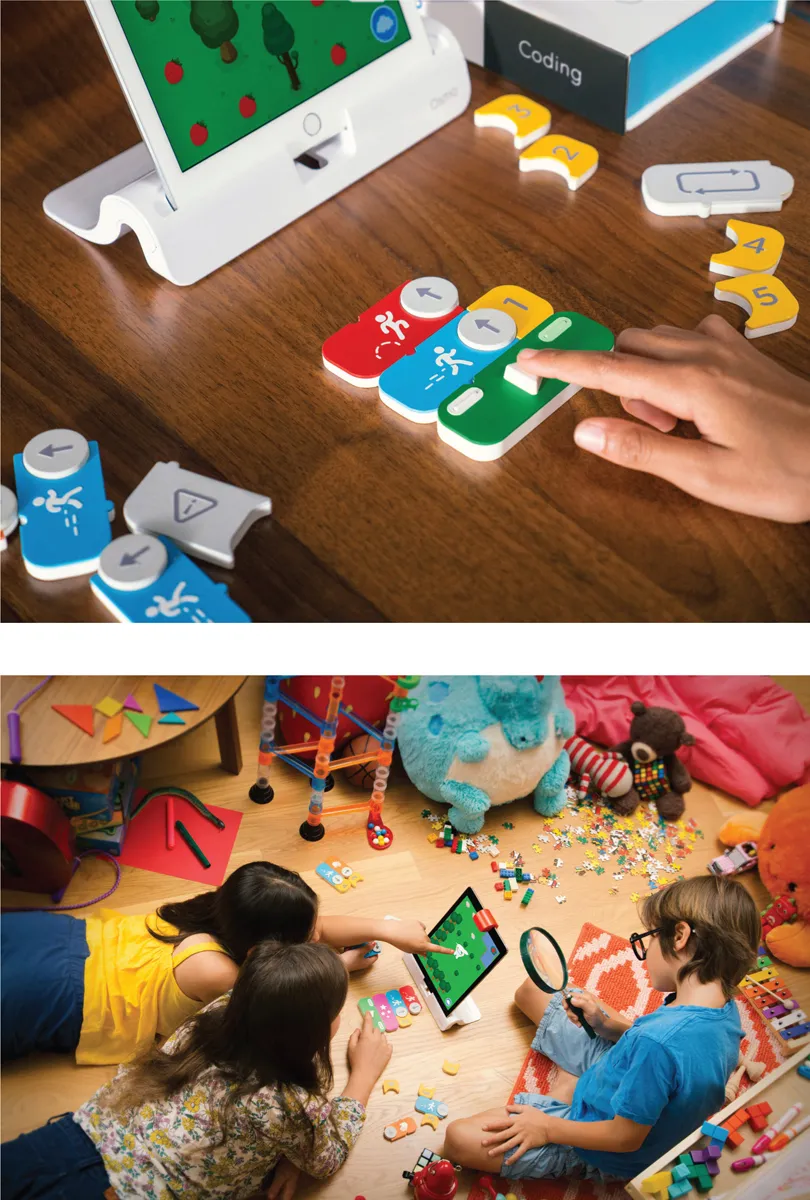
Figure 5
Osmo is a games system which incorporates interactive software and a reflector which allows it to ‘see’ what is in front of it. The player manipulates tangible tools, blocks, and tokens to extend the gameplay beyond the confines of the touchscreen device into the environment of the player. Rich experiences like this require the collaboration of skilled individuals and teams with a deep understanding of technology and of human behaviour.
Life’s experiences
If everything around you that is the product of a design process was taken away, what would remain? The climate defies our attempts to design its behaviour and so we create environments that protect us from it when needed. In almost every other respect, humans create the conditions that define our living experience.
Much of the quality of our life experience depends on the products of design that we encounter on our way. We have expectations, we make choices and, if we are lucky, we can choose how we want to live our lives. Our use of language, social trends and the development of culture evolve through human behaviour and social interaction. Designers need to consider the impact of their work on the people they are designing for and create work that shows an understanding of their needs.
As an individual designer, you will find yourself contributing to the universe of products of design. Your work may impact on small numbers of people, or on whole populations. You will want it to fit neatly into their lives and give them a good experience. If users can intuit meaning in your designs and achieve something without being made to think too hard then you have probably done a good job.
As part of a design team building an interface for an airline booking website you may be told that the main objective is to sell more tickets and increase your client’s sales income. It should be made clear that your client in this scenario is the airline and not its customers. This distinction is important because the needs of the client and the needs of the client’s customers are often quite different. A good UX team manages the tension between competing needs and works to achieve the best possible balance.
UX Designers ask fundamental questions about the context and motivation of potential customers. They need to know about the people who will use the website and what is required to provide them with a good user experience. Taking a wide view from the start they understand that air travel is part of a bigger scenario and is not usually the whole experience. They undertake research to see where their design fits into the user’s life, asking questions like ‘why are they travelling?’, ‘are they travelling alone?’, ‘what is their biggest fear?’
Undertaking user research reveals design challenges. In the case of airline seat booking, it may be discovered through research that more than 75% of travellers are a lot happier if they can see a seating plan of the aircraft and choose to book specific seats. To deliver such a requirement, a host of contributing design elements will need to work effectively for both the user and back-end data systems. At some point the requirement will need to be assessed to see if the potential user experience gains are achievable within the budget for the design. Only if the client can understand the potential benefits will the hard work of making the interface begin. This will include regular testing with users to make sure that the interface design actually provides the benefits expected.
Figure 6
This well-trodden coastal path fulfils the requirements of users to take a scenic route while avoiding obstacles and the cliff edge. In this case, the path does not precisely follow the cliff edge and so a balance has been achieved between the need to take in the sea view and the need to make reasonable progress. This is evidence of successful collaborative design providing a good experience without any apparent design process.
Activity #1
The big picture
This activity introduces the idea that your designs will form part of a much larger scenario for the people who use them. A world exists outside of any user interface that you construct. You need to research the user’s context and observe them in their world. Right now, you do not have the time or the budget to do this, so here is a workable alternative.
Using storytelling you’ll see how it is possible to gain initial insights and ideas that can help your design contribute to improving the user experience. This is a creative process fuelled by your imagination, your own experience, logic and common sense. It’s a quick and relatively cheap way to discover the user’s needs, prioritise design requirements and identify potential problems. Later on it will be necessary to validate any findings with real user research.
Start afresh. Keep away from the Internet, Google and existing airline interfaces. You’ll need a pen, paper and a lot of imagination.
Steps
1 – scenario
A classic rock band are reuniting for one last tour. Erik, Martha and Zak want desperately to see them perform. The band have just released a range of tour dates in different cities in the US and Canada, starting in three months. Erik and Martha live in London (England) and ...