Shortlisted for the Cundill History Prize
"Remarkable and pathbreaking…A radical rethink of colonial historiography and a compelling argument for the reassessment of the historical traditions of Hindustan."
—Mahmood Mamdani
"The brilliance of Asif's book rests in the way he makes readers think about the name 'Hindustan'…Asif's focus is Indian history but it is, at the same time, a lens to look at questions far bigger."
—Soni Wadhwa, Asian Review of Books
"Remarkable…Asif's analysis and conclusions are powerful and poignant."
—Rudrangshu Mukherjee, The Wire
"A tremendous contribution…This is not only a book that you must read, but also one that you must chew over and debate."
—Audrey Truschke, Current History
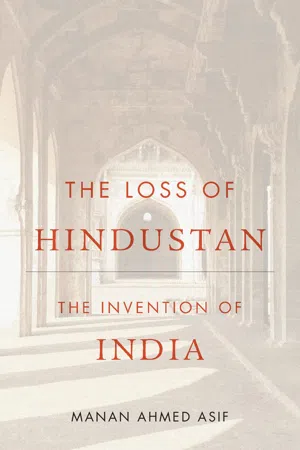
Did India, Pakistan, and Bangladesh have a shared regional identity prior to the arrival of Europeans in the late fifteenth century? Manan Ahmed Asif tackles this contentious question by inviting us to reconsider the work and legacy of the influential historian Muhammad Qasim Firishta, a contemporary of the Mughal emperors Akbar and Jahangir. Inspired by his reading of Firishta and other historians, Asif seeks to rescue our understanding of the region from colonial narratives that emphasize difference and division.
Asif argues that a European understanding of India as Hindu has replaced an earlier, native understanding of India as Hindustan, a home for all faiths. Turning to the subcontinent's medieval past, he uncovers a rich network of historians of Hindustan who imagined, studied, and shaped their kings, cities, and societies. The Loss of Hindustan reveals how multicultural Hindustan was deliberately eclipsed in favor of the religiously partitioned world of today. A magisterial work with far reaching implications, it offers a radical reinterpretation of how India came to its contemporary political identity.
- English
- ePUB (mobile friendly)
- Available on iOS & Android
eBook - ePub
About this book
Trusted by 375,005 students
Access to over 1.5 million titles for a fair monthly price.
Study more efficiently using our study tools.
Information
Publisher
Harvard University PressYear
2020Print ISBN
9780674292338
9780674987906
eBook ISBN
9780674249844
1
INTRODUCTION
The End of Hindustan
WHAT HAPPENED TO HINDUSTAN? The Portuguese, Dutch, British, and French who visited, settled in, and conquered the subcontinent since the sixteenth century used Estado da Índia, Nederlands Voor-Indië, British India, or Établissements français dans l’Inde to denote their colonial holdings.1 Often their maps depicting these settlements labeled parts of the subcontinent as “Mogor” or “Mogul India” to refer to the major native polity of the Mughals.2 In these renderings, it was explained that the Mughals, who claimed to be the kings of all the kings in southern peninsular Asia from the sixteenth century down to the nineteenth century, were called Shahanshah-i Hindustan (emperors of Hindustan). Hence, until the late eighteenth century, Hindoostan or Indostan was regularly embossed in cartouches on colonial maps. The European travelogues, histories, philological works, operas, and plays that wanted to signal their authenticity or knowledge of “Oriental languages” would also use this same word, with its varied spellings, as the “local” name of the subcontinent.3
Yet, in the early nineteenth century, the word Hindustan begins to fade from the colonial archive. The major histories of the subcontinent, written in the early parts of the nineteenth century, were now histories of “British India.” With the British East India Company (BEIC) ascendant, the Maratha or the Sikh polities did not invoke Hindustan in their political claims.4 There was a brief last resurgence of Hindustan in 1857. The rebels and revolutionaries who opposed BEIC rule rallied to the flag of the Mughal king, Bahadur Shah Zafar. He was, once again, hailed as the Shahanshah-i Hindustan—clearly there remained an idea of Hindustan. After violently crushing the revolution, Queen Victoria took British India under her direct rule and assumed the title of Empress of India, sending Bahadur Shah Zafar to die in exile in Burma. His contemporary the poet Mirza Ghalib recognized the momentous change in the fate of the subcontinent with this verse: “Hindustan sayah-i gul pa-e takht tha / jah-o-jalal-i ʿahd-e visal-e butan nah puchh” (Hindustan was the shadow of a rose at the foot of the throne / the grandeur, the splendor of that age of union with the gods, don’t ask!).5 And so, per Ghalib, Hindustan became the past.
Yet, Hindustan lingered even after the formal end of the Mughal polity and the entrenchment of colonial British India. The people of the subcontinent continued to be called, and called themselves, Hindustani. The early twentieth-century world encountered Hindustanis who were taken as indentured labor to the Caribbean and the Americas or who traveled on their own to Europe. North Americans experienced “Hindustanee” students, activists, and lawyers who came to California and Vancouver and rallied against imperial Britain.6 This glimmer of Hindustan as an idea of anti-colonial politics was also present in the subcontinent. It was the idea behind the Hindustan Socialist Republican Association, created by anti-colonial revolutionaries like Chandrashekhar Azad and Bhagat Singh in 1928. It emerged in a slogan asserting independence as Jai Hindustan ki (Victory to Hindustan)—the rallying cry for Subhas Chandra Bose’s Free Hind Army in 1942. Later, when the Republic of India issued its first postage stamp on August 15, 1947, the day of independence, it depicted the tricolor flag, with Emperor Ashoka’s dharma chakra, and Bose’s anti-colonial slogan, shortened to Jai Hind.
Many of these ideas of Hindustan are now lost in the mists of time. Over these many decades since the Partition, the conventional understanding has calcified that Hindustan is either a simple Hindi word for “India,” an articulation of Hindu chauvinism, or, more rarely, something associated with the bygone era of the Mughal polity—itself understood by the Hindu Indian as a demonstration of the imperial violence of foreigners.
The erasure of the precolonial idea of Hindustan has meant that it is taken as a truism that there was no coherent concept of peninsular India before British domination.7 What is nominally understood by this is that the British were the first to control or claim the entire territory of the southern peninsula. In this line of telling, the subcontinent before British colonization was an age of “regional kingdoms” with no coherent notion of territoriality nor the political control over the entire peninsula. The only noted exceptions are of Ashoka, from the third century BCE, whose realm included Kabul, or the Mughal king Aurangzeb, who extended Mughal rule in and beyond the Deccan in the late seventeenth century.
Such conventional wisdom, these historiographic truths, are mistaken. Certainly, the Mughals did not create the concept of Hindustan. There already existed an idea that Hindustan was a place of territorial integrity that encompassed the entire subcontinent, and that diverse communities of believers lived in this place.
Take as a small illustration this Persian inscription from 1325 found in a step well in Batiyagarh, Madhya Pradesh, in Central India.
In the reign of king Ghiyathuddin wa-Dunyathe foundation of this auspicious edifice was laidMay such a king live as long as this world lastsBecause in his reign, the rights of none are lostIn Hindustan all are grateful for his justiceIn Turkistan all are fearful of his supremacy.8
Here Hindustan is depicted as a political collective (all who recognize the king’s justice) and as unique (distinct from the land of the Turks), long before the Mughal imperium.9 Clearly, there is more to the story of Hindustan.10
This book is animated by a set of simple questions: What was the idea of Hindustan? When did it come about and what made it powerful enough to persist for nearly a thousand years? What role did it play in organizing ideas of place, of history, of community? These questions are straightforward, but they are frustratingly difficult to answer. To study the erasure of concepts or ideas is a difficult task, especially when it happens gradually and when the erased concepts are replaced by some hegemonic or majoritarian truth. What was the name of “America” before the settler colonials arrived? Can we even imagine how to answer that question? Even when we can understand that “America” or “Australia” is an erasure of precolonial naming and being and we can understand that the indigenous peoples of the “Americas” were not “Indians,” we let these labels persist.11 We are thus content with the convention that while Pakistan came into being in 1947, “India” was something that stretches back to an “ancient” period. That is to say, “Early Pakistan” or “Early Bangladesh” seem incongruous, but “Early India” a seemingly unproblematic periodization. This is puzzling, since there is critical engagement with “South Asia” as a twentieth-century geopolitical toponym.12 What remains remarkably absent from such debates is the idea of Hindustan.
How does one, then, write the history of something that is not even realizable as missing or cannot even be fully articulated?13 Colonization refuses the colonized access to their own past. By imposing a colonial language, it retards the capacity of indigenous languages to represent reality. It claims that the languages of the colonized lack “technical” or “scientific” vocabulary. It removes the archives, renders history as lack, blurs faces and names.14 Thus, the colonized face a diminished capacity to represent their past in categories other than those given to them in a European language, or provided to them in an imperial archive. This rupture, brought about by the colonial episteme, erases the fuller memory or awareness of the precolonial. Now, a “translated” term for an indigenous concept is deemed sufficient to stand in for it by an academy more inclined to maintain citational coherence than the truth of history. The discipline of history, itself a colonizing tool, is resistant to the demands of the colonized.
When there is no disciplinary recognition that something has been erased, the history of a concept must first deal with the act of political forgetting. Political forgetting superimposes the present over the past such that all the conveniences and prejudices of the present overshadow the complexities and lived-in realities of the past. Political forgetting is an ongoing process that happens in the shadow of the inventions of origins.15 Take, for instance, the efforts by the Republic of India to reclaim street or city names at first given by the British: Bombay to Mumbai in 1995, Calcutta to Kolkata in 2001. More recently, the reclamation has turned to the Mughal: the city founded as Allahabad (or Illahabad to its residents) by the emperor Jalaluddin Akbar in 1583, which is at the confluence of the Ganga and Yumna Rivers, was changed to Prayagraj by the elected government of the province in 2018. Now, Allahabad is a colonial word, and the Mughals a colonizing force.
Such political forgetting is not unique to India in the subcontinent. We can look to Pakistan, where few contemporary Pakistanis recall that there was once something called “East Pakistan.” The state of Pakistan has erased from its textbooks and its official narratives any indication of the existence of an eastern wing to its territory. Few Pakistanis connect the country of Bangladesh with a nation born out of Pakistani violence against the people of East Bengal in 1971. In order to imagine a Hindu-only Republic of India or non-Bengali Islamic Republic of Pakistan, the project of political forgetting targets minorities to deprive them of history, of the right to narrate, of the capacity for recognition in the collective. One is reminded of Walter Benjamin’s warning that “even the dead will not be safe from the enemy if he wins.”16
Political forgetting is an act of writing history. The political forgetting that this book explores concerns the idea of Hindustan. I am interested in Hindustan as an object of historical study, that is, Hindustan as the active or passive subject of history writing. There is the political forgetting that is understood via the study of how Europe worked to erase Hindustan in its own practices of history writing.17 Under the guise of a purported universalism—the field of world history—it stripped “Hindustan” from geography and supplanted it with another concept, “India.” The colonial episteme collected, archived, organized, and excerpted textual and material forms to create histories of India. By “colonial episteme” I mean a domain of knowledge constituted beginning in the sixteenth century by the Portuguese, French, Dutch, German, and British about the subcontinent. Europe’s making of “India” itself as a geography, and the ways in which historical change takes place in that geography, is the first and necessary act of political forgetting of Hindustan. In order to describe the idea of “Hindustan,” I simultaneously show the construction of the idea of “India.” Keeping the colonial episteme in view foregrounds the work of history writing and shared assumptions and ideas across genealogies of knowledge production.
Parallel to the colonial story is the history of the histories of Hindustan. The idea of Hindustan, as a political and spatial concept, was in the works of history written between the tenth and the nineteenth centuries. These are the Arabic, Persian, Sanskrit or Prakrit, and later Urdu sources in which the peninsular subcontinent is imagined, described, and peopled as Hindustan. This is the story of Hindustan that disappears under colonial works of history.
But I am getting ahead of myself. Let me pause and walk through these concerns and claims one at a time. Let me begin with a telling of the fractious ideas about Hindustan from the beginning of the twentieth century and how they shaped the political forgetting that is our contemporary moment. I then turn to the work of history in this loss of Hindustan as an idea. To do so I delve into the first and most consequential European “History of Hindustan,” by Alexander Dow in 1768, which defined early modern and colonial history writing on the subcontinent. In this discussion of the constitution of European history and the field of the philosophy of history, we see the instruments of the erasure of Hindustan. Next, I introduce ...
Table of contents
- Cover
- Title Page
- Copyright
- Dedication
- Contents
- Note on Transliteration and Translation
- 1. Introduction: The End of Hindustan
- 2. The Question of Hindustan
- 3. An Archive for Hindustan
- 4. The Places in Hindustan
- 5. The Peoples in Hindustan
- 6. A History for Hindustan
- 7. Afterword
- Notes
- Bibliography
- Acknowledgments
- Index
Frequently asked questions
Yes, you can cancel anytime from the Subscription tab in your account settings on the Perlego website. Your subscription will stay active until the end of your current billing period. Learn how to cancel your subscription
No, books cannot be downloaded as external files, such as PDFs, for use outside of Perlego. However, you can download books within the Perlego app for offline reading on mobile or tablet. Learn how to download books offline
We are an online textbook subscription service, where you can get access to an entire online library for less than the price of a single book per month. With over 1.5 million books across 990+ topics, we’ve got you covered! Learn about our mission
Look out for the read-aloud symbol on your next book to see if you can listen to it. The read-aloud tool reads text aloud for you, highlighting the text as it is being read. You can pause it, speed it up and slow it down. Learn more about Read Aloud
Yes! You can use the Perlego app on both iOS and Android devices to read anytime, anywhere — even offline. Perfect for commutes or when you’re on the go.
Please note we cannot support devices running on iOS 13 and Android 7 or earlier. Learn more about using the app
Please note we cannot support devices running on iOS 13 and Android 7 or earlier. Learn more about using the app
Yes, you can access The Loss of Hindustan by Manan Ahmed Asif in PDF and/or ePUB format, as well as other popular books in History & Indian & South Asian History. We have over 1.5 million books available in our catalogue for you to explore.