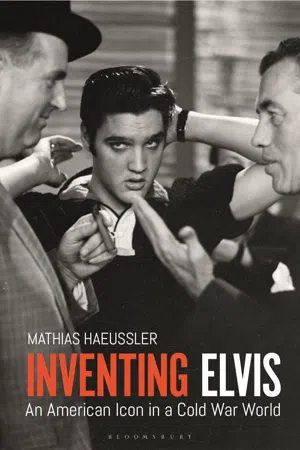
Elvis Presley stands tall as perhaps the supreme icon of 20th-century U.S. culture. But he was perceived to be deeply un-American in his early years as his controversial adaptation of rhythm and blues music and gyrating on-stage performances sent shockwaves through Eisenhower's conservative America and far beyond.
This book explores Elvis Presley's global transformation from a teenage rebel figure into one of the U.S.'s major pop-cultural embodiments from a historical perspective. It shows how Elvis's rise was part of an emerging transnational youth culture whose political impact was heavily conditioned by the Cold War. As well as this, the book analyses Elvis's stint as G.I. soldier in West Germany, where he acted as an informal ambassador for the so-called American way of life and was turned into a deeply patriotic figure almost overnight. Yet, it also suggests that Elvis's increasingly synonymous identity with U.S. culture ultimately proved to be a double-edged sword, as the excesses of his superstardom and personal decline seemingly vindicated long-held stereotypes about the allegedly materialistic nature of U.S. society.
Tracing Elvis's story from his unlikely rise in the 1950s right up to his tragic death in August 1977, this book offers a riveting account of changing U.S. identities during the Cold War, shedding fresh light on the powerful role of popular music and consumerism in shaping images of the United States during the cultural struggle between East and West.
- 240 pages
- English
- ePUB (mobile friendly)
- Available on iOS & Android
eBook - ePub
About this book
Trusted by 375,005 students
Access to over 1.5 million titles for a fair monthly price.
Study more efficiently using our study tools.
Information
1
Rebellious Elvis: An (un) American Dream
On April 22, 1954, millions of Americans gazed at their television sets as they watched the Army–McCarthy congressional hearings unfold. It turned out to be the sad climax of the Red Scare that had kept the United States holding its breath since the early 1950s. Driven by the deceiving and brutish demagogue Senator Joseph McCarthy, the previous few years had seen an all-out witch-hunt against the perpetrators of an allegedly widespread communist subversion of US society. In the 1950s, communism was perceived not only as an external, but also as an internal, threat, and McCarthy’s binary rhetoric was only one of many attempts to create a conformist, homogenous American identity against the wider Cold War background.1
The fact that millions of Americans were watching the McCarthy trials unfold on their own television sets—probably comfortably tucked away on a couch in some newly built, standardized suburban unit—was not coincidental: it was key to the prevalent Cold War mind-set at the time. As part of a wider civic ideology of consumerism and mass consumption, the act of purchasing goods and spending money not only served individual advancement; it was also seen as an almost patriotic act in demonstrating the alleged superiority of the American system of free enterprise and capitalism over the state-controlled Soviet economy.2 The domesticity and conformity associated with such lifestyles constituted another puzzle-piece in the construction of postwar American identities: the nuclear family, and its ingrained social containment, was seen as a crucial safeguard against a potential moral deprivation or communist subversion of American society.3
The popular image of the 1950s as a decade of conservatism and conformity, however, is only part of the story, as bigger societal transformations took place behind the façade of such constructed American identities. The alleged domesticity of the nuclear family, for example, stood increasingly at odds with the growing sexual liberalism of the decade, which found its most famous expression in the Kinsey report on “Sexual Behavior in the Human Female” in 1953 and the founding of Playboy magazine that same year.4 The alleged Cold War consensus also turned a blind eye to the major social inequalities still deeply ingrained in postwar American society, often reaffirming patriarchal hierarchies and the racial segregation of many African Americans. Here too, things were changing: in 1954, the Supreme Court’s Brown v. Board of Education ruling put an end to racial segregation in schools and colleges, and the Montgomery bus boycott marked a watershed in the burgeoning civil rights movement and the slow erosion of Jim Crow legislation in the South. The 1950s United States was not the monolithic entity as which it was often depicted; it was a deeply divided society with major tensions multiplying underneath the surface of Cold War conformity.
The rise of Elvis Presley illustrates the deeply ingrained conflicts and complex transformations of the mid-1950s United States like few others. As the most important icon of a burgeoning youth culture that challenged traditional norms and conventions, Elvis’s public image became intrinsically intertwined with much bigger debates over class, race, and sexuality in the mid-1950s United States, as well as over the role of censorship and the power of the marketplace at a new age of mass media. The public controversies surrounding Elvis’s rise thus offer a unique window into a rapidly changing postwar society, and show how bigger questions of American Cold War identities became negotiated through Elvis’s public image.
The Southern Origins of Elvis
Elvis Presley’s Southern background is crucial to understand not only the person, but also the wider forces that shaped his life, music, and reception.5 It is a story that is inextricably intertwined with the American South’s complex transformations during the second half of the twentieth century; a history that few places exemplify better than Tupelo, a small city with approximately 6,500 citizens in the North of Mississippi.6 One of the last key battlefields in the Civil War, it had based its reconstruction efforts largely on the cotton industry, and retained its cotton city character and the almost feudal community structures that came with it well into the 1930s. It also remained an almost completely segregated city: a major rail line separated the Western side of the city’s white landowners and businessmen from the city’s 40 percent African American population, who lived in the so-called “Shake Rag” neighborhood on the Eastern side of the rail tracks. Even further East, however, there was a small community of poor marginalized whites, who worked in unskilled manual labor jobs and often lived in abject poverty. This is where Elvis Aaron Presley was born on January 8, 1935.7 His father Vernon could not even pay the doctor for the baby’s delivery and had to receive money from welfare; Elvis’s stillborn twin brother Jesse Garon was unceremoniously buried in a shoe box.
Growing up in the poorest part of Tupelo “on the wrong side of the tracks,” Elvis’s earliest years were characterized by poverty and hardship.8 Elvis’s father Vernon had worked on-and-off as a milk delivery driver and in various other manual jobs; his mother Gladys took shifts at the ironing section of the Tupelo Garment Company six days a week, which required her to operate a heavy steam iron and stand up for twelve hours straight well into her pregnancy. They lived in a so-called “shotgun” house, a provisionally constructed two-room hut with old newspapers functioning as wallpaper and no electricity or running water.9 The young Elvis found escape from such hardship in the colorful and extravagant dream worlds of comic books, a popular commodity among youngsters at the time. At the age of eight, he signed up for membership at Tupelo’s Lee County Library and spent much of his free time borrowing and trading comics with friends. He was particularly drawn to Captain Marvel’s Adventures, the story of a rough-sleeping homeless newsboy in New York City who becomes transformed into a superhero: some commentators have noted the uncanny resemblance of some of Elvis’s 1970s jumpsuits with Captain Marvel’s red body suit and white cape outfit.10
Elvis’s earliest years in Tupelo were also shaped by the rich cultural heritage of Southern music that surrounded him, as well as by a certain transcendence of racial boundaries in every-day life. At the First Assembly of God Pentecostal church, which Elvis attended regularly with his parents, he was exposed to gospel-style communal singing, a music that became his earliest and perhaps biggest musical love.11 He also developed a taste for the country music of the white working-class community, following the local country performer Mississippi Slim around the neighborhoods at every opportunity. In 1945, Elvis even won the fifth prize at the local Mississippi-Alabama Fair and Dairy show for his performance of Mississippi Slim’s country standard “Old Shep.”12 Two years later, Elvis was thrown into an altogether different world when the Presley family moved to a “colored” neighborhood that only had a few houses designated for whites. Here, Elvis observed how black musicians jammed on the streets, jukeboxes blasted rhythm ‘n’ blues music, and black churches offered eclectic gospel performances filled with singing and dancing.13 Elvis displayed no hesitation getting in touch with his new environment, and eagerly sucked up all such influences. He had also started to take his newly bought guitar everywhere he went. As Mississippi Slim’s brother later recalled, Elvis always walked to school with the guitar over his shoulder, making some of the girls leave home early to avoid passing the “goofy” kid.14
In November 1948, the Presley family’s move to Memphis, Tennessee, exposed Elvis to yet another different environment. If Tupelo stood for the Old South, Memphis—situated on the Western border of Tennessee along the Mississippi river, with a population of around 400,000 citizens—in many ways signified the New South, a place where rural institutions and archaic social hierarchies clashed with rapid urbanization and industrialization.15 As the only major city within a 200-mile radius, Memphis was regarded as the unofficial capital of the Mid-South, and the bustling economic hub of the Mississippi Delta. Yet it had retained many of its old-fashioned, almost feudal, structures, and Southern elites still dominated the city’s political and social life almost completely. Still a highly segregated city, Memphis was also a major hub of postwar black culture, partly as a result of the massive migration of African Americans from rural areas to cities during and after the Second World War.16 The black community’s social life centered on Beale Street, an area of roughly four blocks with shops, nightclubs, and barbeque stands.17 It also featured a vibrant musical community, attracting rural performers from around the Mississippi Delta as well as established stars like Duke Ellington or Count Basie. A particularly popular new trend at the time was rhythm ‘n’ blues, an upbeat fusio...
Table of contents
- Cover
- Halftitle Page
- Title Page
- Contents
- List of Illustrations
- Acknowledgments
- Introduction
- 1 Rebellious Elvis: An (un) American Dream
- 2 Cold War Elvis: The 1950s Abroad
- 3 American Elvis: The Army Years
- 4 Shining Elvis: The Hollywood Movies
- 5 Iconic Elvis: The 1970s Comeback
- Epilogue
- Bibliography
- Index
- Imprint
Frequently asked questions
Yes, you can cancel anytime from the Subscription tab in your account settings on the Perlego website. Your subscription will stay active until the end of your current billing period. Learn how to cancel your subscription
No, books cannot be downloaded as external files, such as PDFs, for use outside of Perlego. However, you can download books within the Perlego app for offline reading on mobile or tablet. Learn how to download books offline
Perlego offers two plans: Essential and Complete
- Essential is ideal for learners and professionals who enjoy exploring a wide range of subjects. Access the Essential Library with 800,000+ trusted titles and best-sellers across business, personal growth, and the humanities. Includes unlimited reading time and Standard Read Aloud voice.
- Complete: Perfect for advanced learners and researchers needing full, unrestricted access. Unlock 1.5M+ books across hundreds of subjects, including academic and specialized titles. The Complete Plan also includes advanced features like Premium Read Aloud and Research Assistant.
We are an online textbook subscription service, where you can get access to an entire online library for less than the price of a single book per month. With over 1.5 million books across 990+ topics, we’ve got you covered! Learn about our mission
Look out for the read-aloud symbol on your next book to see if you can listen to it. The read-aloud tool reads text aloud for you, highlighting the text as it is being read. You can pause it, speed it up and slow it down. Learn more about Read Aloud
Yes! You can use the Perlego app on both iOS and Android devices to read anytime, anywhere — even offline. Perfect for commutes or when you’re on the go.
Please note we cannot support devices running on iOS 13 and Android 7 or earlier. Learn more about using the app
Please note we cannot support devices running on iOS 13 and Android 7 or earlier. Learn more about using the app
Yes, you can access Inventing Elvis by Mathias Haeussler in PDF and/or ePUB format, as well as other popular books in History & North American History. We have over 1.5 million books available in our catalogue for you to explore.