Depressed by Winterval? Put 'Christ' back into Christmas with a fresh understanding of the Christmas story, based on daily Advent readings and meditations.
If you are troubled by the noise, pressure and materialism of secular Advent with its emphasis on material and commercial rather than spiritual preparation for Christmas, this book will help you to read and think about Advent and Christmas in a new way.
Co-authored by a New Testament specialist and a practising clinical psychologist, it explores the familiar narratives from the Christmas story with freshness and vigour, and draws out their implications for day-to-day living.
The Christmas story is full of themes that we often avoid in churches - asylum seekers and refugees; death; loss and suffering; old age; childlessness - but they can give a new depth and meaning to our Christmas celebrations.
Christmas will not seem the same again.
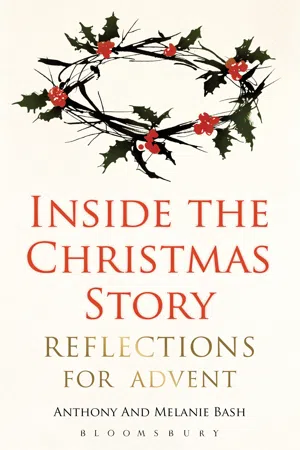
- 160 pages
- English
- ePUB (mobile friendly)
- Available on iOS & Android
eBook - ePub
About this book
Trusted by 375,005 students
Access to over 1 million titles for a fair monthly price.
Study more efficiently using our study tools.
Information
DECEMBER 1
Christmas . . . and Jesus
What then shall I do with Jesus?
MATTHEW 27.22
Sometimes on television, in the weeks before Christmas, children are interviewed and asked to say what Christmas means to them.
It is easy to smile at what they say.
Sometimes, they talk about the presents they receive, the food they eat and the television programmes they watch. The more reflective may also refer to eccentric relatives who visit, or aunts whose clothes smell strange, or grandparents who want to listen to the Queen’s speech.
Only rarely will they speak about Jesus.
It is not that they are embarrassed to speak about Jesus. It is that, so far as they know, Jesus is irrelevant for Christmas.
These children are no different from many adults who also think Christmas to be more-or-less religion-free, because for them, too, there is no obvious link between Jesus and Christmas.
In some contexts, it is now unacceptable even to refer to an overtly ‘Christian’ aspect to Christmas. This is because some insist, for the sake of inclusivity, that the celebration of Christmas in a public setting should be denuded of its Christian origin. So Christmas cards will say ‘Season’s Greetings’ (to avoid a reference to the Christian origin of the festival) and public decorations will be faith-neutral (to avoid supposed offence to those who are not Christians). Some groups even celebrate Christmas at the same time as and without distinguishing it from other winter events.1 For them, Christmas is just one of a variety of mid-winter diversions.
Christmas is becoming like any other secular celebration, such as Thanksgiving in the United States or Guy Fawkes Night in Britain, except that at Christmas, we spend more money and there is a longer build-up. Many think of Christmas to be no more than the name for a break from work in the middle of the winter, the season of mince pies, presents, turkeys, cards and decorated trees.
Of course, some elements of the Christian origins of Christmas remain, though detached from their context and significance. For example, everyone (well, almost everyone) loves a newborn baby. There is something very appealing (and safe) about remembering that Jesus came as a baby in a stable, with shepherds and three wise men, in mid-winter. Many schools put on nativity plays and shops still play carols as background music.
Even so, ask most people what Christmas is about, and I suspect they would say, ‘Presents, families, time off work and food’. Sadly, some may want to add, ‘Stress and debt’. Increasingly few would say that Christmas is to celebrate the birth of Jesus.
Confusion and ignorance about Jesus are not new.
For example, when Pontius Pilate was questioning Jesus shortly before he ordered Jesus’ execution, Pilate was troubled because he could not match what Jesus’ accusers were saying with what his own senses were telling him.
It was evident to Pilate that Jesus was not a political insurrectionist and he did not present a threat to Roman power. It was also clear to Pilate that the threat Jesus presented was to the interests of the Jewish leaders and to the religious status quo in which those leaders had such a large stake.
Pilate was weak. Under pressure from the Jews, Pilate agreed to release a notorious terrorist called Barabbas and to have Jesus executed. This was against Pilate’s own better judgement. It was despite his wife’s unease about what was happening to Jesus. It was also despite the fact that Barabbas represented far more of a political, military and social threat than Jesus did.
The question Pilate did not want to face with courage was this: Which Jesus was before him? Was it the Jesus his senses told him was present, someone inconvenient to the Romans (because he had upset the Jews), but not a threat? Or was it the Jesus the Jews insisted that he was, a threat to public order and safety, and a threat to Roman rule?
When the Jewish leaders asked Pilate to release Barabbas, Pilate said, ‘So then, what do you want me to do with Jesus?’2 The implication of his question is that, surely, the Jewish leaders did not wish Pilate to execute someone he believed to be an innocent man. The tragic reply was ‘Crucify him’.
We sometimes hear sermons about Jesus and Barabbas. The Romans executed Jesus and spared Barabbas. The point is often made that Jesus did not deserve to die (as he had committed no crime) but Barabbas did, because he had committed capital crimes. With this in mind, preachers sometimes make a link between Jesus taking the place of Barabbas and the atoning death of Jesus for us.
I do not want to focus on that link.
Rather, what I want to explore is another type of substitution. It is this: Which Jesus are we celebrating and remembering at Christmas? Is it the Jesus of popular imagination at Christmas or is it the Jesus of the Gospels in his historical and cultural setting? Is the Jesus we are celebrating the Jesus who has been more shaped by the secular world around us than disclosed in Holy Scripture?
We can smile at the Jesus in a Christmas story that is safe, sentimental and sugary. The media have reshaped this Jesus to be tame and domesticated so as not to ruffle us.
In contrast, the real Jesus of the Christmas story can speak to us, challenge us and even unsettle us. So too can God his father, who is so evidently behind the events of the story. More than that: the Christmas story itself, with its accounts of political intrigue, unexpected pregnancies, displaced people, heartache and a massacre of children, addresses issues of life that are timeless and deeply troubling. Where is God in these events, and how can we blend them into a faith that does not give up on a God of love and mercy?
As we engage with Christmas without the sentimental and commercial trappings of the season, we free ourselves to discover more about the person whose birth Christians celebrate. We are also likely to discover more of what it means to be a disciple. The Christmas story, properly understood, can draw us into deeper faith and worship. It can also sometimes leave us challenged, awed and even occasionally frightened.
I admit that I am deeply frustrated throughout the season of Advent (more popularly known as the ‘run-up’ to Christmas) because so much seems to get in the way of finding time to explore the Christmas story as it is meant to be read and understood. The noise, the excitement and the pressure to get everything ready on time bother me.
It does not have to be like this. We can choose to be different and to make time to re-engage with Advent and Christmas. We can resolve to ignore, as best we can, the mythical Jesus of popular culture who has been reconstructed to make us feel comfortable and at ease. Instead, we can make time and interior space to rediscover the Jesus of the New Testament, who disturbs, unsettles and brings change.
Which Jesus will be your focus?
I hope it will be the Jesus whom we discover in the New Testament. This Jesus has changed human history. This Jesus has pointed us to the way to God. This Jesus is the subject of this book.
Notes
1Birmingham City Council in England celebrates ‘Winterval’ (formed from the words ‘winter’ and ‘festival’). This new festival combines neo-pagan celebrations (such as the winter solstice), the Jewish festival of Hanukkah, the Muslim festivals of Ramadan (occasionally, according to when the festival falls) and Eid, the Hindu festival of Diwali and the secular New Year’s Day holiday.
2Matthew 27.22.
DECEMBER 2
Christmas . . . and the rest of life
For everything, there is a season. For every matter under
heaven, there is a right time.
heaven, there is a right time.
ECCLESIASTES 3.1
Life’s problems and issues do not go away at Christmas, and if we think they do, we are fooling ourselves.
The media, the shops and the advertisers would have us believe that we can have the ‘perfect’ Christmas.
They seem to suggest that if we buy the right decorations, put out the best tableware, give and receive the right presents, buy, cook and eat the right food, then the issues we face on a day-to-day basis will evaporate.
Just whom are they deceiving?
Will the right decorations, tableware, presents and food change a selfish spouse for the better? Will they make a chronic disease go away? Will they mend a broken relationship or bring back a loved one who has died?
Of course not, and we know that . . . and yet we hope this Christmas will be different.
I once heard an illustration that has stuck in my mind as being wise and true.
It concerns a couple – let us call them Jim and Fiona – who had an acrimonious divorce.
When Jim and Fiona split up, Jim moved out of the home that he and Fiona had lived in for many years. Just before he went, Jim put some frozen prawns inside the hollow of a large, brass curtain rail in the lounge.
As the weeks went by, Fiona could not understand where the smell in the lounge was coming from. The smell got worse and worse. It became so bad that she decided that she would have to sell the house and buy another.
You can probably guess what happened next.
When Fiona sold the house, she took the curtain rail with her. Soon, the smell in her new house was just as bad as the smell in the old house.
In our family, we have a saying that, like Fiona, ‘We take our prawns with us.’
By this, we mean that the issues we face on a day-to-day basis often do not go away just because it is, for example, someone’s birthday, or that we have gone out for a meal, or that we are on holiday. We are still the same people, with the same needs and weaknesses. A change of scene or a new activity or a visitor does not mean we are different people without the weaknesses, foibles and idiosyncrasies we had before. We still have our prawns because they are still with us.
‘Taking our prawns with us’ also means that at Christmas, many of the issues we face on a day-to-day basis remain.
We know this but sometimes we do not admit or face up to it.
We know that difficult relatives do not become easy for that one day of...
Table of contents
- Cover
- Half-Title
- Before we begin . . .
- December 1 Christmas . . . and Jesus
- December 2 Christmas . . . and the rest of life
- December 3 Christmas . . . and science
- December 4 Christmas . . . and the Gospels of Matthew and Luke
- December 5 Christmas . . . and a family tree
- December 6 Christmas . . . and Jesus’ parents
- December 7 Christmas . . . and prophecy
- December 8 Christmas . . . and Zechariah
- December 9 Christmas . . . and Elizabeth
- December 10 Christmas . . . and forgiveness
- December 11 Christmas . . . and a girl called Mary
- December 12 Christmas . . . and children
- December 13 Christmas . . . and hardship
- December 14 Christmas . . . and Augustus
- December 15 Christmas . . . and humility
- December 16 Christmas . . . and shepherds
- December 17 Christmas . . . and Anna
- December 18 Christmas . . . and Simeon
- December 19 Christmas . . . and the Magi
- December 20 Christmas . . . and presents
- December 21 Christmas . . . and refugees
- December 22 Christmas . . . and loss
- December 23 Christmas . . . and food
- December 24 Christmas . . . and Jesus the man
- December 25 Christmas
- December 26 ‘They think it’s all over . . .’
- Index
Frequently asked questions
Yes, you can cancel anytime from the Subscription tab in your account settings on the Perlego website. Your subscription will stay active until the end of your current billing period. Learn how to cancel your subscription
No, books cannot be downloaded as external files, such as PDFs, for use outside of Perlego. However, you can download books within the Perlego app for offline reading on mobile or tablet. Learn how to download books offline
Perlego offers two plans: Essential and Complete
- Essential is ideal for learners and professionals who enjoy exploring a wide range of subjects. Access the Essential Library with 800,000+ trusted titles and best-sellers across business, personal growth, and the humanities. Includes unlimited reading time and Standard Read Aloud voice.
- Complete: Perfect for advanced learners and researchers needing full, unrestricted access. Unlock 1.4M+ books across hundreds of subjects, including academic and specialized titles. The Complete Plan also includes advanced features like Premium Read Aloud and Research Assistant.
We are an online textbook subscription service, where you can get access to an entire online library for less than the price of a single book per month. With over 1 million books across 990+ topics, we’ve got you covered! Learn about our mission
Look out for the read-aloud symbol on your next book to see if you can listen to it. The read-aloud tool reads text aloud for you, highlighting the text as it is being read. You can pause it, speed it up and slow it down. Learn more about Read Aloud
Yes! You can use the Perlego app on both iOS and Android devices to read anytime, anywhere — even offline. Perfect for commutes or when you’re on the go.
Please note we cannot support devices running on iOS 13 and Android 7 or earlier. Learn more about using the app
Please note we cannot support devices running on iOS 13 and Android 7 or earlier. Learn more about using the app
Yes, you can access Inside the Christmas Story by Anthony Bash,Melanie Bash in PDF and/or ePUB format, as well as other popular books in Theology & Religion & Biblical Biography. We have over one million books available in our catalogue for you to explore.