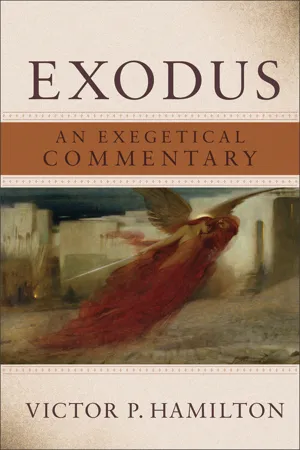
- 752 pages
- English
- ePUB (mobile friendly)
- Available on iOS & Android
eBook - ePub
About this book
Victor Hamilton, a highly regarded Old Testament scholar with over thirty years' experience in the classroom, offers a comprehensive exegesis of the book of Exodus. Written in a clear and accessible style, this major, up-to-date, evangelical, exegetical commentary opens up the riches of the book of Exodus. Hamilton relates Exodus to the rest of Scripture and includes his own translation of the text. This commentary will be valued by professors and students of the Old Testament as well as pastors.
Tools to learn more effectively

Saving Books

Keyword Search

Annotating Text

Listen to it instead
Information
PART 1
Oppression in Egypt
(1:1–6:1)
Little does Jacob realize when God speaks to him nocturnally, instructing him to go down to Egypt (Gen. 46:3–4), that the sojourn will last well beyond his lifetime, 430 years in fact (Exod. 12:40). While on that occasion he hears God’s promises to “make you into a great nation,” and “I will surely bring you back again,” more than likely he is uninformed of what God has earlier said to his grandfather. That is, for 400 of those 430 years Jacob’s descendants will be “enslaved and mistreated” (Gen. 15:13). For one reason or another, God does not bring that grim prospect up to Jacob. God’s emphasis is on the termination of the servitude rather than on the duration of the servitude.
Hence, there is a considerable chronological gap between the end of Genesis, concluding with the death of 147-year-old Jacob, the last 17 years of which he lives in Egypt (Gen. 47:28), and the death of 110-year-old Joseph (Gen. 50:26).
For the first portion of those 400 years, any mistreatment and oppression of the Hebrews in Egypt must be mild and sporadic. Presumably Exodus begins toward the end, or least the second half, of those four centuries. As far as biblical record goes, they are years that the text passes over in virtual silence. There is no record of God’s speaking even once during that interlude. The last time the text has recorded God as speaking to anybody is Gen. 46:2–4, and that is briefly in a nocturnal vision to Jacob. Before that, one has to go back to Gen. 35:1, 10. Fast-forwarding the tape, one finds that God is not heard from again until Exod. 3:4.
The Hebrews’ fortunes go downhill rapidly when an anonymous Pharaoh “who did not know about Joseph” comes to the Egyptian throne (Exod. 1:8). One suspects that if he knew about Joseph and his salvific leadership that also spared Egypt through difficult times, such knowledge would override and cancel out any suspicions he entertains about these “foreigners” who live on his turf and who, in his imagination, pose a colossal threat to the well-being of his empire.
The first two chapters of Exodus provide a summarization of these brutal times for the Hebrews. The Lord’s word to Abram in Gen. 15:13 is now coming to pass graphically and ominously. Still, no word from God, no word that would rend the heavens and stop this ruthless oppressor dead in his tracks. Thankfully the actions of some God-fearing women limit the death toll, but the torment continues.
That is, until God encounters a shepherd by a bush and calls him to be the instrument whom God will use to liberate his people from Egypt and lead them to a promised land. That shepherd is Moses. Chapters 3 and 4 of Exodus record his “call.” It is a “call account” that has more than its share of bumps and sharp curves. But God sticks with a trying-to-get-out-of-it Moses as much as he sticks with a trying-to-get-out-of-it Jonah. In neither case does the Almighty adopt a take-it-or-leave-it disposition.
Chapter 5 records Moses’s first attempt to persuade Pharaoh to release the Hebrews. Judged by the yardstick of “success in ministry,” Moses’s efforts are an unmitigated disaster. Both Pharaoh and his own flock of sheep reject Moses and his message. No wonder, then, that if in chap. 2 it is the Hebrews who are “crying out” (either just crying out, or crying out to God), at the end of chap. 5 it is Moses who is crying out to God. The one commissioned and sent by God to deliver the Hebrews from their lamenting can only articulate his own angry (and honest) lament.
Multiplying in Egypt
(1:1–7)
Translation
1And these [are] the names of the sons of a man named Israel who came to Egypt, each with his own househeld: 2Reuben, Simeon, Levi, Judah, 3Issachar, Zebulun and Benjamin, 4Dan and Naphtali, Gad and Asher. 5Those souls issuing from Jacob’s thigh numbered seventy. Joseph was already in Egypt. 6Joseph, along with all his brothers and that entire generation, died. 7Still, the Israelites were fertile and prolific; they multiplied and became extremely mighty, so that the land was filled with them.
Grammatical and Lexical Notes
1:1. The first word in Exodus is “and” (wĕʾēlleh, “And these [are] the names of . . .”), indicating that Exodus, rather than being a distinct book, is simply the continuation of the narrative that Genesis has begun. However, the LXX does not start with “and” and has its own name: “Exodus.” These facts indicate that for the Greek translator(s) Exodus was considered a distinct book that could stand by itself (Wevers 2004: 21).
1:6. Although the subject of the verb “died” is plural (“Joseph, his brothers, that entire generation”), the verb is singular. There are several examples in Exodus of a compound subject with a singular verb, the reason for which is to highlight the principal person in the narrative (Exod. 4:29; 7:6, 10; 12:30; 15:1; 16:6; 29:21b).
1:7. “Was filled with them” illustrates an accusative of relation after a verb in the Niphal (cf. 1 Kings 7:14, “Huram was full of wisdom”; 2 Kings 3:20, “and the land was full of water”; Ezek. 10:4, “and the court was full of the radiance of the LORD’s glory.”).
1:7. One way Hebrew expresses the superlative (here indicated by “extremely”) is by doubling the word: mĕʾōd mĕʾōd. Genesis examples include 7:19 (“rose greatly”); 17:2, 20 (“greatly increase”); 17:6 (“very fruitful”); 30:43 (“grew exceedingly prosperous”).
Commentary
[1:1] Exodus (in the Hebrew at least; see above note on 1:1) begins with the word “and” (“and these [are]”). This conjunction links the story of Exodus with Genesis, one taking up where the other leaves off. Leviticus (“and-called to Moses”) and Numbers (“and-spoke the Lord”) begin similarly. Genesis through Numbers is one story, a Tetrateuch.
Actually Exodus does not pick up exactly where Genesis leaves off. Exodus 1 goes back to the genealogy of Jacob’s family in Gen. 46:8–27 rather than the end of Genesis. The repetition of the introductory “these are the names of . . .” from Gen. 46:8 indicates the writer’s intention to link Gen. 46:8–27 with Exod. 1:1–5. In the latter passage he does so by resuming the subject of the former, thus arching over the intervening account, 46:28–50:26 (Talmon 1978: 14–15).
For a similar introductory phrase to name lists see Exod. 6:16 (“These are the names of the sons of Levi”); 2 Sam. 23:8 (“These are the names of David’s mighty men”); 1 Kings 4:7–8 (“Solomon also had twelve district governors. . . . These are their names”). An Aramaic text from the fifth century BC begins as follows: “Now these are the names of the women who were found at the gates in Thebes and were taken prisoners” (Cowley 1923: 127, text #34).
[1:2–4] Although these opening verses are taken from Gen. 46:8–27, the order in which the names are listed is different. Actually the best parallel to Exod. 1:2–4 is Gen. 35:23–26 (which also includes Joseph). Genesis 46:8–27 lists first the sons by Leah (vv. 8–15), then those by her maidservant, Zilpah (vv. 16–18), then the sons by Rachel (vv. 19–22), and finally the sons by Rachel’s maidservant, Bilhah (vv. 23–25).
Exodus 1:2–4, however, arranges the sons chiasmically according to matriarchal origin:
A the sons of Leah (Reuben, Simeon, Levi, Judah, Issachar, and Zebulun)
B Rachel’s second son (Benjamin)
B′ the sons of Rachel’s maidservant, Bilhah (Dan, Naphtali)
A′ the sons of Leah’s maidservant, Zilpah (Gad, Asher).
[1:5] The Hebrew word for “thigh” (yerek) may sometimes refer to the genitalia, male or female. For example, what part of the anatomy is involved in those passages in Genesis (24:2, 9; 47:29) in which somebody puts his hand under the “thigh” of another as he makes a promise to that person? Literally, the thigh, or possibly the genitals? Similarly, the reference to the “thigh” of the suspected adulteress wasting away or sagging (Num. 5:21, 22, 27) is probably a euphemism for her procreative organs.
Verse 5 and Deut. 10:22 tell us that Jacob has seventy descendants. “Seventy” is a frequent number in Scripture and elsewhere (Burrows 1936). There are seventy nations (Gen. 10); seventy elders of Israel (Exod. 24:1; Ezek. 8:11); seventy other elders (Num. 11:16); seventy submissive kings (Judg. 1:7); seventy struck by the Lord (1 Sam. 6:19); Gideon’s seventy sons (Judg. 8:30); seventy offspring riding seventy donkeys (Judg. 12:14); Ahab’s seventy sons (2 Kings 10:1). Luke 10:1 says that Jesus sent out seventy or seventy-two of his disciples (there is good ancient manuscript evidence for both numbers). In some instances it seems to be a precise number, and in others it symbolizes a large group of people.
In a Canaanite text from Ugarit that describes Baal as preparing a divine banquet (KTU 1.4 vi:46), this line appears: “Baal/Hadad invites the seventy sons of Athirat / he supplies the gods with rams (and) with wine.” Parker (1997: 134, 171n135) adds this observation, “The number of gods perhaps survive in the later Jewish notion of the seventy angels, one for each of the seventy nations ([Babylonian Talmud,] Shabbat 88b; Sukkah 55b).”
The LXX, along with a Dead Sea Scroll text of Exodus (4QExa), reads “seventy-five” instead of “seventy.” Stephen too uses this number (Acts 7:14), as do Josephus (Ant. 2.7.4 §176) and the book of Jubilees (44.33). The difference is because Gen. 46:20 LXX adds five names to the families of Manasseh and Ephraim (details in R. Klein 1974: 14–15).
[1:6] Unlike in Numbers, there is no indication that this first generation’s death is in any way linked to a judgment from God. The first generation of Israel in Egypt fares much better than the first generation of Israel who flees Egypt.
[1:7] In Genesis the problem is too much infertility. Here so much fertility will arouse the paranoid fears of Pharaoh. Apparently there are few, if any, Sarahs or Rebekahs or Rachels in Goshen.
There are numerous places, especially in Genesis, where the words “be fruitful/fertile” (pārâ) and “multiply” (rābâ) occur together. The two are used with animals (Gen. 1:22; 8:17), Adam (1:28), Noah (9:1, 7), Abraham (17:2, 6), Ishmael (17:20), Isaac (26:4, 24), and Jacob (28:3; 35:11; 48:4). Of these many parallels, the closest to Exod. 1:7 is Gen. 1:28, for they are the only two verses among the lot with a sequence of five nonidentical verbs (“be fruitful/increase/fill/subdue/rule” and “were fertile/prolific/multiplied/became mighty/filled with them”). “The climax of Genesis 1 is Exodus 1: the divine power to proliferate found its highest expression in the emergence of Israel” (Porten and Ruppaport 1971: 368).
The word I have rendered “prolific” is the verb šāraṣ, “to swarm, teem” (Gen. 1:20–21). The related noun, šereṣ, refers to the “swarming things” of...
Table of contents
- Cover
- Title Page
- Copyright Page
- Dedication
- Contents
- Preface
- Abbreviations
- Transliteration Patterns
- Commentaries on Exodus
- Introduction: The Narrative and Theology of Exodus
- Part 1: Oppression in Egypt (1:1–6:1)
- Part 2: Liberation from Egypt (6:2–15:21)
- Part 3: Testing Time in the Wilderness (15:22–18:27)
- Part 4: Covenant and Law at Sinai (19:1–24:18)
- Part 5: How to Build the Tabernacle (25:1–31:18)
- Part 6: The Golden Calf and Covenant Renewal (32:1–34:35)
- Part 7: Tabernacle Built, God’s Glory Fills (35:1–40:38)
- Works Cited
- Author Index
- Scripture and Ancient Sources Index
- Subject Index
- Back Cover
Frequently asked questions
Yes, you can cancel anytime from the Subscription tab in your account settings on the Perlego website. Your subscription will stay active until the end of your current billing period. Learn how to cancel your subscription
No, books cannot be downloaded as external files, such as PDFs, for use outside of Perlego. However, you can download books within the Perlego app for offline reading on mobile or tablet. Learn how to download books offline
Perlego offers two plans: Essential and Complete
- Essential is ideal for learners and professionals who enjoy exploring a wide range of subjects. Access the Essential Library with 800,000+ trusted titles and best-sellers across business, personal growth, and the humanities. Includes unlimited reading time and Standard Read Aloud voice.
- Complete: Perfect for advanced learners and researchers needing full, unrestricted access. Unlock 1.4M+ books across hundreds of subjects, including academic and specialized titles. The Complete Plan also includes advanced features like Premium Read Aloud and Research Assistant.
We are an online textbook subscription service, where you can get access to an entire online library for less than the price of a single book per month. With over 1 million books across 990+ topics, we’ve got you covered! Learn about our mission
Look out for the read-aloud symbol on your next book to see if you can listen to it. The read-aloud tool reads text aloud for you, highlighting the text as it is being read. You can pause it, speed it up and slow it down. Learn more about Read Aloud
Yes! You can use the Perlego app on both iOS and Android devices to read anytime, anywhere — even offline. Perfect for commutes or when you’re on the go.
Please note we cannot support devices running on iOS 13 and Android 7 or earlier. Learn more about using the app
Please note we cannot support devices running on iOS 13 and Android 7 or earlier. Learn more about using the app
Yes, you can access Exodus by Victor P. Hamilton in PDF and/or ePUB format, as well as other popular books in Theology & Religion & Biblical Commentary. We have over one million books available in our catalogue for you to explore.