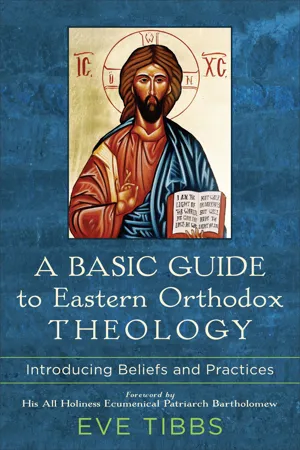
- 240 pages
- English
- ePUB (mobile friendly)
- Available on iOS & Android
eBook - ePub
About this book
Eve Tibbs offers a comprehensive yet accessible introduction to the beliefs and practices of the Eastern Orthodox Church for Western readers. Tibbs has devoted her career to translating the Orthodox faith to an evangelical audience and has over twenty years of experience teaching this material to students. Assuming no prior knowledge of Orthodox theology, this survey covers the basic ideas of Eastern Orthodox Christianity from its origins at Pentecost to the present day.
Tools to learn more effectively

Saving Books

Keyword Search

Annotating Text

Listen to it instead
Information
1
The Orthodox Christian Worldview
“Returning” to the Unknown Ancient Church?
In 1987, about two thousand North American Protestant Christians were received into the Orthodox Church en masse in Los Angeles, California. They were welcomed “home” by Metropolitan Philip Saliba to the Apostolic Church of Saints Peter and Paul. This was the culmination of many years of searching for the New Testament Church by regional leaders within the Campus Crusade for Christ organization. One of these campus ministry leaders, Peter Gillquist, reflected on the “big picture” questions that he and other campus leaders had been asking about the early Church during their quest: “Whatever happened to that Church we read about on the pages of the New Testament? Was it still around? If so, where? We wanted to be a part of it.”1
Along the way, and as a result of their research into ancient texts, they had realized (much to their surprise) that the early Church was both liturgical and hierarchical. They had even tried to reconstruct what they believed to be the theological expression and worship life of the earliest Christians, using some of the ancient texts. “Our motivation was to be . . . a twentieth century expression of the first century Church.”2 The amazing part of this story is that they were unaware that the New Testament Church they were trying to reconstruct still existed, and in very much the same form that it had in the earliest centuries.3 Readers of this book may also be unfamiliar with the Orthodox Church, or at least may not have heard much about its theology or practices.
Even at the World Council of Churches, where one might expect to have found a broader understanding of global Christianity, the Eastern Orthodox Church simply did not fit into the council’s decidedly Western categories. For example, Fr. Alexander Schmemann (1921–1983), former dean of St. Vladimir’s Orthodox Seminary in New York and one of the most respected Orthodox teachers of the twentieth century, was a delegate at the very first assembly of the World Council of Churches in Amsterdam in 1948. Fr. Schmemann described going through the typical registration process, during which he encountered an ecumenical dignitary who, in a very friendly fashion, informed him that the Orthodox delegates would be seated to the extreme right of the hall together with all the representatives of the “high churches,”4 such as Swedish Lutherans, Old Catholics, and Polish Nationals. Fr. Schmemann explained that while he certainly had nothing against those excellent people, he wondered how that decision had been made. The answer was that it simply reflected the “ecclesiological makeup” of the conference, categorized by the dichotomy of the “horizontal” and “vertical” ideas of the Church, and that Eastern Orthodoxy was certainly more “horizontal,” wasn’t it? Fr. Schmemann remarked that in all his studies he had never heard of such a distinction between horizontal and vertical, but—had the choice been up to him—he might have selected a seat at the extreme left, with those whose emphasis on the dynamic life of the Holy Spirit the Orthodox share.5 His experience underlined a fairly common misconception that because the Orthodox Church is liturgical, it must also be formal and static.
Protestant author James Payton, in Light from the Christian East, has stated the Orthodox way of doing theology quite nicely:
Within Orthodoxy, study leads to wonder and, thus, to meditation; those who engage in such mystical contemplation come to know the one of whom the Christian faith speaks, and yet—paradoxically—the one whom it cannot adequately express. The knowledge of God that issues from such encounter is rooted in the revelatory data, to be sure, but the fruit it bears certainly tastes different than what hangs on the vine of an academic study of doctrine.6
All theology in Orthodox Christianity derives from knowledge of God, which is the fruit of direct encounter with the Holy Spirit. This means that Eastern Orthodox theology does not fit well into the typical scholarly categories of the Christian West. And yet the fundamentally different worldview of Orthodox Christianity is appealing to some precisely because of this difference.
Influential Church historian Jaroslav Pelikan, an ordained Lutheran pastor and Sterling Professor of History at Yale, shocked the Protestant world when he was received into the Orthodox Church with his wife in 1998. He indicated to his family that he was not so much converting as returning to the Orthodox Christian Faith, “peeling back the layers of my own belief to reveal the Orthodoxy that was always there.”7 A prolific author of more than thirty books, Pelikan reportedly commented that while others read their way into a conversion, he wrote his way into the Orthodox Church.8
When Hank Hanegraaff, the popular evangelical radio and internet “Bible Answer Man,” was received into the Orthodox Church with his wife and two adult children on Palm Sunday in 2017, the internet exploded with questioning. Some Protestant bloggers were certain that Hanegraaff had left the Christian Faith for something akin to the Roman Catholic Church (the target of the Protestant Reformation) and warned Hanegraaff’s radio listeners that their salvation was now in jeopardy. This horror at a well-known Protestant joining the two-thousand-year-old “traditional” and “liturgical” Orthodox Church was clearly the outgrowth of a view of Christian history with roots in the sixteenth century, compounded by ignorance of the theological differences between the Orthodox Church and Roman Catholicism. It may be beneficial, therefore, to begin with a brief summary of the history of the Orthodox Christian Faith and the Church’s place in world Christianity.
The Orthodox Church in the Christian World
The Orthodox Church considers itself to be the Apostolic Christian Church because it has existed continuously since Pentecost with an unbroken visible and historical connection to the faith communities founded by the twelve Apostles and the Apostle Paul. It is also “Apostolic” because apostolicity, for the Orthodox, means preserving the fullness of the Apostolic Tradition. In other words, not only does the Orthodox Church have an uninterrupted connection to the Church of the Apostles in time, but it also has maintained the same faith and worship as the Apostles.
Until 1054, the Apostolic Church was undivided. There were five main centers, called “Sees,” in that one, undivided Church. Together, Jerusalem, Alexandria, Antioch, and Constantinople (Byzantium) in the Greek-speaking Eastern Roman Empire, and Rome in the Latin-speaking West, were referred to as the “Pentarchy” of the ancient Christian world. There was great diversity from place to place, and there was not always agreement on everything, but the Church remained unified nevertheless.
One little Latin word, Filioque (“and the Son”), was the spark that would later become a blaze. Some churches in the Roman provinces had added this word as a change to the Creed, which had been agreed upon by the undivided Church. The four Eastern Sees disagreed with the theology behind this move, but objected mainly because changes in dogma required agreement by the whole Church under the guidance of the Holy Spirit. (The Filioque controversy is discussed in greater detail in chap. 7.) Other disagreements arose concerning Rome’s introduction of a celibate priesthood and the type of bread to be used in the Eucharist. However, most scholars point to the Filioque controversy as the issue that led to the notion of papal supremacy and became “the straw that broke the camel’s back.”
On a particular Sunday in July 1054, during the Divine Liturgy, Cardinal Humbert of Rome placed a papal edict of excommunication on the altar of the Hagia Sophia cathedral in Constantinople. This action marked the formal divide between East and West, which has been named “the Great Schism.” After 1054, the bishop of Rome became the head, or pope, of the new Roman Catholic Church, while the bishops in the Eastern Sees of the Christian world continued in communion with one another as spiritual leaders of the faithful in the Orthodox churches. These four ancient Eastern Sees are still intact as centers of Orthodox Christianity today.
Major shifts in the Latin-speaking Christian West began to occur about five hundred years after the Great Schism. A Roman Catholic Augustinian monk named Martin Luther gained notoriety by posting ninety-five points for reform he believed were needed in the Roman Catholic Church. By that time in the sixteenth century, several practices and ideas had been added to Roman Catholicism that had no counterparts in the Eastern Christian world. One such novel teaching was that Roman Catholics should contribute their own merits to Christ’s merit (such as by attending Mass and buying “indulgences”)9 to lessen the time they might spend in purgatory after death.10 Luther passionately opposed the concept of indulgences, but nothing like the ideas of Christ’s merit, indulgences, or purgatory had taken root in the Orthodox Church.
Luther also complained about the Roman Catholic practice of not allowing regular laypeople to receive both forms of the Euchar...
Table of contents
- Cover
- Endorsements
- Half Title Page
- Title Page
- Copyright Page
- Dedication
- Contents
- Foreword
- Preface
- Acknowledgments
- Introduction
- 1. The Orthodox Christian Worldview
- 2. The Church
- 3. Communion and Revelation
- 4. Ministry and Leadership
- 5. Christology
- 6. Who Are We? What Are We to Do?
- 7. The Holy Trinity
- 8. Orthodox Worship
- Epilogue
- Appendix: Excerpts from Selected Apostolic and Patristic Writings
- Glossary of Orthodox Terms
- Index
- Back Cover
Frequently asked questions
Yes, you can cancel anytime from the Subscription tab in your account settings on the Perlego website. Your subscription will stay active until the end of your current billing period. Learn how to cancel your subscription
No, books cannot be downloaded as external files, such as PDFs, for use outside of Perlego. However, you can download books within the Perlego app for offline reading on mobile or tablet. Learn how to download books offline
Perlego offers two plans: Essential and Complete
- Essential is ideal for learners and professionals who enjoy exploring a wide range of subjects. Access the Essential Library with 800,000+ trusted titles and best-sellers across business, personal growth, and the humanities. Includes unlimited reading time and Standard Read Aloud voice.
- Complete: Perfect for advanced learners and researchers needing full, unrestricted access. Unlock 1.4M+ books across hundreds of subjects, including academic and specialized titles. The Complete Plan also includes advanced features like Premium Read Aloud and Research Assistant.
We are an online textbook subscription service, where you can get access to an entire online library for less than the price of a single book per month. With over 1 million books across 990+ topics, we’ve got you covered! Learn about our mission
Look out for the read-aloud symbol on your next book to see if you can listen to it. The read-aloud tool reads text aloud for you, highlighting the text as it is being read. You can pause it, speed it up and slow it down. Learn more about Read Aloud
Yes! You can use the Perlego app on both iOS and Android devices to read anytime, anywhere — even offline. Perfect for commutes or when you’re on the go.
Please note we cannot support devices running on iOS 13 and Android 7 or earlier. Learn more about using the app
Please note we cannot support devices running on iOS 13 and Android 7 or earlier. Learn more about using the app
Yes, you can access A Basic Guide to Eastern Orthodox Theology by Eve Tibbs in PDF and/or ePUB format, as well as other popular books in Teología y religión & Denominaciones cristianas. We have over one million books available in our catalogue for you to explore.