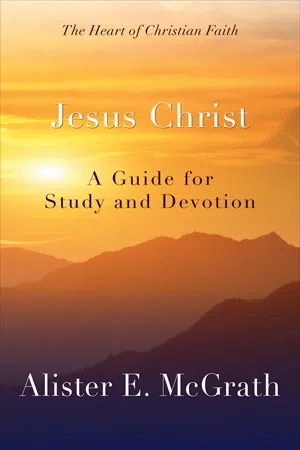
- 128 pages
- English
- ePUB (mobile friendly)
- Available on iOS & Android
eBook - ePub
About this book
In this book, the third in the Heart of Christian Faith series, Alister E. McGrath provides an exploration of how we can best understand Jesus Christ using analogies, illustrations, and stories. This short, accessible guide also provides a pastoral and spiritual consideration of the difference that our belief in God makes to the way in which we think about ourselves and our world. With future volumes to examine other core Christian principles, McGrath's new series will define "mere Christianity" to a new generation for many years to come.
Tools to learn more effectively

Saving Books

Keyword Search

Annotating Text

Listen to it instead
Information
1
Jesus of Nazareth: the turning point

We all need heroes – people we can look up to, who inspire us to become better human beings. When I was very young, well-meaning relatives gave me lots of books about the history of the ancient world. As I began reading, I became fascinated by some of the great stories of the classical period. I was enchanted by Homer’s Odyssey and its central character, Odysseus. But perhaps my greatest hero was Alexander the Great. I read the stories of his conquests with enormous enthusiasm: here was someone really interesting, who seemed to me to be a wonderful role model. It wasn’t until I grew older that I realized there was a darker side to Alexander too.
Back in my youth, I assumed that Christians were people who looked up to Jesus of Nazareth, much as I hero-worshipped Alexander the Great. I personally found it difficult to see why! He was someone who had some good things to say, certainly, but it seemed to me that Christians had inflated his importance. They had added on a host of strange ideas which made it difficult to perceive him as any kind of role model, because the essence of a role model, I believed, was that he should be like me – only better. My heroes were people who made me want to imitate them.
So why on earth did Christianity talk about things like Jesus being ‘truly divine’? That was making something very simple needlessly complicated. Christianity was surely about bringing our behaviour into line with the New Testament’s account of the life and teachings of Jesus, who was a good religious and moral teacher – and no more. Christmas was merely the time of year when Christians remembered his birth, and Good Friday the day on which they remembered his death. As for Easter, I found it a total mystery.
As I reacted against religion in my late teens, it was inevitable that I would also react against Jesus. But though my hostility towards people who professed faith led me to view Jesus with suspicion, I couldn’t help but be aware of his haunting, enigmatic quality. I had a nagging feeling that I was missing something, and couldn’t quite work out what it was. There were other things to worry about in any case, like getting ready to study the natural sciences at Oxford University. So I stopped thinking about Jesus. And there I expected the matter to rest.
But it didn’t. During my first term at Oxford, I gradually realized that atheism was drab and bleak, while Christianity was intellectually rich and vibrant. I still find it difficult to put into words what drew me to faith. Conversations with friends helped me grasp that I had misunderstood what Christianity was all about. I had the sense of standing on the shoreline of an immense ocean that stretched out as far as the eye could see, and like Evelyn Waugh before me (see the first book in this series, Faith and the Creeds, page 29), I began the delicious and delightful process of exploring my new-found faith. In time, I came to sense what was so special about Jesus of Nazareth, and in the following pages, I would like to set out some of the ideas and approaches I found helpful, in the hope that they will be useful to you too.
It was the 1950s, and I was staying with my grandparents in their house in the Irish countryside. It was very cold. The windows in my bedroom had frosted over and I could see nothing through them. There were very beautiful, delicate patterns on the ice that covered the glass – whorls, stars and spirals – but they prevented me from observing what was outside. So I took a piece of cloth and began to rub the surface of the window. In a few moments, I had cleared enough to reveal what lay beyond: sparkling white hedges and fields, stretching far into the distance.
Everyone reading this book will be able to think of a similar story. Maybe you were struggling to focus a telescope when a fuzzy blur suddenly became a crisp and sharp landscape, or you remember a moment when confusing matters or events began to fall into a coherent pattern. It’s as if someone turns a light on and you see how things hang together for the first time. There are lots of occasions when we simply can’t quite work out how everything fits together. We need someone to tell us. Or to show us.
That’s the human predicament. Living in a world of swirling mist, of shadows and half-light, we know deep down that there is a God and long to know what this God is really like. The Psalmist put it brilliantly, when he expressed his deep yearning to ‘see the goodness of the LORD in the land of the living’ (Psalm 27.13), and this same idea is expressed time after time in the Old Testament.
The people of Israel knew there was a God. They called this God by name – the ‘Lord God of Israel’. This was a faithful God, who could be trusted, whose glory was reflected in the beauty and majesty of the natural world. Yet this God often seemed distant from everyday existence, and perhaps this helps us understand why Israel longed for their God to come close – to visit them.
The last prophetic work of the Old Testament, the book of Malachi, expresses this longing of Israel in words that are both beautiful and heart-rending: ‘the Lord whom you seek will suddenly come to his temple’ (Malachi 3.1). But as the centuries pass, nothing seems to happen. The God who is the heart’s desire of Israel never comes. Perhaps God has forgotten Israel. Or perhaps there is no God to forget Israel in the first place.
Then everything changes. Something happens. And afterwards, for those who are aware of its significance, the world becomes very different. The New Testament and the creeds leave us in no doubt about what this event is – the life, death and resurrection of Jesus of Nazareth.
The story of Jesus of Nazareth
Stories engage our imagination, often opening up deeper and better ways of thinking for us to explore. The story of Jesus of Nazareth is perhaps the greatest and most engaging story ever told. The four Gospels set out to tell that story and by doing so give rise to ideas about Jesus – ideas that are affirmed and examined more thoroughly in early Christian preaching (in the Acts of the Apostles) and teaching (mainly in the New Testament letters).
The story of Jesus cannot be told in isolation but rather links up with other stories: one concerns God’s creation of the world; another tells of God’s calling of Israel; a third tells of the age-old human quest for meaning and significance. The story of Jesus intersects with all three. His is the story that allows us to see all other stories in their proper light. Greek philosophy and the law of Israel alike were fulfilled and transcended in this one individual, who declares, ‘Do not think that I have come to abolish the law or the prophets; I have come not to abolish but to fulfil’ (Matthew 5.17). Human wisdom and divine promise converge in Jesus of Nazareth.
The Gospel of Mark, which we will turn to frequently in this chapter, quickly draws our attention to the figure of John the Baptist, and makes a connection between the appearance of John and the great prophetic expectation of the coming of the Lord. ‘See, I am sending my messenger ahead of you, who will prepare your way; the voice of one crying out in the wilderness: “Prepare the way of the Lord”’ (Mark 1.2–3). John is a transitional figure between the Old Covenant and the New, pointing to someone even more significant who will come after him (Mark 1.7– 8). ‘In those days Jesus came from Nazareth in Galilee and was baptized by John in the Jordan’ (Mark 1.9).
Mark’s story of Jesus of Nazareth continues with his account of the calling of the first disciples.
As Jesus passed along the Sea of Galilee, he saw Simon and his brother Andrew casting a net into the lake – for they were fishermen. And Jesus said to them, ‘Follow me and I will make you fish for people.’ And immediately they left their nets and followed him.
(Mark 1.16 –18)
Those first disciples clearly found something compelling in Jesus – a sort of ‘X factor’ that could never be put into words. Perhaps they did not fully understand their own reasons for following him. But we are left in no doubt that they recognized that there was something very special about this stranger. So powerful was his attraction that they left behind their nets – their only source of income as fishermen.
The theme of deep personal trust in Jesus of Nazareth runs through the long history of Christian thought. People find in him something transformative and satisfying – a reason for living, their heart’s desire, a firm stronghold in times of despair, or someone who seems to know the secrets of the kingdom of God. Without fully understanding who Jesus is, or why he should be so compelling, they choose to follow him. Their hearts have been won. Their imaginations have been captivated. Their minds, however, must now try to take in what has happened. Who must Jesus be to elicit such a response on their part? What is so different about him? They are following Jesus; they have yet to figure out just who he is.
I found myself reading and rereading that passage, Mark 1.16 –18, in my first period of faith. After reading it, I felt I had glimpsed something only partially, yet with sufficient clarity to want to know more, and to trust that there was more to be known. I felt like someone on the brow of a hill, looking down over a shrouded landscape, patiently waiting for the mist to lift. And as I continued to read Mark’s Gospel, I began to appreciate that the disciples seem to have been in a similar position to my own. They didn’t really understand who Jesus of Nazareth was either. They recognized that there was something very special about him – the aforementioned ‘X factor’ – but realized there was yet much to discover. Gradually, they began to learn more about the identity and significance of Jesus, and as I journeyed with them, reading Mark’s Gospel, I shared in their discoveries.
It is almost as if Mark is gradually drawing aside a curtain, so his readers are allowed to see Jesus of Nazareth just a bit at a time. It would be impossible for someone to take in everything about Jesus at once, so once we’ve appreciated a particular aspect of his significance, Mark moves us on. Jesus’ character is revealed, layer by layer, each adding depth and detail to what we already know. And through living in Jesus’ company, we gradually grow in our understanding of what he is all about.
Looking back on my days as a student, I now realize that I had some of the best teachers I could have hoped for. I recall a lecturer at Oxford who introduced us to quantum theory – one of the most important (and difficult) aspects of modern physics. He began by asking us to think of atoms being like tiny suns with planets orbiting them. We all nodded in agreement. That seemed very straightforward. Atoms had nuclei (which were like the sun) and electrons (which were like the planets). The lecturer played around with the mathematics till he was sure we’d understood him. It all seemed so easy.
Then he smiled at us in a rather apologetic manner. ‘Actually, it’s a bit more complicated than that.’ And he began to explain how we needed to modify this very simple picture in order to fit in the experimental results. But he explained it so well that we were able to follow him. And once he was sure we had understood this more complex model, he smiled again. ‘Actually, it’s a bit more complicated than that as well . . .’
By the end of the course, we had been brought up to speed with the latest thinking in this hugely complex area of scientific thought. Something that seemed to be simple turned out to be much more complicated, exciting and satisfying. But by leading us into it gradually, step by step and layer by layer, our lecturer helped us to build up the rich picture of reality disclosed by quantum theory.
That’s exactly what theologians found to be true about the identity of Jesus of Nazareth. We begin by thinking of him in very simple terms – for example, as our Lord, our friend, or our redeemer. And once we’ve worked out what that means, we realize that it’s a bit more complicated than that. It’s all about stretching our minds and hearts, so that we can grasp Jesus of Nazareth in all his fullness, instead of being satisfied with slick and easy answers to deep and important questions.
Let’s try and tease out some of the themes that we find in Mark’s narrative. We’ll begin with one we’ve already begun to explore, which is evident in the calling of the first disciples, and echoed in many of the accounts of the encounters of Jesus with others. There was something special about him – something that fascinated people, compelling them to pay attention, drawing them in, and ultimately leading them to follow him.
For many of us, given our over-intellectualized Western culture, this seems to make little sense. Surely we ought to work out who Jesus really is before we throw caution to the winds? Surely rational reflection ought to come before personal commitment? Yet Mark’s account of the impact of Jesus on those around him offers another way of looking at things. There seems to be something about Jesus that invites a response at the deepest level of our being. We know the disciples realized they were in the presence of someone rather special and that their decision to follow him included a commitment to work out what it was that made him so. Their personal commitment to Jesus of Nazareth led to an extended ‘discipleship of the mind’, as their heads tried to catch up with their hearts.
It’s hard to find an analogy that does justice to this aspect of Jesus, as depicted in the Gospels, but a good attempt at expressing it may be seen in C. S. Lewis’s character Aslan, the great lion of Narnia. Lewis presents Aslan as a ‘Christ-figure’, a literary figure who in some way echoes and embodies the presence and person of Jesus of Nazareth. Throughout the Chronicles of Narnia, Lewis portrays Aslan as a magnificent and noble lion, who has a profound impact on those he meets, including the four Pevensie children, who have found their way into Narnia through the famous wardrobe in the old Professor’s house. Aslan evokes awe and wonder. He is wild – an awe-inspiring, magnificent creature, who has not been tamed through domestication, or had his claws pulled out to ensure he is powerless. When his name is mentioned for the first time, the four children feel ‘quite different’. Yet they have dissimilar reactions. Edmund feels ‘mysterious horror’; Peter feels ‘brave and adventurous’; Susan feels elated; and Lucy gets the feeling you have when you ‘realize it is the beginning of the holidays’.1
There is clearly something special about Aslan. Each of the children experiences him in his or her own distinct way. The one Aslan relates to each child in a special way – a way that reflects his identity and their own. Lewis’s narrative, widely regarded as one of the finest expressions of Christianity’s respect for the individuality of believers, constantly emphasizes that Aslan encounters and transforms people individually. They want to know more about him because they find him so enthralling and majestic. It is impossible to miss Lewis’s allusions to the Gospel narratives about the encounters between Jesus Christ and individuals – such as Zacchaeus or the woman at the well. Such individuals come away from those encounters as different people. Their world has been turned upside down by a stranger who seems to know everything about them. And having encountered him and been amazed by him, they try to work out who he really is.
We’ll revisit this theme of the deep attractiveness of Jesus later in this book. For the moment, let’s return to Mark’s account and consider another strand of his story – that of Jesus of Nazareth as teacher.
More than just a teacher
We are all familiar with the figure of a teacher – a person who says things we believe to be helpful, valuable and reliable. Mark tells us that many crowded around Jesus to hear his parables of the kingdom of God, while making clear that there was something unusual about the quality of Jesus’ words. ‘They were astounded at his teaching, for he taught them as one having authority’ (Mark 1.22).
This is probably the aspect of Jesus we find easiest to understand. Mark obviously wants us to reflect on Jesus’ qualities as a teacher. Why was he so authoritative? Was it that he taught very effectively? Or did people perceive an extraordinary depth in him, something that set Jesus apart from other religious teachers of his day?
It’s an important question, so let’s pause for a moment to think it through. There is no doubt that Jesus was a religious teacher. The problem is that some people limit his significance to this single category in an effort to solve the riddle of his identity. Well, Jesus being a teacher is part of the truth, but it’s not the whole truth. It’s a snapshot, but not the ‘big picture’. His role cannot be limited to giving us good advice, for that would make us people whose only need was to be told what to do. And just as there’s no point in advising a blind woman that she ought to learn to see, there’s little point in telling us the good deeds we ought to perform if there’s actually something wrong with human nature that prevents us fro...
Table of contents
- Cover Page
- Halftitle
- Series
- Title
- Copyright
- Contents
- Introduction
- 1 Jesus of Nazareth: The Turning Point
- 2 Jesus of Nazareth: Assembling the Big Picture
- 3 Incarnation: The Word Became Flesh
- 4 Atonement: Putting Things Right
- 5 Jesus of Nazareth and the Life of Faith
- Notes
Frequently asked questions
Yes, you can cancel anytime from the Subscription tab in your account settings on the Perlego website. Your subscription will stay active until the end of your current billing period. Learn how to cancel your subscription
No, books cannot be downloaded as external files, such as PDFs, for use outside of Perlego. However, you can download books within the Perlego app for offline reading on mobile or tablet. Learn how to download books offline
Perlego offers two plans: Essential and Complete
- Essential is ideal for learners and professionals who enjoy exploring a wide range of subjects. Access the Essential Library with 800,000+ trusted titles and best-sellers across business, personal growth, and the humanities. Includes unlimited reading time and Standard Read Aloud voice.
- Complete: Perfect for advanced learners and researchers needing full, unrestricted access. Unlock 1.4M+ books across hundreds of subjects, including academic and specialized titles. The Complete Plan also includes advanced features like Premium Read Aloud and Research Assistant.
We are an online textbook subscription service, where you can get access to an entire online library for less than the price of a single book per month. With over 1 million books across 990+ topics, we’ve got you covered! Learn about our mission
Look out for the read-aloud symbol on your next book to see if you can listen to it. The read-aloud tool reads text aloud for you, highlighting the text as it is being read. You can pause it, speed it up and slow it down. Learn more about Read Aloud
Yes! You can use the Perlego app on both iOS and Android devices to read anytime, anywhere — even offline. Perfect for commutes or when you’re on the go.
Please note we cannot support devices running on iOS 13 and Android 7 or earlier. Learn more about using the app
Please note we cannot support devices running on iOS 13 and Android 7 or earlier. Learn more about using the app
Yes, you can access Jesus Christ by Alister E. McGrath in PDF and/or ePUB format, as well as other popular books in Theology & Religion & Systematic Theology & Ethics. We have over one million books available in our catalogue for you to explore.