eBook - ePub
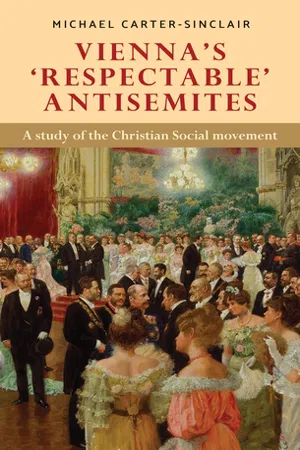
Vienna’s ‘respectable’ antisemites
A study of the Christian Social movement
- 259 pages
- English
- ePUB (mobile friendly)
- Available on iOS & Android
eBook - ePub
About this book
Vienna's 'respectable' antisemites offers a radical challenge to conventional accounts of one of the darkest periods in the city's history: the rise of organised, politically directed antisemitism between the late-nineteenth and mid-twentieth centuries. Drawing on original research into the Christian Social movement, the book analyses how issues such as nationalism, mass poverty and social unrest enabled the gestation in 'respectable' society of antisemitism, an ideology that seemed to be dying in the 1860s, but which was given new strength from the 1880s. It delivers a riposte to portrayals of the lower clergy as a marginalised group that was driven to defend itself from liberal attacks by turning to anti-liberal, antisemitic action, as well as exposing the nurturing role played by senior clergy. As the book reveals, the Church in Vienna as a whole was determined to counter liberalism, to the point of welcoming any authoritarian regime that would do so.
Trusted by 375,005 students
Access to over 1.5 million titles for a fair monthly price.
Study more efficiently using our study tools.
Information
1
Before the rise of the antisemites
Revolution and Habsburg survival
The antisemites of Vienna attempted to identify the pre-liberal era as a golden age of unchanging, eternal certainties. In reality, the liberal era was one of change, but changes that affected the Habsburg Empire in the 1860s had deep roots, the products of circumstances that had long been developing in much of Europe. Capitalist economies, for instance, had been maturing for decades on the west of the continent. They enabled industrial and commercial projects on a scale that had never before been seen. Investment brought new technologies, such as railways.1 Populations grew rapidly, concentrated in towns and cities. These developments, to varying degrees, impacted on the Empire by the middle of the nineteenth century. The Habsburgs were neither able nor wanted to resist some changes, since they brought economic progress. However, changes were also accompanied by revolutions in ideas, not least as to how the state should be organised and where the legitimacy of the state resided.
The political ideals of the liberal era, based on Enlightenment rationalism, encompassed the notion that the people should be organised along national lines and that sovereignty should rest with the nation, not a monarch. These ideas had erupted with the French revolution, and the revolutionary and Napoleonic wars spread these ideas widely across the continent. Ideas brought change, and war swept away a number of European dynasties, redrawing political boundaries. What was commonly known as ‘Germany’ was particularly affected. ‘Germany’ then was not a single entity; rather, it was a number of states of varying size, loosely bound in the thousand-year-old Holy Roman Empire, and many of the smaller states looked to the Habsburgs, as Holy Roman Emperors, for protection. Napoleon, however, abolished the Empire in 1806, and it was never resurrected.
As a result, in 1815 a new body, the German Confederation, chaired jointly by Austria and Prussia, brought together all the German states, including Austria – again loosely, and initially for matters of shared commercial interests. From 1815 to the 1840s, a period known as ‘the restoration’ was broadly one of political repression, yet revolutionaries continued to pursue their causes across Europe with varying degrees of success, and they could not be suppressed. Would-be revolutionaries worked for liberal and nationalist goals while, in response, police and their agents suppressed anti-establishment activities.
Then, in 1848, political discontent and economic hardship brought a new wave of revolutions across parts of Europe.2 Some governments faced revolutionaries who attempted to replace absolutist monarchical systems with liberal institutions. Others faced nationalist insurgencies, such as that of Poles against Prussian rule. The Habsburgs confronted both, as liberals rose in Vienna and other German-speaking centres, while Hungarians and Italians demanded the creation of independent nation-states. Within and beyond the Austrian Empire, some German speakers fought at barricades for the cause of German unification as a single German state. Most revolutionaries intended the German Confederation to form the basis of a unified Germany, but it was unclear whether the ‘German lands’ of the Habsburgs should be included. In the autumn of 1848, the matter seemed to be resolved when revolutionaries offered Friedrich Wilhelm IV of Prussia the crown of a united Germany that would have excluded the Habsburg areas, but he refused it, dismissing with some contempt those who offered it. This, however, set a precedent that Germany need not include Austria.3
Eventually, revolution was suppressed within the Habsburg state, but the dynasty had to sacrifice the legitimate Emperor, Ferdinand II, whose mental capacities were insufficient for the role. So, Ferdinand was peacefully deposed and replaced by his eighteen-year-old nephew, Franz Josef, symbol of a new vigour in the reigning house. Franz Josef and his advisors set about consolidating their power by means of an authoritarian policy known as neo-absolutism, through which they attempted to centralise political control. Local parliaments, known as diets, were suspended, and city councils either had powers revoked or were now run by Habsburg placemen.4
Directives from the centre aimed to strengthen the state, as Franz Josef and his circle worked to rebuild the prestige and legitimacy of the monarchy. This is not to say that the dynasty had only enemies at home, but they could not eliminate those who agitated for change, and the dynasty relied heavily on repression for control. This could be counter-productive, sometimes rallying the opposition, particularly in Hungary, which, in the 1850s, underwent a cultural revival that defied power.5
One prominent institution, the Catholic Church, stood by the Habsburgs throughout the revolutionary period and endorsed the dynasty as it pursued an authoritarianism that suppressed political freedoms. In 1855, a concordat – an agreement between the Vatican and the state – rewarded the Church.6 This enshrined marriage in Austria as a religious, rather than a civil, institution. The Church was granted permission to intervene in family life and in matters of morality. It received a significant role in education, overseeing and taking part in teaching at state elementary schools. In return, the Church was to act as the eyes and ears of the state and to form an extended administration, assisting with such matters as the census or the reporting of individuals suspected of disloyalty towards the dynasty.
Neo-absolutism attempted to achieve economic modernisation but without releasing liberal political ideas. Through the introduction of reforms that loosened the grip of some traditional guilds on trade and industry, parts of the economy were liberalised with the intention of building tax revenues, then making military and diplomatic advances. Capital markets were opened, allowing manufacturers to found factories. City planning initiatives began the process of making Vienna a modern city, fit to govern an empire, with roads widened, military fortifications demolished and public works programmes begun.7
Progress was made, but the narrow circle that surrounded the Habsburgs was unable to achieve what was needed. So, reconciliation was extended to a number of those with ability who had been classed as revolutionaries in 1848 when, in reality, they had wanted reform of the monarchy, not its overthrow. Now, in the late 1850s, the Habsburgs reached out, and former ‘revolutionaries’ were called on to perform roles in revitalising the state.8
This was still not enough, however, to counter potential threats from abroad, and disaster came as France and the Kingdom of Sardinia drew the dynasty into war in 1859. Austria was defeated and forced to concede parts of its territory on the Italian peninsula. These territories, in addition to a number of states that had been independent, went to a new Kingdom of Italy, ruled by the Sardinian dynasty. Defeat forced the Habsburgs to reach out further than they already had in the late 1850s. Political reins were loosened, slightly; a constitution was promised; and the dynasty called into government liberals, men who, they hoped, would bring positive reform. This had been no golden era for Austria, whatever antisemites later claimed, but change now came about, not through revolution but by invitation, and the liberal era in Austria was born.
The early 1860s: continuities and change
The first political tasks of the new era concerned external relations, and peace was achieved with France and Italy, bringing some diplomatic and military respite. The Emperor managed this process, since he retained control over foreign and military policy, but internal affairs passed to the liberals. Constitutions and other legal measures were introduced that reflected liberal views of how the world should be ordered. They proposed equality for all before the law, regardless of rank or social status. They implemented systems of voting that could be subjected to scrutiny. Liberals talked of the collective and equal rights of nations within the Empire, and the state was set on a secularising path, with no religious group given preference over another.
However, these were not signs of a modern democratic state. For instance, few could vote. Men [sic] earned this ‘privilege’ by demonstrating that they deserved responsibility, usually through wealth, occupational status or educational achievements. These were considered rational steps, but Austrian liberals now merged rationalism with tradition. There was no need to sweep away the entirety of the old order; their constitutional state had room for monarchy and aristocracy. Liberal reforms were also not intended to destroy all pre-existing economic relationships, although some practices that were considered to be outdated were abolished. For liberals, the world of work was one where the free market ruled, individual and collective achievement within this context was the ideal and state intervention in markets was only a final resort when markets had failed. While charity was seen as a virtue, people should learn self-reliance, to benefit society.
One important qualifier needs to be added about the liberal administrations that governed from Vienna. They were not just liberal but German liberal, and, while they believed that the Empire had room for its multiple nationalities, German language and culture occupied, for them, the high ground. German liberals believed they had a unique bond with the Empire as the people of the state, the Staatsvolk, on whom the Empire could rely for loyalty. These ideas placed limits on the equality of peoples that the constitutions promised, and the gap between the words of the constitutions and their implementation could be wide.
The use of German as the language of large parts of state business often gave German speakers advantages in terms of state employment. Electoral systems were also structured to ensure that, in parts of the Empire, Germans were over-represented compared with the electorates of other nations. These and other matters stimulated the development of nationalist activism, particularly among Czec...
Table of contents
- Cover
- Half-Title
- Title
- Copyright
- Contents
- Acknowledgements
- Some general notes
- Archival sources and abbreviations
- Introduction
- 1 Before the rise of the antisemites
- 2 Antisemites begin to organise, 1873–89
- 3 To the brink of power, 1889–95
- 4 A Christian, socially engaged movement? 1896–1914
- 5 A German movement? 1896–1914
- 6 War and the end of empire, 1914–18
- 7 An unloved republic? 1919–26
- 8 The right asserts itself, 1927–33
- 9 Building a Christian and German Austria? 1934–8
- 10 An end to Austria?
- 11 Principal conclusions and further questions
- Appendix: Elections in Vienna, 1932
- Bibliography
- Index
Frequently asked questions
Yes, you can cancel anytime from the Subscription tab in your account settings on the Perlego website. Your subscription will stay active until the end of your current billing period. Learn how to cancel your subscription
No, books cannot be downloaded as external files, such as PDFs, for use outside of Perlego. However, you can download books within the Perlego app for offline reading on mobile or tablet. Learn how to download books offline
Perlego offers two plans: Essential and Complete
- Essential is ideal for learners and professionals who enjoy exploring a wide range of subjects. Access the Essential Library with 800,000+ trusted titles and best-sellers across business, personal growth, and the humanities. Includes unlimited reading time and Standard Read Aloud voice.
- Complete: Perfect for advanced learners and researchers needing full, unrestricted access. Unlock 1.5M+ books across hundreds of subjects, including academic and specialized titles. The Complete Plan also includes advanced features like Premium Read Aloud and Research Assistant.
We are an online textbook subscription service, where you can get access to an entire online library for less than the price of a single book per month. With over 1.5 million books across 990+ topics, we’ve got you covered! Learn about our mission
Look out for the read-aloud symbol on your next book to see if you can listen to it. The read-aloud tool reads text aloud for you, highlighting the text as it is being read. You can pause it, speed it up and slow it down. Learn more about Read Aloud
Yes! You can use the Perlego app on both iOS and Android devices to read anytime, anywhere — even offline. Perfect for commutes or when you’re on the go.
Please note we cannot support devices running on iOS 13 and Android 7 or earlier. Learn more about using the app
Please note we cannot support devices running on iOS 13 and Android 7 or earlier. Learn more about using the app
Yes, you can access Vienna’s ‘respectable’ antisemites by Michael Carter-Sinclair in PDF and/or ePUB format, as well as other popular books in History & 19th Century History. We have over 1.5 million books available in our catalogue for you to explore.