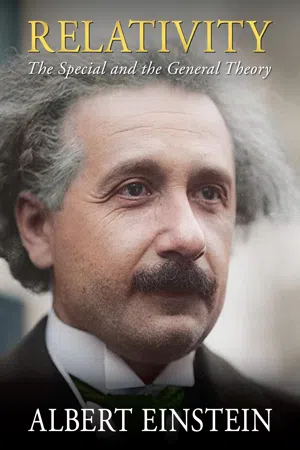
- English
- ePUB (mobile friendly)
- Available on iOS & Android
eBook - ePub
Trusted by 375,005 students
Access to over 1.5 million titles for a fair monthly price.
Study more efficiently using our study tools.
Information
Part 1
The Special Theory of Relativity
1. Physical Meaning of Geometrical Propositions

In your schooldays most of you who read this book made acquaintance with the noble building of Euclid’s geometry and you remember — perhaps with more respect than love — the magnificent structure, on the lofty staircase of which you were chased about for uncounted hours by conscientious teachers. By reason of your past experience, you would certainly regard everyone with disdain who should pronounce even the most out-of-the-way proposition of this science to be untrue. But perhaps this feeling of proud certainty would leave you immediately if someone were to ask you: “What, then, do you mean by the assertion that these propositions are true?” Let us proceed to give this question a little consideration.
Geometry sets out from certain conceptions such as ‘plane’, ‘point’, and ‘straight line’, with which we are able to associate more or less definite ideas, and from certain simple propositions (axioms) which, in virtue of these ideas, we are inclined to accept as ‘true’. Then, on the basis of a logical process, the justification of which we feel ourselves compelled to admit, all remaining propositions are shown to follow from those axioms, i.e. they are proven. A proposition is then correct (‘true’) when it has been derived in the recognised manner from the axioms. The question of ‘truth’ of the individual geometrical propositions is thus reduced to one of the ‘truth’ of the axioms. Now it has long been known that the last question is not only unanswerable by the methods of geometry, but that it is in itself entirely without meaning. We cannot ask whether it is true that only one straight line goes through two points. We can only say that Euclidean geometry deals with things called ‘straight lines’, to each of which is ascribed the property of being uniquely determined by two points situated on it. The concept ‘true’ does not tally with the assertions of pure geometry, because by the word ‘true’ we are eventually in the habit of designating always the correspondence with a ‘real’ object; geometry, however, is not concerned with the relation of the ideas involved in it to objects of experience, but only with the logical connection of these ideas among themselves.
It is not difficult to understand why, in spite of this, we feel constrained to call the propositions of geometry ‘true’. Geometrical ideas correspond to more or less exact objects in nature, and these last are undoubtedly the exclusive cause of the genesis of those ideas. Geometry ought to refrain from such a course, in order to give to its structure the largest possible logical unity. The practice, for example, of seeing in a ‘distance’ two marked positions on a practically rigid body is something which is lodged deeply in our habit of thought. We are accustomed further to regard three points as being situated on a straight line, if their apparent positions can be made to coincide for observation with one eye, under suitable choice of our place of observation.
If, in pursuance of our habit of thought, we now supplement the propositions of Euclidean geometry by the single proposition that two points on a practically rigid body always correspond to the same distance (line-interval), independently of any changes in position to which we may subject the body, the propositions of Euclidean geometry then resolve themselves into propositions on the possible relative position of practically rigid bodies.1 Geometry, which has been supplemented in this way, is then to be treated as a branch of physics. We can now legitimately ask as to the ‘truth’ of geometrical propositions interpreted in this way, since we are justified in asking whether these propositions are satisfied for those real things we have associated with the geometrical ideas. In less exact terms we can express this by saying that by the ‘truth’ of a geometrical proposition in this sense we understand its validity for a construction with rule and compasses.
1. It follows that a natural object is associated also with a straight line. Three points A, B and C on a rigid body thus lie in a straight line when the points A and C being given, B is chosen such that the sum of the distances AB and BC is as short as possible. This incomplete suggestion will suffice for the present purpose.
Of course the conviction of the ‘truth’ of geometrical propositions in this sense is founded exclusively on rather incomplete experience. For the present we shall assume the ‘truth’ of the geometrical propositions, then at a later stage (in the general Theory of Relativity) we shall see that this ‘truth’ is limited, and we shall consider the extent of its limitation.
2. The System of Co-ordinates

On the basis of the physical interpretation of distance which has been indicated, we are also in a position to establish the distance between two points on a rigid body by means of measurements. For this purpose we require a ‘distance’ (rod S) which is to be used once and for all, and which we employ as a standard measure. If, now, A and B are two points on a rigid body, we can construct the line joining them according to the rules of geometry. Then, starting from A, we can mark off the distance S time after time until we reach B. The number of these operations required is the numerical measure of the distance AB. This is the basis of all measurement of length.2
2. Here we have assumed that there is nothing left over, i.e. that the measurement gives a whole number. This difficulty is got over by the use of divided measuring-rods, the introduction of which does not demand any fundamentally new method.
Every description of the scene of an event or of the position of an object in space is based on the specification of the point on a rigid body (body of reference) with which that event or object coincides. This applies not only to scientific description, but also to everyday life. If I analyse the place specification ‘Times Square, New York,’3 I arrive at the following result. The earth is the rigid body to which the specification of place refers; ‘Times Square, New York’ is a well-defined point to which a name has been assigned and with which the event coincides in space.4
3. Einstein used ‘Potsdamer Platz, Berlin’ in the original text. In the authorised translation this was supplemented with ‘Trafalgar Square, London’. We have changed this to ‘Times Square, New York’, as this is the most well known/identifiable location to English speakers in the present day. [Note by the janitor.]
4. It is not necessary here to investigate further the significance of the expression ‘coincidence in space’. This conception is sufficiently obvious to ensure that differences of opinion are scarcely likely to arise as to its applicability in practice.
This primitive method of place specification deals only with places on the surface o...
Table of contents
- Preface
- Note to the Fifteenth Edition
- Part 1
- 1. Physical Meaning of Geometrical Propositions
- 2. The System of Co-ordinates
- 3. Space and Time in Classical Mechanics
- 4. The Galileian System of Co-ordinates
- 5. The Principle of Relativity
- 6. The Theorem of the Addition of Velocities Employed in Classical Mechanics
- 7. The Apparent Incompatibility of the Law of Propagation of Light with the Principle of Relativity
- 8. On the Idea of Time in Physics
- 9. The Relativity of Simultaneity
- 10. On the Relativity of the Conception of Distance
- 11. The Lorentz Transformation
- 12. The Behaviour of Measuring Rods and Clocks in Motion
- 13. Theorem of the Addition of Velocities. The Experiment of Fizeau
- 14. The Heuristic Value of the Theory of Relativity
- 15. General Results of the Theory
- 16. Experience and the Special Theory of Relativity
- 17. Minkowski’s Four-Dimensional Space
- Part 2
- 18. Special and General Principle of Relativity
- 19. The Gravitational Field
- 20. The Equality of Inertial and Gravitational Mass as an Argument for the General Postulate of Relativity
- 21. In What Respects are the Foundations of Classical Mechanics and of the Special Theory of Relativity Unsatisfactory?
- 22. A Few Inferences from the General Principle of Relativity
- 23. Behaviour of Clocks and Measuring-Rods on a Rotating Body of Reference
- 24. Euclidean and Non-Euclidean Continuum
- 25. Gaussian Co-ordinates
- 26. The Space-Time Continuum of the Special Theory of Relativity Considered as a Euclidean Continuum
- 27. The Space-Time Continuum of the General Theory of Relativity is not a Euclidean Continuum
- 28. Exact Formulation of the General Principle of Relativity
- 29. The Solution of the Problem of Gravitation on the Basis of the General Principle of Relativity
- Part 3
- 30. Cosmological Difficulties of Newton’s Theory
- 31. The Possibility of a ‘Finite’ and Yet ‘Unbounded’ Universe
- 32. The Structure of Space According to the General Theory of Relativity
- Appendices
- Appendix I
- Appendix II
- Appendix III
- Appendix IV
- Appendix V
Frequently asked questions
Yes, you can cancel anytime from the Subscription tab in your account settings on the Perlego website. Your subscription will stay active until the end of your current billing period. Learn how to cancel your subscription
No, books cannot be downloaded as external files, such as PDFs, for use outside of Perlego. However, you can download books within the Perlego app for offline reading on mobile or tablet. Learn how to download books offline
Perlego offers two plans: Essential and Complete
- Essential is ideal for learners and professionals who enjoy exploring a wide range of subjects. Access the Essential Library with 800,000+ trusted titles and best-sellers across business, personal growth, and the humanities. Includes unlimited reading time and Standard Read Aloud voice.
- Complete: Perfect for advanced learners and researchers needing full, unrestricted access. Unlock 1.5M+ books across hundreds of subjects, including academic and specialized titles. The Complete Plan also includes advanced features like Premium Read Aloud and Research Assistant.
We are an online textbook subscription service, where you can get access to an entire online library for less than the price of a single book per month. With over 1.5 million books across 990+ topics, we’ve got you covered! Learn about our mission
Look out for the read-aloud symbol on your next book to see if you can listen to it. The read-aloud tool reads text aloud for you, highlighting the text as it is being read. You can pause it, speed it up and slow it down. Learn more about Read Aloud
Yes! You can use the Perlego app on both iOS and Android devices to read anytime, anywhere — even offline. Perfect for commutes or when you’re on the go.
Please note we cannot support devices running on iOS 13 and Android 7 or earlier. Learn more about using the app
Please note we cannot support devices running on iOS 13 and Android 7 or earlier. Learn more about using the app
Yes, you can access Relativity by Albert Einstein in PDF and/or ePUB format, as well as other popular books in Physical Sciences & Mathematical & Computational Physics. We have over 1.5 million books available in our catalogue for you to explore.