STRUCTURAL ANALYSIS & SYNTHESIS A LABORATORY COURSE IN STRUCTURAL GEOLOGY
Structural Analysis and Synthesis is the best-selling laboratory manual of its kind. Specifically designed to support the laboratory work of undergraduates in structural geology courses, the book helps students analyze the various aspects of geological structures, and to combine their analyses into an overarching synthesis.
This book is intended for use in the laboratory portion of a first course in structural geology. As is explicit in the book's title, it is concerned with both the analysis and synthesis of structural features. In this fourth edition, the has been broadened to include a range of new content and features, including:
Video content that demonstrates how to perform some of the more challenging structural geology techniques
An acknowledgment of the increasing importance of environmental applications of structural geology – vital to students who may go on to pursue careers in the environmental sphere
An increased emphasis on quantitative techniques, complete with descriptions of computer program applications
Contingent with this quantitative emphasis, the book also outlines the limitations of such techniques, helping students to appropriately apply the techniques and evaluate their trustworthiness
Structural Analysis and Synthesis is a renowned and widely recognized aid to students in grasping and mastering the techniques required in structural geology, and will find a home wherever the principles and practices of structural geology are taught.
Trusted by 375,005 students
Access to over 1 million titles for a fair monthly price.
Measure planes and lines in the field using standard techniques.
Become familiar with the azimuth and quadrant methods for defining the orientations of planes, lines, and lines within planes.
Draw and read back orientations on maps.
This chapter investigates the orientations of lines and planes in space. The structural elements that we measure in the field are lines and planes, and analyzing them on paper or on a computer screen helps us visualize and understand geologic structures in three dimensions. In this chapter, we examine nomenclature, measurement, and representation of these structural elements. Solving apparent‐dip problems is commonly also included in a chapter on lines and planes, but these problems are much more easily solved using a stereonet and will be included in Chapter 3.
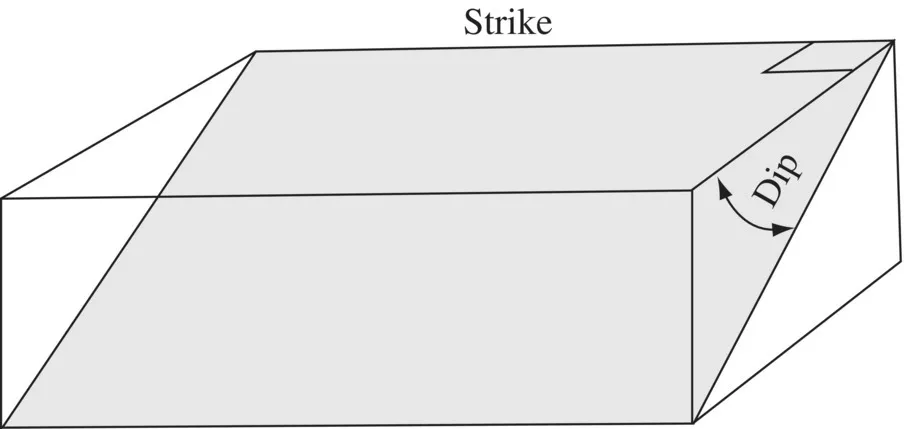
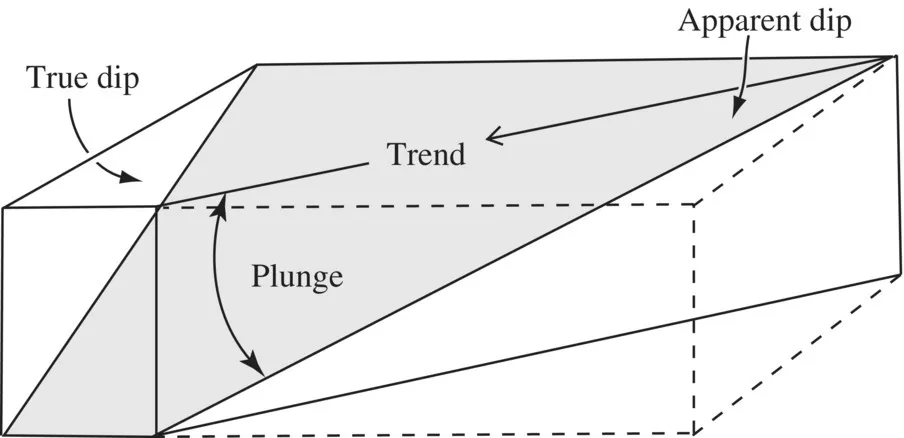
All orientations contain two components: an inclination and a declination. The declination is a horizontal angle of rotation from a reference point, most commonly true north. Declinations include the strike of a planar feature (Figure 1.1) and the trend of a linear feature (Figure 1.2). Inclination is the angle that a plane or line is sloped relative to the horizontal plane of the earth’s surface. For planes, this quantity is the dip (Figure 1.1), and for lines, it is the plunge (Figure 1.2).
The orientation of planar features is measured with a strike and dip. By convention, they are labeled strike, dip, and dip‐direction, though there are variations. The dip direction is the quadrant toward which the dip is inclined. Dips must be perpendicular to their corresponding strike and are indicated by the dip direction. A northeast (NE) strike, for example, can only have a southeast (SE) or northwest (NW) dip direction. The orientation of linear features is measured with trend and plunge and is reported as plunge/trend. Lines do not require a dip direction, so the written orientation is readily distinguished from that of a plane.
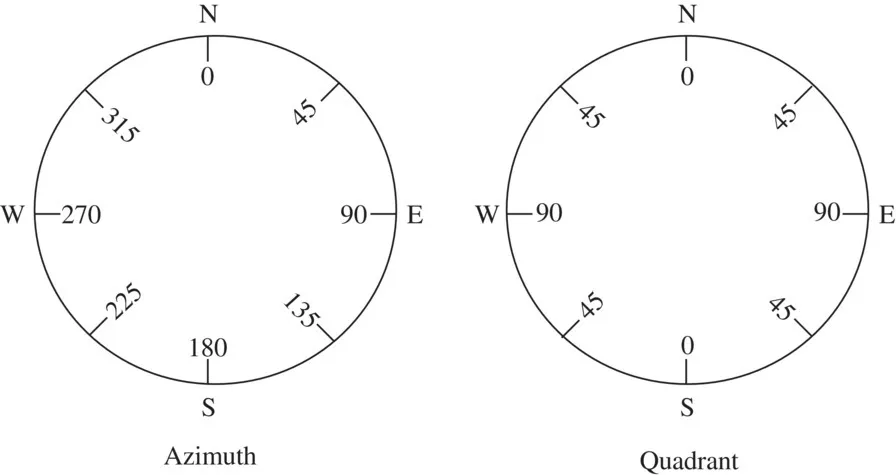
There are two ways of expressing the strikes of planes and the trends of lines (Figure 1.3). The azimuth method is based on a 360° clockwise circle and the quadrant method is based on the four 90° compass quadrants – north, south, east, and west. The quadrant system is the most commonly used in the United States, but in other countries the azimuth system is the convention. Strikes are traditionally measured from the north‐half of the transit or compass, but it is understood that the line extends in both directions. Unless horizontal, trends must be measured from the direction that they plunge, so they can be in any direction.
Figure 1.1 Strike and dip of a plane.
Figure 1.2 Trend and plunge of an apparent dip.
Figure 1.3 Azimuth and quadrant methods of expressing compass directions.
A plane that strikes due northwest–southeast and dips 50° southwest could be described as 315°, 50°SW (azimuth) or N45°W, 50°SW (quadrant). Similarly, a line that trends due west and plunges 30° may be described as 30°/270° in azimuth (sometimes written as 30° → 270° or 30°, 270°) or 30°/N90°W in quadrant. For azimuth notation, always use three digits (e.g. 008°, 065°, 255°), so that a bearing cannot be confused with a dip (one or two digits). In this book, the strike is given before the dip, and the plunge is given before the trend. We recommend that you use the azimuth convention in your work. It is much easier to make err...
Table of contents
Cover
Table of Contents
Title Page
Copyright Page
Preface
About the Companion Website
1 Attitudes of Lines and Planes
2 Outcrop Patterns and Structure Contours
3 Stereographic Projection
4 Folds and Cross Sections
5 Stereographic Analysis of Folded Rocks
6 Rotations and Determining Original Directions in Folded Rocks
Yes, you can cancel anytime from the Subscription tab in your account settings on the Perlego website. Your subscription will stay active until the end of your current billing period. Learn how to cancel your subscription
No, books cannot be downloaded as external files, such as PDFs, for use outside of Perlego. However, you can download books within the Perlego app for offline reading on mobile or tablet. Learn how to download books offline
Perlego offers two plans: Essential and Complete
Essential is ideal for learners and professionals who enjoy exploring a wide range of subjects. Access the Essential Library with 800,000+ trusted titles and best-sellers across business, personal growth, and the humanities. Includes unlimited reading time and Standard Read Aloud voice.
Complete: Perfect for advanced learners and researchers needing full, unrestricted access. Unlock 1.4M+ books across hundreds of subjects, including academic and specialized titles. The Complete Plan also includes advanced features like Premium Read Aloud and Research Assistant.
Both plans are available with monthly, semester, or annual billing cycles.
We are an online textbook subscription service, where you can get access to an entire online library for less than the price of a single book per month. With over 1 million books across 990+ topics, we’ve got you covered! Learn about our mission
Look out for the read-aloud symbol on your next book to see if you can listen to it. The read-aloud tool reads text aloud for you, highlighting the text as it is being read. You can pause it, speed it up and slow it down. Learn more about Read Aloud
Yes! You can use the Perlego app on both iOS and Android devices to read anytime, anywhere — even offline. Perfect for commutes or when you’re on the go. Please note we cannot support devices running on iOS 13 and Android 7 or earlier. Learn more about using the app
Yes, you can access Structural Analysis and Synthesis by Stephen M. Rowland,Ernest M. Duebendorfer,Alexander Gates in PDF and/or ePUB format, as well as other popular books in Physical Sciences & Geology & Earth Sciences. We have over one million books available in our catalogue for you to explore.