- 264 pages
- English
- ePUB (mobile friendly)
- Available on iOS & Android
About this book
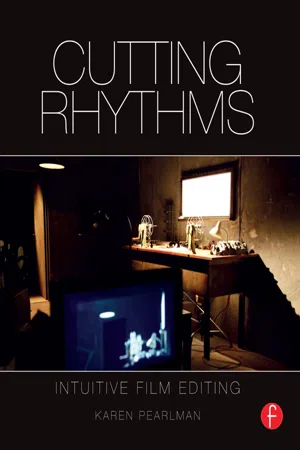
There are many books on the technical aspects of film and video editing. Much rarer are books on how editors think and make creative decisions.
Filled with timeless principles and thought-provoking examples from a variety of international films, the second edition of Karen Pearlman's Cutting Rhythms offers an in-depth study of the film editor's rhythmic creativity and intuition, the processes and tools editors use to shape rhythms, and how rhythm works to engage audiences in film. While respecting the importance of intuitive flow in the cutting room, this book offers processes for understanding what editing intuition is and how to develop it. This fully revised and updated edition contains:
-
- New chapters on collaboration and "editing thinking";
-
- Advice on making onscreen drafts before finalizing your story
-
- Tips on how to create and sustain audience empathy and engagement;
-
- Explanations of how rhythm is perceived, learned, practiced and applied in editing;
-
- Updated discussions of intuition, structure and dynamics;
-
- An all-new companion website (www.focalpress.com/cw/pearlman) with video examples and links for expanding and illustrating the principles of key chapters in the book.
Tools to learn more effectively

Saving Books

Keyword Search

Annotating Text

Listen to it instead
Information
Chapter 1
Rhythmic Intuition
Intuitive Thinking
Six Components of Intuition
- “Expertise—the unreflective execution of intricate skilled performance”An example of expertise is the way a professional editor with years of experience uses her gear. It’s like touch-typing or riding a bicycle; she doesn’t have to think about what button to push in order to do an operation, and this frees her concentration to focus on the material she’s working with. I call it “breathing with the Avid,” but it’s not restricted to Avid. It’s a matter of knowing your gear of choice so expertly that its operation doesn’t require conscious thought.Another important instance of expertise is that which arises from years of experience with the editing process. Editors often say that each new project is like learning to edit all over again, and in my experience this is an accurate description of what it feels like. However, after accruing a degree of experience in shaping a story or scene, an editor becomes expert, in the sense that she can see a possible organization or flow very quickly and without conscious thought. Note, however, that there is practice and learning at work in acquiring this expertise that, just like learning the gear, can be made explicit. Later chapters in this book break down some of that learning into principles and tasks that can be practiced.
- “Implicit learning—the acquisition of such expertise by non-conscious or non-conceptual means”A lot of implicit learning about editing is acquired by watching films. There are conventions of filmmaking that show up in most TV programs, ads, and movies. An editor may not know the names of these conventions or techniques but has seen them enough to know what they are without ever having consciously learned them.An editor also accrues a substantial amount of implicit learning about the world through observation and participation in the movement and rhythms of the world. This is something that all humans do, of course, but as will be discussed below, doing it mindfully is a useful tool for enhancing an editor’s rhythmic intuition.
- “Judgment—making accurate decisions and categorizations without, at the time, being able to justify them”Judgment can be seen at work whenever an editor makes an adjustment to a cut and it works better. Once the “working better” is visible, an editor is rarely called upon to explain why or how. In fact, there are reasons why something works better that can be articulated, but the use of judgment implies making good decisions without going through the process of justifying them. Judgment is, however, acquired by having a thorough understanding of the material, the story, the conditions, and the traditions within which you are working. The capacity to make judgments is a good example of something no one is born with, but which can be enhanced and developed through explicit teaching and learning.
- “Sensitivity—a heightened attentiveness, both conscious and non-conscious, to details of a situation”An editor has sensitivity or heightened attentiveness to movement and emotion in the material. Developing sensitivity is a matter of learning to see the potential of movements and moments before they are shaped—a subject that will be taken up at length in this book!
- “Creativity—the use of incubation and reverie to enhance problem solving”Creativity is a complex and much discussed notion, sometimes understood to mean generating new ideas or concepts, but just as often considered to be the process of making new associations or links, which, of course, is exactly what an editor does. Editing creativity is the lateral association of images or sounds to solve the problem at hand, which is the shaping of the film and its rhythms. The editor’s reveries yield connections between images, sounds, and movements in the raw material, which will create new and coherent meanings. Practice, and trial and error, informs these reveries, of course, but also the editor’s acquired knowledge of the world, herself, and her sensitivity to movement and emotion give her the basis from which to make creative connections and associations.
- “Rumination—the process of ‘chewing the cud’ of experience in order to extract its meanings and its implications”Rumination is what is at work when you are washing the dishes and suddenly the solution to an intractable sequence is clear to you. It is the kind of thinking that happens when you’re thinking about something else, and you have immersed yourself so deeply in your material that it inhabits a part of your brain even when you’re not actually looking at it or working on it. Rumination is what happens on the weekend or while you’re making a cup of tea and can yield some of your best solutions and ideas, which is why healthy work/rest cycles are so important to editing: they enhance your intuition!
Movement and Intuition
- Editors shape movement. Physics, filmmakers, and philosophers all weigh in here to say that movement is what we perceive and what we are.
- Editors’ brains are especially tuned to movement. We use kinaesthetic empathy and mirror neurons to understand movement’s expressive potential. (These terms will be unpacked below.)
- Editors respond with their own internal sense of movement to the movement they see and hear. Or as Dany Cooper, ASE, multi award winning editor and former President of the Australian Screen Editor’s Guild says: “It’s a body thing.”5
Rhythm is Made of movement
Table of contents
- Cover
- Title
- Copyright
- Contents
- PREFACE TO THE SECOND EDITION
- PREFACE TO THE FIRST EDITION
- ACKNOWLEDGMENTS
- INTRODUCTION
- CHAPTER 1 Rhythmic Intuition
- CHAPTER 2 Editing as Choreography
- CHAPTER 3 Timing, Pacing, and Trajectory Phrasing
- CHAPTER 4 Tension, Release, and Synchronization
- CHAPTER 5 Physical, Emotional, and Event Rhythms
- CHAPTER 6 Physical Rhythm
- CHAPTER 7 Emotional Rhythm
- CHAPTER 8 Event Rhythm
- CHAPTER 9 Style
- CHAPTER 10 Devices
- CHAPTER 11 Collaboration and The Vulcan Mind Meld
- CHAPTER 12 Editing Thinking and Onscreen Drafting
- BIBLIOGRAPHY
- INDEX
Frequently asked questions
- Essential is ideal for learners and professionals who enjoy exploring a wide range of subjects. Access the Essential Library with 800,000+ trusted titles and best-sellers across business, personal growth, and the humanities. Includes unlimited reading time and Standard Read Aloud voice.
- Complete: Perfect for advanced learners and researchers needing full, unrestricted access. Unlock 1.4M+ books across hundreds of subjects, including academic and specialized titles. The Complete Plan also includes advanced features like Premium Read Aloud and Research Assistant.
Please note we cannot support devices running on iOS 13 and Android 7 or earlier. Learn more about using the app