The primary years are recognised as a distinct period in a child's development with significant consequences for ongoing educational success. During this critical time, formal schooling and the associated activities introduce children to new and extended social roles where they learn to cooperate and collaborate with their peers and adults. Children also begin to develop a sense of themselves and their competence in a range of domains including social, academic, sport and music.
This edited collection provides specialist guidance in developing curriculum, pedagogy and assessment to meet the needs of primary years children. The text begins by exploring the unique characteristics of this age group including cognitive, social, emotional and physical development. It considers the expectations of teachers, including ethical and legal issues and guidance on how to develop positive learning spaces and collaborative approaches. There is an exploration of the needs of the child including facilitating transition from the early years and into secondary school. The text then considers the curriculum in depth including language and literacy, mathematics and numeracy, science and technology, health and physical education and the humanities. A focus on some of the key challenges in primary education bring the book to its conclusion, including effectively harnessing digital technology, developing age appropriate pedagogies, practising differentiated learning and effective assessment.
Rich with insights from experts in the field and featuring case studies and practical examples throughout, this is a key resource for both pre-service and in-service primary teachers. Other professionals working with primary years students and parents will also benefit from engaging with this book.
eBook - ePub
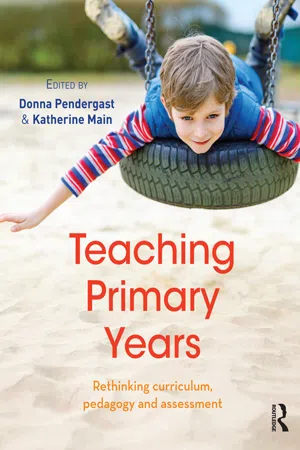
Teaching Primary Years
Rethinking curriculum, pedagogy and assessment
- 520 pages
- English
- ePUB (mobile friendly)
- Available on iOS & Android
eBook - ePub
Teaching Primary Years
Rethinking curriculum, pedagogy and assessment
About this book
Trusted by 375,005 students
Access to over 1.5 million titles for a fair monthly price.
Study more efficiently using our study tools.
Information
Topic
EducationSubtopic
Education GeneralChapter One
Primary years education
Learning intentions
In this chapter we will:
- investigate the role and importance of primary years education in society
- examine the features of primary years education in the Australian context
- reflect on the effectiveness of primary years education in Australia.
The primary years
For this book, the year levels relate to the school Years 2/3 through to Years 6/7 and the period of middle childhood ranging from around seven to twelve years of age. The primary years have not always been recognised as a unique and important developmental period, with many theorists viewing these years as a time when development plateaus as children consolidate the foundation knowledge and skills of the early years and prepare for the rapid growth about to be experienced in the young adolescent years. However, middle childhood and the primary years are a time when children expand their social contexts, which has a significant effect on their development. During these critical years, formal schooling and the associated activities introduce children to new and extended social roles where they learn to cooperate and collaborate with their peers and adults. It is also a time when children begin to develop a sense of who they are and their competence in a range of domains, including social, academic, sport, music and other areas.
Provocation 1.1 Reflecting on your experience of being a primary school student
Reflect on your experience of primary years education.
- What were the features of the schools you attended or the learning environment in which you completed your primary years? Consider the location, number of students in the school, class sizes and teacher characteristics.
- What is your favourite memory of your primary years?
- What did you like least? What did you like most?
Share your experience with others. Now consider:
- In what ways has your unique experience shaped you?
- What would you change if you could? Why?
Teachers of primary years learners will benefit from specialist preparation, as they are required to build on the skills and knowledge gained during the early years, and to prepare to understand and manage the issues related to middle childhood. Thus the primary years require a focused approach to teaching and learning with their own philosophy, policy, curriculum, pedagogy and assessment.
Primary years education as a human right
The United Nations Universal Declaration of Human Rights was proclaimed in 1948, setting out the fundamental human rights that have guided and protected humanity since then (United Nations, 1948). Among the 30 Articles, Article 26 relates to education:
- Everyone has the right to education. Education shall be free, at least in the elementary and fundamental stages. Elementary education shall be compulsory. Technical and professional education shall be made generally available and higher education shall be equally accessible to all on the basis of merit.
- Education shall be directed to the full development of the human personality and to the strengthening of respect for human rights and fundamental freedoms. It shall promote understanding, tolerance and friendship among all nations, racial or religious groups, and shall further the activities of the United Nations for the maintenance of peace.
- Parents have a prior right to choose the kind of education that shall be given to their children (United Nations, 1948).
This Article affirms the universally accepted importance of education and formally highlights a commitment, in the strong form of a right, to free education for all children in the primary years with the purpose of developing respect and placing value on understanding, tolerance, freedom and peace. Since the proclamation, the capacity for education to serve as a vehicle for change has enabled a clear mandate for global institutions, such as the United Nations. In the last decade of the twentieth century through to the present day, there has been a focus on seeking evidence that these rights are being met.
In 2000, after a series of UN conferences and summits, the United Nations Millennium Declaration set an agenda for the next fifteen years as a response to ongoing poverty and inequity. Nations around the world committed, for the first time, to a new global partnership to reduce extreme poverty, and set out a series of eight targets, known as the Millennium Development Goals (MDGs). Goal 2 of the Millennium Development Goals was to achieve universal primary education (UPE) by 2015 as a means of addressing poverty and inequity. From 2000 to 2015 there was a decline in the number of out-of-school children of primary school age from 100 million to 61 million; however, progress has stalled since 2015—especially for girls. In 2015, there remained a gap with regard to achieving the MDGs, with 91 per cent of primary school-age children enrolled in school, leaving a gap of almost one in ten primary-aged students not enrolled in a primary school globally (UNICEF, 2018a), with girls from poor countries likely to be represented more strongly than any other group.
Building from this base, in 2015 the United Nations committed to the Sustainable Development Goals (SDGs), a set of seventeen aspirational global goals with 169 targets (United Nations, 2015a). This involved a commitment from the 194 member states to shift the world to a sustainable path. The agenda sets a ‘deliberative approach’, which aims for global transformation where poverty and gender inequality no longer exist; where good healthcare and education are available for all; and where economic growth no longer harms the environment. The goals are highly aspirational, and every country in the world falls short on more than half, with a quarter of the world’s countries falling short on all seventeen goals. Compared with the MDGs, the SDGs are universal, more ambitious and very comprehensive. The SDGs also acknowledge that gender plays a crucial role in achieving the goals, noting that ‘Ensuring gender equality in health, political and economic Leadership and employment, not just gender parity in education, underpins the sustainable development agenda’ (UNESCO, 2016, p. 30).
While many of the goals relate to a range of aspects relevant to education, Goal 4 specifically relates to the achievement of quality education, with an agenda of ensuring ‘inclusive and equitable quality education and promote lifelong learning opportunities for all’; it has ten targets, including Target 4.1, which is particularly pertinent to primary education:
Target 4.1: By 2030, ensure that all girls and boys complete free, equitable and quality primary and secondary education leading to relevant and effective learning outcomes. (United Nations, 2015b, p. 18)
In Australia, the Melbourne Declaration on Educational Goals for Young Aus tralians (MCEETYA, 2008) is the over-arching approach shaping nationally consistent directions and aspirations for Australian schooling. The Melbourne Declaration sets out two over-arching goals for schooling:
- Australian schooling promotes equity and excellence.
- All young Australians become:
- – successful learners
- – confident and creative individuals, and
- – active and informed citizens (2008, p. 7).
The Melbourne Declaration includes a Commitment to Action in the following eight interrelated areas in order to support the achievement of the educational goals:
- developing stronger partnerships
- supporting quality teaching and school Leadership
- strengthening early childhood education
- enhancing middle years development
- supporting senior years of schooling and youth transitions
- promoting world-class curriculum and assessment
Provocation 1.2 Ten-year-old girls reveal our future
According to the United Nations, the success or failure of the global SDGs largely depends upon the fate of ten-year-old girls, as this is where many of the outcomes of the strategies will see a real impact (UNFPA, 2016). This is the age when girls’ life possibilities begin to either expand or contract. The ten facts are:
- Most (89 per cent) of the 60 million ten-year-old girls around the world live in countries with high levels of poverty.
- More than 35 million live in countries considered to be very unequal in terms of gender.
- Ten per cent of girls between the ages of five and fourteen do more than 28 hours of household chores each week—twice the load carried by boys.
- Many girls are married soon after turning ten, and expected to assume domestic responsibilities.
- One in three girls experience domestic violence.
- Girls aged between ten and nineteen are more likely to die from AIDS than any other cause.
- Suicide is the second leading cause of death.
- Sixteen million girls between the ages of six and eleven will never start school.
- Each additional year that a girl remains in school translates to 10 per cent more wages later in life.
- Investments in the health, education and empowerment of ten-year-old girls can triple a girl’s lifetime income (developed from Zerzan, 2016).

- Using these ten facts about girls, investigate the degree to which this is a reflection of ten-year-old girls in Australia. Consider this across a range of demographic features—for example, comparing girls with boys and Aboriginal with non-Aboriginal girls.
- How do Australian ten-year-old girls compare with their counterparts around the world?
- improving educational outcomes for Aboriginal and Torres Strait Islander youth and disadvantaged young Australians, especially those from low socioeconomic backgrounds, and
- strengthening accountability and transparency (MCEETYA, 2008).
The importance of education in Australia has recently been highlighted in a review entitled Through Growth to Achievement (Department of Education, 2018), also known colloq...
Table of contents
- Cover
- Half Title
- Title Page
- Copyright Page
- Contents
- Figures, tables and provocations
- Abbreviations
- Preface
- Contributors
- Chapter 1 Primary years education
- Chapter 2 Primary years students
- Chapter 3 Primary school teachers
- Chapter 4 Place and space for primary learners
- Chapter 5 Social and emotional wellbeing
- Chapter 6 Leadership
- Chapter 7 Transition
- Chapter 8 English and literacy
- Chapter 9 Maths and numeracy
- Chapter 10 Technology and coding
- Chapter 11 Science
- Chapter 12 History, Geography, Economics and Civics
- Chapter 13 The arts
- Chapter 14 Languages
- Chapter 15 Health and Physical Education
- Chapter 16 Age-appropriate engaging pedagogies
- Chapter 17 Integrated learning
- Chapter 18 Cooperative learning and collaborative teaching
- Chapter 19 Promoting pro-social behaviour
- Chapter 20 Digital learning
- Chapter 21 Personalised learning: Disability and gifted learners
- Chapter 22 Assessment and learning
- Index
Frequently asked questions
Yes, you can cancel anytime from the Subscription tab in your account settings on the Perlego website. Your subscription will stay active until the end of your current billing period. Learn how to cancel your subscription
No, books cannot be downloaded as external files, such as PDFs, for use outside of Perlego. However, you can download books within the Perlego app for offline reading on mobile or tablet. Learn how to download books offline
Perlego offers two plans: Essential and Complete
- Essential is ideal for learners and professionals who enjoy exploring a wide range of subjects. Access the Essential Library with 800,000+ trusted titles and best-sellers across business, personal growth, and the humanities. Includes unlimited reading time and Standard Read Aloud voice.
- Complete: Perfect for advanced learners and researchers needing full, unrestricted access. Unlock 1.5M+ books across hundreds of subjects, including academic and specialized titles. The Complete Plan also includes advanced features like Premium Read Aloud and Research Assistant.
We are an online textbook subscription service, where you can get access to an entire online library for less than the price of a single book per month. With over 1.5 million books across 990+ topics, we’ve got you covered! Learn about our mission
Look out for the read-aloud symbol on your next book to see if you can listen to it. The read-aloud tool reads text aloud for you, highlighting the text as it is being read. You can pause it, speed it up and slow it down. Learn more about Read Aloud
Yes! You can use the Perlego app on both iOS and Android devices to read anytime, anywhere — even offline. Perfect for commutes or when you’re on the go.
Please note we cannot support devices running on iOS 13 and Android 7 or earlier. Learn more about using the app
Please note we cannot support devices running on iOS 13 and Android 7 or earlier. Learn more about using the app
Yes, you can access Teaching Primary Years by Katherine Main,Donna Pendergast in PDF and/or ePUB format, as well as other popular books in Education & Education General. We have over 1.5 million books available in our catalogue for you to explore.