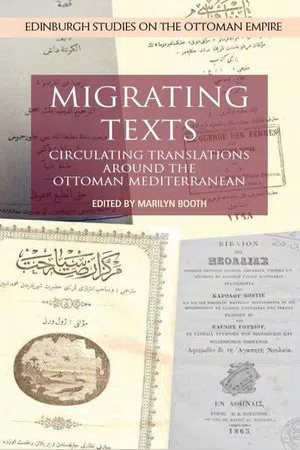
Explores translation in the context of the multi-lingual, multi-ethnic late-Ottoman Mediterranean world. Fénelon, Offenbach and the Iliad in Arabic, Robinson Crusoe in Turkish, the Bible in Greek-alphabet Turkish, excoriated French novels circulating through the Ottoman Empire in Greek, Arabic and Turkish: literary translation at the eastern end of the Mediterranean offered worldly vistas and new, hybrid genres to emerging literate audiences in the nineteenth and early-twentieth centuries. Whether to propagate 'national' language reform, circulate the Bible, help audiences understand European opera, argue for girls' education, institute pan-Islamic conversations, introduce political concepts, share the Persian Gulistan with Anglophone readers in Bengal, or provide racy fiction to schooled adolescents in Cairo and Istanbul, translation was an essential tool. But as these essays show, translators were inventors, and their efforts might yield surprising results.
Trusted by 375,005 students
Access to over 1 million titles for a fair monthly price.
The chapters in this section maintain the broad focus of the Introduction but each scrutinises an intercultural, interlinguistic field differently. In ‘What was (really) translated in the Ottoman Empire? Sleuthing nineteenth-century Ottoman translated literature’, Johann Strauss approaches the history of translation obliquely, through the ways translation happened but was misnamed, mis-identified or subsumed in massive projects of comPilation. For instance, Şemseddin Sami’s encyclopedic Kamusü l-a
lam (1889–98), an important conduit for knowledge transmission amongst late-nineteenth-century Ottomans, must be reconsidered as in large measure a translation, but from multiple sources. Although one could read these misattributions as a history of scholarly and cartographic ‘error’, they become a means by which to think about both what was translated and how texts and authors were presented to readers. And the scholar’s task becomes one of sleuthing: lurking in unexpected places, looking for odd clues. The ways that translation is not defined tells us about attitudes toWards translation, as an act that was not necessarily regarded as secondary authorship. If the translator’s name is not mentioned, what does this mean? As Strauss argues, it is difficult to evaluate Robinson Crusoe’s reception among the Ottoman reading public if we do not establish which version was actually translated into Turkish. Without a closer look, we cannot gauge what these ‘translations’ actually conveyed about authors famous elsewhere. Strauss’s approach warns against premature conclusions about the contents and vectors of knowledge transmission, and explores points raised in the Introduction about the blurry boundaries of ‘translation’. how might a closer look at misattribution and misappropriation urge the revision of established canons of translated literature? And what might it tell us about studying translation historically, as sleuths and spies, examining our odd and incomplete archives by trying to put ourselves in the places of translators then?
Strauss’s microscopic scrutiny of the Ottoman translation scene is followed by Peter Hill’s telescopic gaze at translation across the world since the seventeenth century. ‘Translation and the globalisation of the novel’ reconnoiters the diffusionist model of literary translation made famous by Franco Moretti. Hill graphs the spread of some particularly ‘best-translating’ novels over the length and breadth of the Mediterranean coasts and far beyond, A ‘distant reading’ of how works such as Fénelon’s Télémaque and Defoe’s Robinson Crusoe move from a north-west European ‘core’ through ‘semi-peripheries’ and ‘peripheries’, reveals regularities supporting Moretti’s model. Yet as an approach designed for literatures of that ‘core’, its limitations are apparent when one looks from the ‘peripheries’. Hill argues for a hybrid practice via mid-level generalisations; and he proposes testing the diffusionist model by looking at ‘secondary’ translation and diffusion from centres outside Moretti’s ‘core’, the sort of lateral transmission that this project highlights.
Orit Bashkin’s chapter focuses on a ‘national’ space in the early twentieth century only to interrogate assumptions about ‘the national’ as a concept and practice that forecloses multiplicity. ‘On Eastern cultures: Transregionalism and multilingualism in Iraq’ juxtaposes the journalistic works of Hibat al-Din al-Shahrastani and the fiction of Mahmud Ahmad al-Sayyid to challenge a national narrative holding that the Iraqi state rejected the Ottoman past and its multilingual, multi-ethnic cultures. A study of these individuals’ work counters the notion that Iraqi culture was tyPified by isolated and isolationist grouPs whose translation Practices targeted specific sectarian grouPs, and it reminds us how tightly intertWined journalism and translation have been. Al-Shahrastani’s journal al-
Ilm points to the multilingual and transnational milieu of 1910s Najaf, while al-Sayyid’s later writings underscore the survival of transregional networks. Readers depended on publications coming from Istanbul, Teheran, Cairo, Beirut and the Indian subcontinent. Al-Shahrastani and al-Sayyid seem to reside in different Worlds: a Shi
i
alim, a Sunni socialist writer of Prose fiction. But both were shaPed by Iraqi society’s mélange of cultures and languages – and the ways translation was fundamental to creating shared conversations in the Arab-Ottoman print market on modernity, colonialism, constitutionalism, nationalism and reform.
1
What was (Really) Translated in the Ottoman Empire? Sleuthing Nineteenth-century Ottoman Translated Literature
Johann Strauss
In one of our major bibliographical sources for works published in Ottoman Turkish, Seyfettin Özege’s catalogue of Turkish books printed in Arabic script,1 numerous titles are listed as ‘translated from …, translated by …’ without giving any indication of the original work and its author because this information was not mentioned in the translation itself. But these are not the only problems of attribution encountered while studying translation in the nineteenth-century Ottoman Empire. Closer examination also reveals misidentifications, works whose ‘authors’ do not exist, and translations that have not been identified as ‘translations’. There are also translations whose titles were altered consciously in order to avoid problems with censorship.2 Inaccuracies and errors can be found not only in Özege’s otherwise extremely valuable catalogue but also in other works dealing with translation activity among the Ottoman Turks, in works of Turkish literary or intellectual history.3 To write the history of translation in the Ottoman Empire, one must be a bit of a sleuth and a spy, searching for clues wherever they might exist, listening through the keyholes of title pages and colophons and other texts, and at times making imaginative (if evidence-based!) connections. If translation by its nature is a rewriting, a possessing anew of a text already in the world, it is hardly surprising that writers and publishers might not always care to make the original known; or they might not know what that original is. This is a feature of the history of translation everywhere, but the present chapter narrates one scholar’s attempts through the years to track and trace one instance of it: the sometimes elusive, often meandering, paths by which texts appeared in the Ottoman Empire. Such pathways may help us think historically about how writers (translators), readers and publishers thought about translation – and how the attempts since then at ‘p...
Table of contents
Cover
Half Title
Title Page
Copyright
Contents
List of Charts and Maps
Acknowledgements
The Contributors
Note on Translation and Transliteration
Introduction: Translation as Lateral Cosmopolitanism in the Ottoman Universe: Marilyn Booth
Part I. Translation, Territory, Community
Part II. Translation and/as Fiction
Part III. ‘Classical’ Interventions, ‘European’ Inflections: Translation as/and Adaptation
Bibliography
Index
Frequently asked questions
Yes, you can cancel anytime from the Subscription tab in your account settings on the Perlego website. Your subscription will stay active until the end of your current billing period. Learn how to cancel your subscription
No, books cannot be downloaded as external files, such as PDFs, for use outside of Perlego. However, you can download books within the Perlego app for offline reading on mobile or tablet. Learn how to download books offline
Perlego offers two plans: Essential and Complete
Essential is ideal for learners and professionals who enjoy exploring a wide range of subjects. Access the Essential Library with 800,000+ trusted titles and best-sellers across business, personal growth, and the humanities. Includes unlimited reading time and Standard Read Aloud voice.
Complete: Perfect for advanced learners and researchers needing full, unrestricted access. Unlock 1.4M+ books across hundreds of subjects, including academic and specialized titles. The Complete Plan also includes advanced features like Premium Read Aloud and Research Assistant.
Both plans are available with monthly, semester, or annual billing cycles.
We are an online textbook subscription service, where you can get access to an entire online library for less than the price of a single book per month. With over 1 million books across 990+ topics, we’ve got you covered! Learn about our mission
Look out for the read-aloud symbol on your next book to see if you can listen to it. The read-aloud tool reads text aloud for you, highlighting the text as it is being read. You can pause it, speed it up and slow it down. Learn more about Read Aloud
Yes! You can use the Perlego app on both iOS and Android devices to read anytime, anywhere — even offline. Perfect for commutes or when you’re on the go. Please note we cannot support devices running on iOS 13 and Android 7 or earlier. Learn more about using the app
Yes, you can access Migrating Texts : Circulating Translations around the Eastern Mediterranean by Marilyn Booth in PDF and/or ePUB format, as well as other popular books in Literature & Literary Criticism for Comparative Literature. We have over one million books available in our catalogue for you to explore.