In this complete guide to modern China, Michael Dillon takes students through its social, political and economic changes, from the Qing Empire, through the civil war and the Communist state, to its incarnation as a hybrid capitalist superpower.
Key features of the new edition include:
- A brand new chapter on the Xi Jinping premiership
- Coverage of the recent developments in Hong Kong
- Unique analysis of Tibet and Xinjiang
- Teaching aides including biographies of leading figures, timelines and a glossary
Clearly and compelling written, this textbook is essential for any student of the history or politics of modern China.
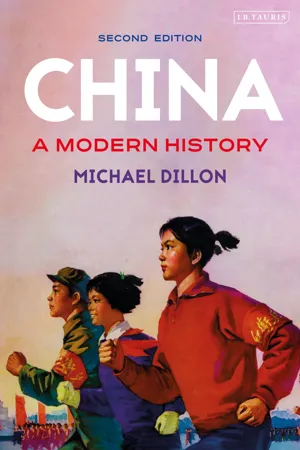
- 512 pages
- English
- ePUB (mobile friendly)
- Available on iOS & Android
eBook - ePub
About this book
Trusted by 375,005 students
Access to over 1 million titles for a fair monthly price.
Study more efficiently using our study tools.
Information
1
Rise and Fall of the Chinese Empire
Chapter Outline
Manchu conquest and Qing state
Kangxi and the Dzungar Mongols
Diplomacy and Russia
Qianlong’s frontier campaigns
Qing society and economy
Qing culture: Manchus and Confucians
From 1644 to 1911, China was ruled by emperors of the Qing dynasty, a Manchu rather than a Chinese imperial family: it was to be the last in a succession of ruling houses that, by convention, stretches back in an unbroken line to the unification of the Warring States by the First Emperor Qin Shi Huangdi in 221 BC. A list of the dynasties of imperial China provides a comforting illusion of continuity and stability from the Qin to the Qing, but the collapse of one dynasty and its replacement by another was rarely a peaceful transition. Typically the ruling elite lost the confidence of the populace and its authority waned in a period perhaps of scandal at court or peasant rebellion, and a new house came to power, claiming that it now possessed the ‘mandate of heaven’ [tianming], the right to reign, which the deposed court were deemed to have lost by virtue of their defeat. By no means all of the dynasties that ruled China were Chinese, in the sense that they were not all of Han origin. Long before the conquests of the Emperor Qin Shi Huangdi, the Chinese state and Chinese society had evolved though perennial conflict between the steppe and the sown; between the nomad stock breeders of the northern and western high pastures and the settled rice and millet farmers of the fertile basins created by the Yangzi and the Yellow River; between the Turkic, Mongol, Tungusic and Tibetan cultures of the frontier pastoralists and warriors and the Han Chinese culture of the central plains and eastern lowlands – the culture of the ideograph and the scholar bureaucrat.
| 1644–1911 | Qing Dynasty |
| 1644 | Last Ming Emperor commits suicide |
| 1644 | Manchu armies march through the passes to take Beijing |
| 1661 | Kangxi Emperor reign begins |
| 1673–81 | Three Feudatories revolt against the Qing |
| 1722 | Yongzheng reign begins |
| 1735 | Qianlong reign begins |
| 1796 | Jiaqing reign begins |
| 1796 | White Lotus rebellion against the Qing |
| 1820 | Daoguang reign begins |
| 1850 | Xianfeng reign begins |
| 1861 | Tongzhi reign begins |
| 1875 | Guangxu Emperor reign begins, with Empress Dowager the power behind the throne |

Map 3 Qing Dynasty (Source: Wikimedia Commons).

Figure 1 The Forbidden City was the Imperial Palace from the Ming Dynasty to the end of the Qing Dynasty. It is now the Palace Museum (Photo by Frédéric Soltan/Corbis via Getty Images).
The Chinese, as is the way with imperial powers, regarded their own culture as superior to all others, and the lands that they controlled were known as Zhongguo, the ‘central kingdoms’, a concept that was later transmitted to the west as the Middle Kingdom. Chinese speakers, especially literate and educated Chinese speakers, often considered the frontier folk to be barbarians, but that did not prevent them from being overrun by these barbarians from time to time. Strict and loyal Confucian scholars might lament the loss of China to these uncouth herders and warriors, but the impact of the frontier peoples on the culture of China has been profound, and it is problematic to be precise about what in Chinese culture is of genuine Chinese origin and what came to the Middle Kingdom from the steppes of Mongolia, the Tibetan plateau or the mountains and forests of Manchuria, or indeed vice versa. From earliest times to the thirteenth century, the blending of nomad and farmer, of the steppe peoples with the men and women of Han ethnic origin, was a complex process, although Chinese historians of an orthodox Confucian persuasion prefer to highlight dynasties such as the Han (206 BC–AD 221) and Tang (618–906) where ‘Chinese’ culture was thought to be at its most highly developed; they have a tendency to play down the ‘barbarian’ dynasties which were disdained as temporary aberrations.1 Some of these aberrations were to persist for centuries. The defeat of the Song dynasty by the Mongol armies of Kublai Khan, which captured the city of Hangzhou in 1279, led to the creation of a Mongol dynasty, the Yuan, to rule China, but more significantly to the incorporation of the Chinese world into a wider, pan-Asian, Mongol empire that included Turks and Persians. The Yuan dynasty was overthrown in 1368 by what was ostensibly a native Chinese dynasty, the Ming, but which in fact contained many non-Chinese elements, including an influential community of Muslims. The Ming dynasty reigned until the mid-seventeenth century, when its authority disintegrated amid the classic combination of palace corruption and peasant rebellion. The final years of the Ming were sorrowful and distressing for Chinese scholars and a painful ordeal for the population as a whole: the agony was only, and temporarily, brought to an end when in 1644 the armies of yet another barbarian people, the Manchus, marched down through the passes to the north-east of the Ming capital, Beijing, to capture the city which was about to fall to the armies of a Chinese peasant rebel, Li Zicheng.
The Manchus were a confederation of tribal peoples who had created a powerful state to the north-east of China, in the area that was later named after them – Manchuria.2 The name Manchu dates back only to 1635; before that they had used a variety of tribal names, including the ancient Nurchen. They were nomadic and organized into military units or banners but sought to emulate the imperial system they saw across the border in China. In 1636, the Manchu ruler Hong Taiji (often referred to erroneously as Abahai in Western sources), who lived from 1592 to 1643, had given his state a Chinese name, Qing, which means pure or clear, although at the same time he enjoined his subjects to retain their Manchu language, dress and culture and the warrior virtues, particularly mounted archery, which he believed to be an essential part of their heritage. This attempt to marry a Chinese-style state system to values from their tribal homeland was to create tensions and conflicts throughout much of their rule in China. In his final years Hong Taiji embarked on his Great Enterprise, the conquest of China, a military triumph for the Manchus that he did not live to see. The posthumous title of Chongde was bestowed on him and he can be regarded as the founder and first emperor of the Qing – his reign being dated from 1636 to 1643 – although in conventional Chinese historiography the Qing dynasty begins with the Shunzhi Emperor in 1644. His clan, the Aisin Gioro, was to provide rulers for the Qing dynasty all the way through to the last emperor, Aisin Gioro Pu Yi in 1908.3
Manchu conquest and Qing state
The history of modern China is dominated by the Han aspiration of throwing off the Manchu yoke, but how did China come to bear that yoke? When the Ming capital of Beijing was under threat by the rebel armies of Li Zicheng in 1644, generals of the Ming army made the decision that, rather than allow the peasant Li to take the imperial capital, they would invite in the armies of the Manchus to help them put down the rebellion. This the Manchus did with great success, but, having been invited into China, they stayed – for over 250 years. Their conquest of China was prolonged and bloody. The fall of Ming cities to the Manchus was accompanied by massacres, notably the ten-day sack of the great commercial centre of Yangzhou in May 1645. These brutalities were long remembered by the Han Chinese and were evoked in the rallying cries of the revolutionaries who fought the Manchus in the late nineteenth and early twentieth centuries.
It was not until the suppression in 1681 of the Three Feudatories rebellion that the whole of China Proper was securely under Manchu rule. The Manchus had granted fiefdoms in the southern regions of Yunnan, Guangdong and Fujian to Ming officials who had collaborated with them during the conquest. The Kangxi Emperor came to perceive these semi-independent kingdoms as a threat to his authority and to the unity of the Qing state, and he decided to abolish the fiefdoms in 1673. The Three Feudatories rebellion was the resistance by the feudal princes to their abolition. The Manchu armies continued to counter all resistance to their conquest with campaigns of terror and mass slaughter; to consolidate their control, they established garrisons of banner troops in the main towns of the conquered territories.4 The conquest was slow: western China would not be firmly under the control of the Qing until the late eighteenth century, and the island of Taiwan only became a province in 1885.
Kangxi and the Dzungar Mongols
The expansion of the Qing dynasty westwards coincided with the eastward march of the Russian empire and also with the extension of Britain’s empire in India. The first target of the Manchus was neither of these but a much smaller state established by the Mongols, the former rulers of China who had been forced back to the steppes by the Ming dynasty and who were in the process of creating their own Dzungar power base in Central Asia. The Manchus resisted the power of the Mongols but at the same time traded with them to acquire horses and forged military alliances. They invoked blood ties, a shared steppe heritage and a shared written language, for their script was derived from Mongol characters; most of all they appealed to a powerful sense of the cultural difference between the two peoples of nomad heritage and the Chinese.
The Kangxi Emperor, who reigned from 1662 to 1722, was the third son of the Shunzhi Emperor, the first emperor of the Qing. His Chinese name was Xuanye and he was of the ruling Aisin Gioro clan of the Manchus, but he was also descended from Mongol aristocrats on his father’s side. After satisfying himself that the defeat of the Three Feudatories in the south had secured China Proper for the Qing dynasty, he turned his attention to his northern borders and to the Mongols. Tribute missions from the powerful Galdan Tseren, who had become the Khan of the Dzungars in 1670 after a fratricidal civil war, were growing in size and in number and frequently behaved more like raiding parties than diplomatic and trade missions. Galdan had also built an alliance with Tibet on the basis of the Buddhism that the Mongols shared with the Tibetans. This form of Buddhism differs markedly in belief and or ganization from the Buddhism of China and is sometimes called Lama Buddhism, although its adherents prefer the name Tibetan Buddhism.
In 1687 when Galdan’s forces invaded the territory of the Khalkha Mongols, which was much closer to the Qing capital, Kangxi counter-attacked. The Qing supported the Khalkhas against Galdan, and in 1690 Kangxi led his first military expedition against the Dzungars. Galdan’s forces were not annihilated, which is what the Emperor had intended, but they were forced to withdraw well beyond the borders of the territory that the Qing state controlled. This was a major victory for the Kangxi Emperor, but the campaign had been costly.
Diplomacy and Russia
This was the age of expanding empires by land as well as by sea, and the expansion of the Qing empire to the north and west could only proceed so far before it came into contact with the eastward expansion of Tsarist Russia in search of furs to trade and the all year round warm water port that its ice-bound navy needed so desperately for winter campaigns. In the seventeenth century, embassies from St Petersburg began their attempt to open China to trade and diplomatic representation, a ...
Table of contents
- Cover
- Half-Title
- Title
- Contents
- Acknowledgements
- Introduction
- 1 Rise and Fall of the Chinese Empire
- 2 China and the West: The Road to the Opium War
- 3 Taiping, Nian and Muslim Uprisings (1850–84)
- 4 Restoration and Western Colonization (1861–98)
- 5 Boxer Rising and Imperial Decline (1899–1911)
- 6 Struggle for a Republic of China (1911–16)
- 7 May Fourth Movement, Communists and Nationalists (1917–24)
- 8 Northern Expedition and United Front (1923–7)
- 9 Nanjing Decade and Long March (1927–37)
- 10 Japanese Invasion, Second United Front and Civil War (1937–49)
- Interlude: New China, New History?
- 11 Liberation and the People’s Republic of China (1949–54)
- 12 Agriculture, Industry, Marriage Reform and the Intelligentsia (1950–7)
- 13 Great Leap Forward (1958–65)
- 14 Cultural Revolution (1966–80)
- 15 Modernizing and Opening China (1977–89)
- 16 Tibet, Xinjiang and Inner Mongolia
- 17 Hong Kong and Taiwan
- 18 China after Deng Xiaoping: From Jiang Zemin to Xi Jinping
- Biographical Notes
- Further Reading
- Index
- Copyright
Frequently asked questions
Yes, you can cancel anytime from the Subscription tab in your account settings on the Perlego website. Your subscription will stay active until the end of your current billing period. Learn how to cancel your subscription
No, books cannot be downloaded as external files, such as PDFs, for use outside of Perlego. However, you can download books within the Perlego app for offline reading on mobile or tablet. Learn how to download books offline
Perlego offers two plans: Essential and Complete
- Essential is ideal for learners and professionals who enjoy exploring a wide range of subjects. Access the Essential Library with 800,000+ trusted titles and best-sellers across business, personal growth, and the humanities. Includes unlimited reading time and Standard Read Aloud voice.
- Complete: Perfect for advanced learners and researchers needing full, unrestricted access. Unlock 1.4M+ books across hundreds of subjects, including academic and specialized titles. The Complete Plan also includes advanced features like Premium Read Aloud and Research Assistant.
We are an online textbook subscription service, where you can get access to an entire online library for less than the price of a single book per month. With over 1 million books across 990+ topics, we’ve got you covered! Learn about our mission
Look out for the read-aloud symbol on your next book to see if you can listen to it. The read-aloud tool reads text aloud for you, highlighting the text as it is being read. You can pause it, speed it up and slow it down. Learn more about Read Aloud
Yes! You can use the Perlego app on both iOS and Android devices to read anytime, anywhere — even offline. Perfect for commutes or when you’re on the go.
Please note we cannot support devices running on iOS 13 and Android 7 or earlier. Learn more about using the app
Please note we cannot support devices running on iOS 13 and Android 7 or earlier. Learn more about using the app
Yes, you can access China by Michael Dillon in PDF and/or ePUB format, as well as other popular books in History & Chinese History. We have over one million books available in our catalogue for you to explore.