Buckwheat: Forgotten Crop for the Future
eBook - ePub

Buckwheat: Forgotten Crop for the Future

Issues and Challenges

  1. 144 pages
  2. English
  3. ePUB (mobile friendly)
  4. Available on iOS & Android
eBook - ePub

Buckwheat: Forgotten Crop for the Future

Issues and Challenges

About this book

Buckwheat: Forgotten crop for the Future offers an overview of this globally important crop, including its history, origin and its importance to functional food sector. Due to its short growth span, ability to grow at higher altitudes and superior quality of its protein, buckwheat is considered as an important crop for addressing global food requirements. The book also provides upto date information on the abiotic stress tolerance properties of the crop including its hyperaccumulating potential. The book talks about the issues and challenges being faced for adopting this crop and the ways to address and overcome these limitations. The book guides the readers through different varietal adaptations and provides information on appropriate research directions. This book would serve as an ideal guide for researchers and advanced-level students seeking better understanding of the buckwheat crop.

  • Introduces the buckwheat's origin, history and diversity
  • Summarizes the distribution of buckwheat species around the world
  • Presents agro-techniques and cultivation practices of buckwheat
  • Explores the nutraceutical potential of buckwheat
  • Includes adaptation of buckwheat towards different environmental factors affecting growth and production
  • Discusses the reasons for declining buckwheat production
  • Addresses the strategies for buckwheat crop improvement

Tools to learn more effectively

Saving Books

Saving Books

Keyword Search

Keyword Search

Annotating Text

Annotating Text

Listen to it instead

Listen to it instead

Information

1 Origin and History of Buckwheat

Introduction
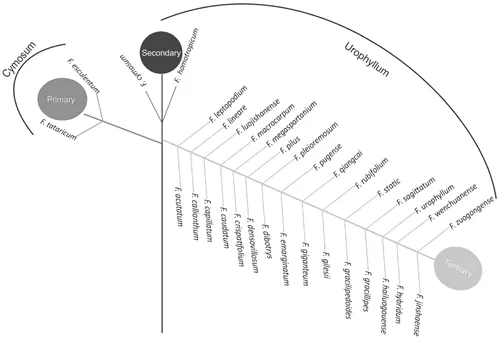
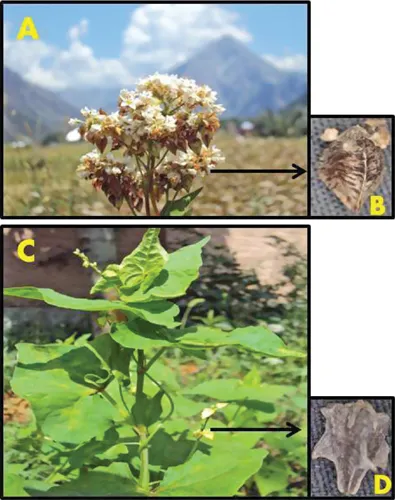
The name Fagopyrum is derived from the Greek word fagos meaning “beech” and pyrum meaning “wheat,” and the common name, buckwheat, is from Buchswein, German for beech-wheat because of the triangular seeds that look like little beech-nuts (Paulickova 2008). However, it is neither a nut nor a cereal but is categorized as a separate group called pseudocereals because it has both similarities and dissimilarities with cereals. Further, it is not considered a true cereal because cereals are monocots, unlike buckwheat, which is dicot and contains a cereal-like starchy endosperm. Reports have also revealed that, depending on their botanical origin, the starch granules of buckwheat differ in size, shape and composition (Farooq et al. 2016). The morphology of buckwheat shows that it is an annual, broad-leafed plant and attains a maximum height of about 0.6–1.5 meters (Skrabanja et al. 2004). Buckwheat belongs to the family Polygonaceae and genus Fagopyrum, which comprises approximately 34 species including both diploids (2n = 16) and tetraploids (2n = 4x= 32) (Zhou et al. 2018; Singh et al. 2020); likewise, some new species have recently been included, namely Fagopyrum crispatifolium (Liu et al. 2008), Fagopyrum pugense (Tang et al. 2010), Fagopyrum wenchuanense (Shao et al. 2011) and Fagopyrum qiangcai (Shao et al. 2011), which are well characterized both taxonomically as well as phylogenetically (Zhou et al. 2012). Further, Fagopyrum is categorized into two groups, i.e. the cymosum group, which has big lusterless achene partly enclosed with insistent perianths, and consists of 8 species; and the urophyllum group, which has small lustrous achene thoroughly enclosed with insistent perianths and constitutes approximately 16 species (Ohnishi and Matsuoka 1996; Ohnishi 2016; Zhou et al. 2018). F. esculentum, F. tataricum, F. homotropicum and F. cymosum are included in the cymosum group along with the allotetraploid perennial species, i.e. F. cymosum and its two diploid varieties, F. cymosum var. pilus and F. cymosum var. megaspartanium of the cymosum group, forming the cymosum complex (Chen 1999) (Figure 1.1). Ohnishi (2016) reported that these can readily cross within the complex and are closely related to each other. Data has also revealed that F. megaspartanium and F. pilus of the cymosum complex might be the ancestors of the two commonly cultivated buckwheat species, i.e. F. tataricum and F. esculentum, based on certain parameters such as the meiotic behavior of hybrid chromosome, DNA polymorphism and allozyme analyses (Chen 2001; Ohsako and Ohnishi 2000; Li et al. 2013; Chen et al. 2004). In Jammu and Kashmir, four different Fagopyrum species are cultivated, viz. F. esculentum Moench, F. tataricum Gaertn., F. sagittatum Gilib. and F. kashmirianum Munshi (Munshi 1982; Tahir and Farooq 1988) and one species, viz. F. cymosum Meissn, which grows wild and is propagated through rhizome (Tahir and Farooq 1989). Moreover, the species of buckwheat that have been found so far are diploid (2n = 16), except F. cymosum and F. gracilipes, which are tetraploid in nature (4n = 32). Buckwheat is characterized by a single, upright and hollow stem that exhibits color variation ranging from green to red and turns brown at maturity. The shape of the leaves is heart-shaped or triangular, 5–7 cm long, and is arranged alternately on the stem. The flower is attractive and is usually clustered in racemes at the tip of branches or on short pedicles emerging from the leaf axils, and the inflorescence is composed of 7–9 blossoms. Moreover, the flowers are bisexual in nature with apparent parts that include 3–5 sepals and petals (tepals), 6–9 stamens and a single pistil, and the color of the flower ranges from white or light green to pink or red (Cawoy et al. 2009). The ovary is superior and possesses one locule with an egg that develops into an achene, and the base of the ovary is associated with nectar-secreting glands. One of the specialized properties of buckwheat is that it exhibits sexual dimorphism, i.e. it comprises of two types of flowers, viz. pin flowers consisting of a short stamen and long pistil and thrum flowers with a long stamen and short pistil. Depending upon the variety, the shape of the seeds varies from triangular to wing-shaped, and the texture of the seeds ranges from glossy brown or black to silvery gray (Krkoskova and Mrazova 2005) (Figure 1.2). The seed comprises an outer thick covering (hull) with a lesser density than water and an inner part (groat) that resembles a cereal kernel in its raw chemical composition and structure. Li and Zhang (2001) reported that the stiffness of the hull depends upon the cultivar; for example, F. esculentum has a softer scale than its relative species F. tataricum. In addition, buckwheat has a dense and fibrous root system with a deep taproot that makes up about 3–4% of the total plant weight (Woo et al. 2016); this plays a pivotal role in various physiological processes such as promoting earthworm activity and thus enhancing the porosity of the soil (Farooq et al. 2016).
FIGURE 1.1 Classification of genus Fagopyrum on the basis of distinct morphological identification that forms the base of gene pool classification.
FIGURE 1.2 Images of buckwheat, showing the growth habit of cultivated buckwheat (Fagopyrum esculentum) and the seed (A and B), with a comparison of the seed of Tartary buckwheat (Fagopyrum tataricum) (C and D).

Origin and Distribution

Buckwheat is believed to have originated in central Asia, but the origins of its domestication date back 4,000–5,000 years in southern China (Gondola and Papp 2010). Li and Yang (1992) reported that in China, the earliest findings of buckwheat came from a tomb of the Western H...

Table of contents

  1. Cover
  2. Half-Title
  3. Title
  4. Copyright
  5. Dedication
  6. Contents
  7. Foreword
  8. Preface
  9. Acknowledgments
  10. Authors
  11. Chapter 1 Origin and History of Buckwheat
  12. Chapter 2 Cultivation and Agronomic Practices of Buckwheat
  13. Chapter 3 Journey of Buckwheat to Functional Food Sector
  14. Chapter 4 Buckwheat: A Future Crop to Combat Abiotic Stress
  15. Chapter 5 Reasons for Declining Buckwheat Production
  16. Chapter 6 Strategies for Buckwheat Crop Improvement Using Modern Approaches
  17. Index

Frequently asked questions

Yes, you can cancel anytime from the Subscription tab in your account settings on the Perlego website. Your subscription will stay active until the end of your current billing period. Learn how to cancel your subscription
No, books cannot be downloaded as external files, such as PDFs, for use outside of Perlego. However, you can download books within the Perlego app for offline reading on mobile or tablet. Learn how to download books offline
Perlego offers two plans: Essential and Complete
  • Essential is ideal for learners and professionals who enjoy exploring a wide range of subjects. Access the Essential Library with 800,000+ trusted titles and best-sellers across business, personal growth, and the humanities. Includes unlimited reading time and Standard Read Aloud voice.
  • Complete: Perfect for advanced learners and researchers needing full, unrestricted access. Unlock 1.4M+ books across hundreds of subjects, including academic and specialized titles. The Complete Plan also includes advanced features like Premium Read Aloud and Research Assistant.
Both plans are available with monthly, semester, or annual billing cycles.
We are an online textbook subscription service, where you can get access to an entire online library for less than the price of a single book per month. With over 1 million books across 990+ topics, we’ve got you covered! Learn about our mission
Look out for the read-aloud symbol on your next book to see if you can listen to it. The read-aloud tool reads text aloud for you, highlighting the text as it is being read. You can pause it, speed it up and slow it down. Learn more about Read Aloud
Yes! You can use the Perlego app on both iOS and Android devices to read anytime, anywhere — even offline. Perfect for commutes or when you’re on the go.
Please note we cannot support devices running on iOS 13 and Android 7 or earlier. Learn more about using the app
Yes, you can access Buckwheat: Forgotten Crop for the Future by Tanveer Bilal Pirzadah,Reiaz Ul Rehman in PDF and/or ePUB format, as well as other popular books in Biological Sciences & Biology. We have over one million books available in our catalogue for you to explore.