Rabbits have many uses - as well as being cherished pets, they are bred for their meat and fur, and as laboratory animals. Understanding their genetics and genomics is key to their production and, equally, to their care, welfare and health. Beginning with an introduction to the rabbit, including key information on their evolution, domestication and breed types, this book then concentrates on the genetics and genomics of this valuable animal. This book covers: - Cytogenetics, genetic maps and QTL mapping;- Immunogenetics;- Genetics of coat colour, meat, fibre and fur production, reproduction, disease resistance and more.Concluding with practical applications such as creating transgenic and genome edited rabbits, biotechnical applications and the rabbit as a biomedical model, this book brings this important topic fully up-to-date. It provides an indispensable resource for animal and veterinary researchers and students, as well as rabbit breeders and laboratory scientists.
- 344 pages
- English
- ePUB (mobile friendly)
- Available on iOS & Android
eBook - ePub
Genetics and Genomics of the Rabbit, The
About this book
Trusted by 375,005 students
Access to over 1.5 million titles for a fair monthly price.
Study more efficiently using our study tools.
Information
1 The Evolution, Domestication and World Distribution of the European Rabbit (Oryctolagus cuniculus)
Luca Fontanesi1*, Valerio Joe Utzeri1 and Anisa Ribani1
1Department of Agricultural and Food Sciences, Division of Animal Sciences, University of Bologna, Italy

1.1 The Order Lagomorpha
The European rabbit (Oryctolagus cuniculus, Linnaeus 1758) is a mammal belonging to the order Lagomorpha.
Lagomorphs are such a distinct group of mammalian herbivores that the very word ‘lagomorph’ is a circular reference meaning ‘hare-shaped’ (Chapman and Flux, 1990; Fontanesi et al., 2016). A unique anatomical feature that characterizes lagomorphs is the presence of small peg-like teeth immediately behind the upper-front incisors. For this feature, lagomorphs are also known as Duplicidentata. Therefore, instead of four incisor teeth characteristic of rodents (also known as Simplicidentata), lagomorphs have six. The additional pair is reduced in size. Another anatomical characteristic of the animals of this order is the presence of an elongated rostrum of the skull, reinforced by a lattice-work of bone, which is a fenestration to reduce the weight (Chapman and Flux, 1990; Rose, 2006). The herbivorous diet and the terrestrial mode of life are the primitive conditions of this order (López-Martínez, 1985). All lagomorphs are also characterized by a specific feeding behaviour known as caecotrophy, that is the re-ingestion of soft cecal-derived faeces needed to assure essential vitamin uptake, the digestion of the vegetarian diet and water reintroduction (Hörnicke, 1981).
The order Lagomorpha was recognized as a distinct order within the class Mammalia in 1912, separated from the order Rodentia within which lagomorphs were originally placed (Gidely, 1912; Landry, 1999). Lagomorphs are, however, considered to be closely related to the rodents from which they diverged about 62–100 million years ago (Mya), and together they constitute the clade Glires (Chuan-Kuei et al., 1987; Benton and Donoghue, 2007). Lagomorphs, rodents and primates are placed in the major mammalian clade of the Euarchontoglires (O’Leary et al., 2013).
Modern lagomorphs might be evolved from the ancestral lineage from which derived the †Mimotonidae and †Eurymilydae sister taxa, following the Cretaceous-Paleogene (K-Pg) boundary around 65 Mya (Averianov, 1994; Meng et al., 2003; Asher et al., 2005; López-Martínez, 2008).
The systematics of the order are not completely clear yet and currently under revision by the International Union for Conservation of Nature and Natural Resources (IUCN), Species Survival Commission (SSC), Global Mammal Assessment, and Lagomorph Specialist Group (LSG). The order is divided into two families (Fig. 1.1; Hoffmann and Smith, 2005; Chapman and Flux, 2008; Fontanesi et al., 2016): (i) Ochotonidae (the pikas), with 26 teeth, and (ii) Leporidae (the jackrabbits and hares, and the rabbits), with 28 teeth. According to the most accepted taxonomy, these two families account for a total of 92 living species (Chapman and Flux, 1990; Fontanesi et al., 2016; Melo-Ferreira and Alves, 2018).
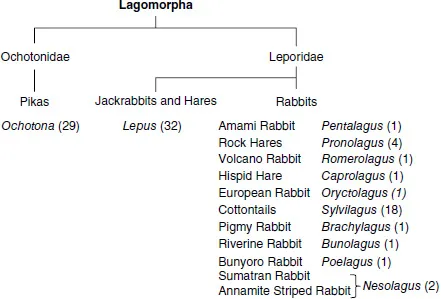
Fig. 1.1. Schematic representation of systematics of the order Lagomorpha (number in parenthesis indicates the number of species within the genera). (Modified from Fontanesi et al., 2016)
Fossil and molecular estimates are not completely in agreement in the identification of the evolutionary split between these two extant families. Fossil data seem consistent in indicating that the divergence period occurred before 42 Mya (Ruedas et al., 2018) even if molecular estimates based on mitochondrial and nuclear genome sequences have placed this family split in a more recent period (about 30 Mya; Matthee et al., 2004). Merging fossil data and molecular estimates, the differentiation time has been placed around 50 Mya (Meredith et al., 2011).
The list of all recognized extant lagomorph species is reported in Table 1.1. The family Ochotonidae comprises 29 species of small (70–300 g) egg-shaped mammals with distinct rounded ears and no visible tail. All species have been assigned to the genus Ochotona. They have hind legs not much longer than the fore legs. Most of these species are vocal. There are two major groups of pikas (Smith, 1988; Smith et al., 1990; Lissovsky, 2014): (i) those that live in rocks or talus have low reproductive rates and are generally long-lived; they are territorial either as individuals or pairs and have extremely low rates of social interaction; and (ii) those that live in meadow or steppe habitat and burrow; they have high reproductive rates and are generally short-lived; these species form extended families and are highly social. These groups have been divided into five subgenera (Alienauroa, Conothoa, Lagotona, Ochotona, and Pika), commonly recognized mainly considering their distribution (Hoffmann and Smith, 2005; Lissovsky, 2014). A recent phylogenomic analysis recognized four subgenera of extant pikas (Alienauroa, Conothoa, Ochotona and Pika), with the mountain group Conothoa being the sister group of all other pikas (Wang et al., 2020).
Table 1.1. List of lagomorph species. (From Chapman and Flux, 1990; Fontanesi et al., 2016; Melo-Ferreira and Alves, 2018)
Family/genus | Species | Common name |
|---|---|---|
Ochotonidae | ||
Ochotona | O. alpina | Alpine Pika |
O. argentata | Helan Shan Pika | |
O. cansus | Gansu Pika | |
O. collaris | Collared Pika | |
O. coreana | Korean Pika | |
O. curzoniae | Plateau Pika | |
O. dauurica | Daurian Pika | |
O. erythrotis | Chinese Red Pika | |
O. forresti | Forrest’s Pika | |
O. gloveri | Glover’s Pika | |
O. hoffmanni | Hoffmann’s Pika | |
O. hyperborea | Northern Pika | |
O. iliensis | Ili Pika | |
O. koslowi | Koslov’s Pika | |
O. ladacensis | Ladak Pika | |
O. macrotis | Large-eared Pika | |
O. matchurica | Mantchurian Pika | |
O. nubrica | Nubra Pika | |
O. opaca | Kazakh Pika | |
O. pallasii | Pallas’s Pika | |
O. princeps | American Pika | |
O. pusilla | Steppe Pika | |
O. roylei | Royle’s Pika | |
O. rufescens | Afghan Pika | |
O. rutila | Turkestan Red Pika | |
O. syrinx | Qinling Pika | |
O. thibetana | Moupin Pika | |
O. thomasi | Thomas’s Pika | |
O. tutuchanensis | Turuchan Pika | |
Leporidae | ||
(the rabbits) | Brachylagus idahoensis | Pygmy Rabbit |
Bunolagus monticularis | Riverine Rabbit | |
Caprolagus hispidus | Hispid Hare | |
Nesolagus netscheri | Sumatran Striped Rabbit | |
Nesolagus timminsi | Annamite Striped Rabbit | |
Oryctolagus cuniculus | European rabbit | |
Pentalagus furnessi | Amami Rabbit | |
Poelagus majorita | Bunyoro Rabbit | |
Pronolagus crassicaudatus | Natal Red Rock Hare | |
Pronolagus randensis | Jameson’s Red Rock Hare | |
Pronolagus rupestris | Smith’s Red Rock Hare | |
Pronolagus saundersiae | Hewitt’s Red Rock Hare | |
Romerolagus diazi | Volcano Rabbit | |
Sylvilagus | S. aquaticus | Swamp Rabbit |
S. audubonii | Desert Cottontail | |
S. bachmani | Brush Rabbit | |
S. brasiliensis (sensu stricto) | Tapetí, Andean Cottontail, Rio de Janeiro Dwarf Cottontail | |
S. cognatus | Manzano Mountain Cottontail | |
S. cunicularius | Mexican Cottontail | |
S. dicei | Dice’s Cottontail | |
S. floridanus | Eastern Cottontail | |
S. gabbi | Gabb’s Cottontail | |
S. graysoni | Tres María Cottontail | |
... |
Table of contents
- Cover
- Title page
- Copyright
- Contents
- Contributors
- Preface
- 1 The Evolution, Domestication and World Distribution of the European Rabbit (Oryctolagus cuniculus)
- 2 Rabbit Breeds and Lines and Genetic Resources
- 3 The Genome of the European Rabbit and Genomic Tools
- 4 Cytogenetics, Physical and Genetic Maps and QTL Mapping in the European Rabbit
- 5 Immunogenetics in the Rabbit
- 6 Genetics and Molecular Genetics of Coat Colour in the European Rabbit
- 7 Genetics of Fibre and Fur Production in Rabbits
- 8 Genetics and Molecular Genetics of Morphological and Physiological Traits and Inherited Disorders in the European Rabbit
- 9 Genetics of Disease Resistance in the European Rabbit
- 10 Genetics and Genomics of Growth, Carcass and Meat Production Traits in Rabbits
- 11 Biology of Reproduction and Reproduction Technologies in the Rabbit
- 12 Genetics of Reproduction in the Rabbit
- 13 Genetic Improvement in the Meat Rabbit
- 14 Rabbit Research in the Post-genomic Era: Transcriptome, Proteome and Metabolome Analyses
- 15 Methods to Create Transgenic and Genome-edited Rabbits
- 16 Pluripotent Stem Cells in Rabbits
- 17 Biotechnology Applications in the Rabbit
- 18 The Rabbit as a Biomedical Model
- Index
Frequently asked questions
Yes, you can cancel anytime from the Subscription tab in your account settings on the Perlego website. Your subscription will stay active until the end of your current billing period. Learn how to cancel your subscription
No, books cannot be downloaded as external files, such as PDFs, for use outside of Perlego. However, you can download books within the Perlego app for offline reading on mobile or tablet. Learn how to download books offline
Perlego offers two plans: Essential and Complete
- Essential is ideal for learners and professionals who enjoy exploring a wide range of subjects. Access the Essential Library with 800,000+ trusted titles and best-sellers across business, personal growth, and the humanities. Includes unlimited reading time and Standard Read Aloud voice.
- Complete: Perfect for advanced learners and researchers needing full, unrestricted access. Unlock 1.5M+ books across hundreds of subjects, including academic and specialized titles. The Complete Plan also includes advanced features like Premium Read Aloud and Research Assistant.
We are an online textbook subscription service, where you can get access to an entire online library for less than the price of a single book per month. With over 1.5 million books across 990+ topics, we’ve got you covered! Learn about our mission
Look out for the read-aloud symbol on your next book to see if you can listen to it. The read-aloud tool reads text aloud for you, highlighting the text as it is being read. You can pause it, speed it up and slow it down. Learn more about Read Aloud
Yes! You can use the Perlego app on both iOS and Android devices to read anytime, anywhere — even offline. Perfect for commutes or when you’re on the go.
Please note we cannot support devices running on iOS 13 and Android 7 or earlier. Learn more about using the app
Please note we cannot support devices running on iOS 13 and Android 7 or earlier. Learn more about using the app
Yes, you can access Genetics and Genomics of the Rabbit, The by Luca Fontanesi in PDF and/or ePUB format, as well as other popular books in Biological Sciences & Biology. We have over 1.5 million books available in our catalogue for you to explore.