- 208 pages
- English
- ePUB (mobile friendly)
- Available on iOS & Android
eBook - ePub
About this book
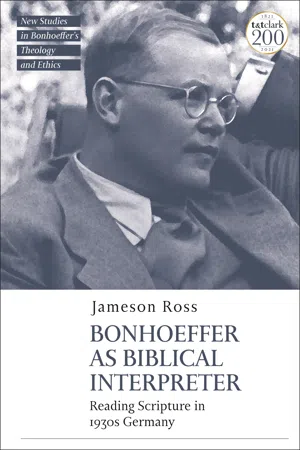
By oscillating between Dietrich Bonhoeffer's explicit hermeneutical reflections and his actual practice of interpreting biblical texts, Jameson E. Ross shows that Bonhoeffer's interpretive acts consist of a theologically self-reflective hermeneutic in which Scripture is for interpretation, underscoring how essential the interpreter's Spirit-given freedom, actions, theology, context and needs are for reading Scripture. Offering a fresh vision for methodological discussions in theology, this book is a valuable resource for graduate and postgraduate students and researchers on modern theology, political theology and ethics, and biblical exegesis.
Trusted by 375,005 students
Access to over 1.5 million titles for a fair monthly price.
Study more efficiently using our study tools.
Information
Chapter 1
Prelude: Framing Interpretation
The claim advanced in this chapter is that Dietrich Bonhoeffer’s student essay of 1925, entitled “Läßt sich eine historische und pneumatische Auslegung der Schrift unterscheiden, und wie stellt sich die Dogmatik hierzu?” [Can One Distinguish between a Historical and Pneumatological Interpretation of Scripture, and How Does Dogmatics Stand to This?], anticipates the various ways he engages the Bible in the 1930s, whether for theological work, preaching, or the training of seminarians. The theological and hermeneutical framework developed in the paper from 1925 serves as a constant for Bonhoeffer’s biblical interpretation. Confirmation of this claim will, in the nature of the case, have to wait until further chapters can demonstrate the relationship of specific interpretive decisions to these more fundamental theological and hermeneutical convictions; what is necessary at this stage is to unfold the character of these convictions, carefully attending to the issues as Bonhoeffer addresses them so that the relationship to what follows can be more clearly seen. This chapter will proceed, then, first by setting up the context within which Bonhoeffer’s paper was written and presented (Section 1). The next sections will consider the content of the paper through an exposition (Section 2) and synthetic summary of some key relations (Section 3), and finally some of the expectations this paper creates for what Bonhoeffer’s engagement with the Bible should look like within the framework he sets out will be forecasted (Section 4).
1. The Setting of Bonhoeffer’s 1925 Paper
After one year at the University of Tübingen, 1923 to 1924, Bonhoeffer began his studies at Berlin University. Preeminent among his professors, both from the standpoint of the university faculty at large and from Bonhoeffer’s perspective, were Adolf von Harnack, Karl Holl, and Reinhold Seeberg (his future doctoral supervisor). These three feature prominently on the course list from the summer semester of 1925, five of seven curriculum items relate to them: Bonhoeffer enrolled in Holl’s “Church History I” and his Seminar in Church History, Seeberg’s “Ethics” and Seminar in Systematics, and Harnack’s “History of the Development of the New Testament and the Apocryphal Gospels.”1 Seeberg’s seminar in systematic theology gave Bonhoeffer his first opportunity to launch out into his chosen field: the product was the subject matter of this chapter, the paper on interpreting Scripture; the grade was simply, “Genügend” [Satisfactory], a bad mark and the worst he would receive during his time at Berlin University.
The reasons the paper did not succeed, as his previous academic attempts had and future ones would, are not difficult to discover. As a 19-year-old student he was overly confident, biting off more than he could possibly chew. The essay ranges from a critique of historical–critical scholarship to an outline of the chief problems with several centuries of Scripture reading to various elements of a doctrine of Scripture to engagement with contemporary issues of dogmatic and exegetical work. The scope is simply too much, leaving sections sparse and clipped in terms of explanation and argumentation. In addition, his confidence at times results in nearly heroic (brash?) claims. For instance, he writes the following in a footnote that seems less likely to actually state his position vis-à-vis the canon but rather as a defense of Luther: “Wir wissen, daß Luther einen sehr kühnen Schritt tut, aber wir wissen auch, daß es im Interesse evangelischen Glaubens liegt, ihn mitzutun” [We know that Luther is taking a very bold step, but we also know that it is in the interest of Protestant faith for us to take it with him].2 At times, he is loose, downright sloppy even, in his formulations, which in certain moments provides the impetus for Seeberg’s attempts to rein him in with some exasperated marks in the margins (Nein! Was heißt das? also!).3 There is no question that the paper is, in a sense, an excellent piece of work completed and presented to the seminar by a bright and independently minded young scholar, but a young and inexperienced scholar nonetheless.
One of the other major reasons the paper did not succeed in academic terms is that Bonhoeffer demonstrated his recent acquaintance with Karl Barth. According to Bethge, in the preceding semester, winter 1924–5, Bonhoeffer started to read Barth’s work.4 Whether it was the result of his cousin Hans-Christoph von Hase sending him Barth’s lecture notes from Göttingen or from the continuing effects of the 1923 Barth-Harnack debate,5 he started to gain a sense of an alternative theological vision, articulated especially in Barth’s second edition of the Römerbrief (1922) and The Word of God and the Word of Man published in 1924.6 Bonhoeffer cites Barth a few times in the essay and is certainly influenced by Barth’s thinking about dogmatics and its relationship to Scripture, but Seeberg was not impressed by his student’s new fascination. On balance though, it seems that Seeberg may have missed the degree to which Bonhoeffer was able to maintain his independence in important places in the essay, demonstrating just how much his Berlin teachers had made their mark on him and anticipating some significant differences between Bonhoeffer and Barth on the Bible as well as some of the most enduring disagreements these two theologians had from 1925 through to 1945.
This is a fascinating relationship and the beginning of many dramatic ups and downs for both men, but it is possible that—at least in regard to the paper from 1925—if it receives too much attention it can distort Bonhoeffer’s own emphasis. Most of the comments made on the 1925 essay focus on Barth’s influence and Bonhoeffer’s negotiating of Barth and Berlin.7 There is no doubting the fact that he is trying to develop something of a via media between these very influential theological paradigms (though it is certainly anachronistic to describe Barth’s project as a “paradigm” at this stage), but the importance of this essay can be seen not exclusively in concert or contrast with Barth but in respect of Bonhoeffer’s theological development itself. The main concern here is what Bonhoeffer says in the essay and how what he says anticipates his future biblical work.
2. The Content of Bonhoeffer’s 1925 Paper
The essay consists of nineteen pages in DBW, containing a brief introduction, four main parts, a conclusion, a bibliography, and a table of contents.8 What follows is an exposition that attempts to unfold the logic and concerns of each section. This is followed by a synthesis that outlines the key relations that inform Bonhoeffer’s conception of the doctrines of revelation and Scripture as well as the shape interpretation should take in their light.
2.1. Exposition
2.1.1. Introduction and Historical Interpretation After an introduction to the subject of his essay, which helpfully and economically serves to anticipate the main themes—revelation, Spirit, and the historical grounding of revelation—Bonhoeffer offers a somewhat polemical description of an approach to interpreting Scripture concerned solely with history. On his reading, the historian, lacking theological interests, still privileges the Bible because of the significant role it has played through the centuries, but at the same time constantly underscores that it is a book among others since it was written by humans who adapted and edited traditions in a variety of historical settings. The historian, as a subject examining a distinct object, begins the work of criticism—textual, literary, form, etc.—leading to comparisons with other religious texts and figures and the identification of preexisting, adopted forms underlying the biblical texts.
Bonhoeffer does affirm a number of aspects of this approach—the validity of leaving dogmatic commitments aside because it is possible they could lead one to misconstrue the research, the recognition that humans wrote the texts and as a result historical means are necessary to understand them, and that the Bible should receive careful attention in the light of its historically significant place in culture—but his problem with an approach that is solely historical is less about these various rationale and more about result. The less than charitable bits arise as asides rather than as a full-frontal attack on the entire historical approach. In the section on various critical methods applied to the Bible, he says:
Nach dieser vollkommenen Zertrümmerung der Texte verläßt die Kritik den Kampfplatz, Schutt und Splitter zurücklassend, ihre Arbeit scheint erledigt.9
After this utter destruction of the texts, criticism leaves the arena: rubble and fragments are left behind; its work is, it seems, finished.
And, to conclude the section:
Aber die Historik bleibt hier stehen und hält ihre Arbeit für beendet.10
However, historical work ceases at this point; it holds its work as completed.
The rhetorical force of the battle metaphor in the first quotation says quite a bit, but it can possibly obscure his actual point made in both of these sentences, which is that the result of a strictly historical approach is that it does not go far enough; it does not do anything after it has applied the various forms of criticism. According to Bonhoeffer, the problem with an approach to interpreting Scripture simply historically is the devastation that is caused and the fact that there are no resources left over to put it all back together again. This section shows his familiarity with the all-conquering discipline associated with his university but also that he has a conception of interpretation—yet to be spelled out in the essay—that assumes a purpose broader than simply demonstrating historical causes, effects, similarities, differences, precedents, and patterns. He writes, “Nun, wir werden weiter sehen” [Not content to remain there, let’s move forward], both to the next section of the essay and also to his real concern for historical and theological interpretation.11
2.1.2. Pneumatological Interpretation The first short section on historical interpretation is followed by a much longer one devoted to pneumatological interpretation, of which there are two forms: one appropriate and the other, according to Bonhoeffer, inappropriate. These two types, though distinct, are united and thus rightly called pneumatological, insofar as both agree on a crucial point: the Bible is God’s word. He writes:
Die erste Aussage aller Pneumatik ist, daß die Bibel nicht nur Wort über Gott, sondern Wort Gottes selbst ist, d. h. irgendwie ist hier der entscheidende Begriff der Offenbarung einzuschalten.12
The first thing to say about all pneumatic interpretation is that the Bible is not only a word about God, but is itself God’s word, that is, in some form or other here the decisive concept of revelation is introduced.
Interpreting the Bible is an activity that puts one into a context in which the Spirit of God—this is pneuma-tological interpretation after all—is at work to make God known. In a telegraphed form, developed to a slightly greater extent in later sections of the paper, Bonhoeffer says that the past is made present: interpretation on the basis of the Spirit is concerned with the past, as is historical interpretation, but it is concerned with it for a specific, present purpose. This kind of interpretation desires to make something of the past in the present or, better, to be shown something of the important and involving relation of God’s past and present. He nods here to a relationship between revelation, its relation to Scripture, and the concrete place of the interpreter. This is the key dynamic in dogmatics, preaching and church life, and getting this key dynamic out of balance leads to an inadequate type of pneumatological interpretation. That inadequate form is treated first. It is insufficient because it fails to discern the right relation between revelation and Scripture: revelation, a divine activity, is wrestled into the human sphere and put to work for various interpretive purposes.
In this section of the essay it is difficult at times to follow the structure of the argument. Bonhoeffer does have a point to make, resources to draw on in making it, and specific negative examples and some implications, but the organization has a tendency to obscure his central insight. To be fair, his paper is not meant to be a history of interpretation so one should not have high expectations of a detailed engagement with much of this material, but it remains a weakness of the paper that topics are introduced extremely briefly, leaving the reader who does not already share the perspective of the author to do quite a bit of work to get up to speed.
The scope of his indictment begins with the early centuries of the church and moves through to ...
Table of contents
- Cover
- Half-title Page
- Series Page
- Title Page
- Contents
- Foreword
- Acknowledgments
- A Note on Translation
- List of Abbreviations
- Introduction
- Chapter 1 Prelude: Framing Interpretation
- Chapter 2 Berlin: Practicing Interpretation in the Academy
- Chapter 3 London: Practicing Interpretation in the Church
- Chapter 4 Interlude: Reframing Interpretation
- Chapter 5 Finkenwalde: Practicing Interpretation in the Seminary
- Conclusion
- Bibliography
- Index
- Copyright Page
Frequently asked questions
Yes, you can cancel anytime from the Subscription tab in your account settings on the Perlego website. Your subscription will stay active until the end of your current billing period. Learn how to cancel your subscription
No, books cannot be downloaded as external files, such as PDFs, for use outside of Perlego. However, you can download books within the Perlego app for offline reading on mobile or tablet. Learn how to download books offline
Perlego offers two plans: Essential and Complete
- Essential is ideal for learners and professionals who enjoy exploring a wide range of subjects. Access the Essential Library with 800,000+ trusted titles and best-sellers across business, personal growth, and the humanities. Includes unlimited reading time and Standard Read Aloud voice.
- Complete: Perfect for advanced learners and researchers needing full, unrestricted access. Unlock 1.5M+ books across hundreds of subjects, including academic and specialized titles. The Complete Plan also includes advanced features like Premium Read Aloud and Research Assistant.
We are an online textbook subscription service, where you can get access to an entire online library for less than the price of a single book per month. With over 1.5 million books across 990+ topics, we’ve got you covered! Learn about our mission
Look out for the read-aloud symbol on your next book to see if you can listen to it. The read-aloud tool reads text aloud for you, highlighting the text as it is being read. You can pause it, speed it up and slow it down. Learn more about Read Aloud
Yes! You can use the Perlego app on both iOS and Android devices to read anytime, anywhere — even offline. Perfect for commutes or when you’re on the go.
Please note we cannot support devices running on iOS 13 and Android 7 or earlier. Learn more about using the app
Please note we cannot support devices running on iOS 13 and Android 7 or earlier. Learn more about using the app
Yes, you can access Bonhoeffer as Biblical Interpreter by Jameson E. Ross in PDF and/or ePUB format, as well as other popular books in Teologia e religione & Studi biblici. We have over 1.5 million books available in our catalogue for you to explore.