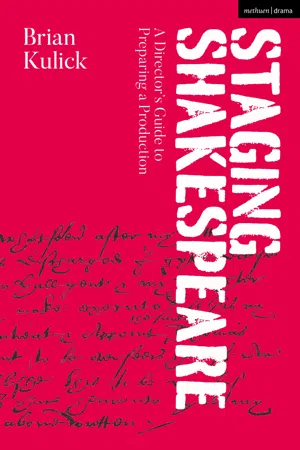
This book begins with a phone call. You answer it and learn that you got the job. Several months from now you're going to stage a Shakespeare play. Now … what do you do? I mean, what do you do after that initial burst of adrenalin has passed through your body and you realize you haven't a clue as to what the play is really about, or what you might want to do with it? How exactly do you prepare for such an equally wonderful and daunting task?
This is the central question of this book. It grows out of decades of preparing for Shakespeare productions and watching others do the same. It will save you some of the panic, wasted time, and fruitless paths experienced. It guides you through the crucial period of preparation and helps focus on such issues as:
· What Shakespeare's life, work, and world can tell us
· What patterns to look for in the text
· What techniques might help unpack Shakespeare's verse
· What approaches might unlock certain hidden meanings
· What literary lenses might bring things into sharper focus
· What secondary sources might lead to a broader contextual understanding
· What thought experiments might aid in visualizing the play
Ultimately, this book draws back the curtain and shows how the antique machinery of Shakespeare's theatre works. The imaginative time span begins from the moment you learn that on such and such date you will begin rehearsing such and such Shakespeare play. Our narrative clock starts ticking the moment you put down the phone and stops when you arrive at the rehearsal hall and begin your first table read. So much of what will be the success or failure of a director's project rests on this work that is done before rehearsals even begin.
- 232 pages
- English
- ePUB (mobile friendly)
- Available on iOS & Android
eBook - ePub
About this book
Trusted by 375,005 students
Access to over 1.5 million titles for a fair monthly price.
Study more efficiently using our study tools.
Information
PART ONE
“It Shall be Inventoried”: A Brief Look at Shakespeare’s Dramatic World
1“Now Sir, What is Your Text?”: Which Shakespeare? Which Text?
When someone says, “I’m doing Shakespeare”, I always want to immediately ask them, “Which Shakespeare?” In other words, is it Early Shakespeare (Two Gentlemen of Verona to Henry V), Middle Shakespeare (As You Like It to Antony and Cleopatra), or Late Shakespeare (Pericles to The Tempest)? Even though these plays are all ostensibly by Shakespeare (sometimes with a little help from Christopher Marlowe, or Thomas Middleton, or even the tavern owner George Wilkins), they are all very different Shakespeares. Not that we have any real idea of who Shakespeare was. Do not be fooled by the wealth of biographies that have emerged from the nineteenth century all the way to the day before yesterday. When you get right down to it, there is probably five pages of actual biographical data on this fellow named William Shakespeare, and what makes up the rest of these books is historical padding, summaries of the plays, and a whole host of surmises. The little actual biographical evidence we have is mostly due to a handful of legal documents. Thank God Shakespeare seems to have been litigious in nature or we would know virtually nothing about the man. Not that we necessarily know that much more about any of his colleagues. Biographies, at that time, were reserved for monarchs, murderers, or martyrs. No one, at least not in England, was paying any real attention to the lives of writers, especially writers of so ephemeral and seemingly irredeemable an art as theatre. And so Shakespeare remains something of a mystery. Borges once quipped, “We worship Shakespeare, and we know as little about Shakespeare as we know about God.”1
Be that as it may, we are left with a body of work, some thirty-seven or so plays, that when placed side by side begin to tell a larger story of sorts. It is the story of a particular writer’s ever-evolving relation to the world. We could call this thirty-seven-volume work, “Portrait of an Artist as an Ever-Evolving Eye.” It is a vision that, over the course of a lifetime, looks at the world from four very distinct vantages points. These ways of being-in-the-world rhyme with William James’s four stages of humankind. This is a system James first articulated in his majestic Varieties of Religious Experience. He names these stages: Once-Born, Twice-Born, The Sick Soul, and (what I will rechristen) The Reborn. Let’s briefly unpack each of these categories of being and then relate them to the phases of Shakespeare’s canon. We will begin with:
Once-Born
From Two Gentlemen of Verona to Henry V
Shakespeare tells us, via Jaques in As You Like It, that there are seven stages of man. William James, the nineteenth-century philosopher and sometimes transcendentalist, reduces these stages down to four. He calls the first stage “once-born” and describes it in the following fashion: “In many persons, happiness is congenital and irreclaimable. ‘Cosmic emotion’ inevitably takes in them the form of enthusiasm and freedom. I speak not only of those who are animally happy. I mean those who, when unhappiness is offered or proposed to them, positively refuse to feel it, as if it were something mean and wrong.”2 James goes on to give us a brief catalog of those that he designates as “once-born.” This includes the Ancient Greeks, the Romans, Saint Augustine, Saint Francis, the young Rousseau, Diderot, “many of the leaders of the eighteenth century anti-Christian movement,” Walt Whitman, and a certain Theodore Parker, who he quotes as writing in a letter: “I have swum in clear sweet waters all my days; and if sometimes they were a little cold, and the stream ran adverse and something rough, it was never too strong to be breasted and swum through.”3
Those who are “once-born” are, to carry this metaphor further, robust swimmers, seemingly unperturbed by whatever rough waters might come their way. They do not lose sight of the other shore, and swim resolutely onward, in the belief that they will reach it. This is very much the case of many of the characters that we find in Shakespeare’s early comedies and histories. Yes, the lovers of Love’s Labour’s Lost, Much Ado About Nothing, and A Midsummer Night’s Dream all meet with a series of dire complications, but everything—ultimately—ends on a positive note, with everyone being made all the better for weathering such hardships. The same is true for Shakespeare’s histories which, if we look at them in the order that they were penned, chronicle a movement from the darkness of the three parts of Henry VI, through Richard III, toward Henry IV Part 1 and Part 2, ultimately reaching their glorious apotheosis in Henry V. There are also characters who do indeed resist the siren call of the once-born. There are such dramatic personages as Titus, Shylock, Don John, and—to a lesser extent—Jaques. But these discordant figures are outnumbered by a veritable army of lovers and warriors who swim onward, against the current, resolute in their goal. These are such figures as Andrew Aguecheek, Antipholus, Berowne, Bianca, Bolingbroke, Bottom, Catherine, Celia, Caesar, Claudio, Clarence, Demetrius, Dogberry, Doll Tearsheet, Don Alonso, Dromio, Duke Senior, Falstaff, Feste, Flute, Friar Lawrence, Hal, Helenia, Hermia, Hero, Hotspur, Jessica, Juliet, Kate, Lysander, Lancelot, Maria, Oberon, Olivia, Orlando, Orsino, Petruchio, Phoebe, Pistol, Portia, Puck, Mistress Quickly, Peter Quince, Richard II, Richard III, Romeo, Sebastian, Sir Toby, Titania, Theseus, Touchstone, Tybalt, and so on.
Now, I know what you’re thinking. You’re thinking, “Wait a minute, back up a bit. Just before Romeo did you actually add Richard III to the list of those who are ‘once-born.’? In what universe is such a taxonomy possible?” Let me attempt to explain, beginning with warriors in general and then the specifics of a dramatic personage like Richard III. James believes that the consciousness of the warriors of ancient Greece and Rome may be “full to the brim of sad mortality,” yet they still comport themselves very much within a “sunlit world” of order.4 He cites the following passage of Homer to support his argument. It is the moment when Achilles is about to slay Lycaon, Priam’s young son. He hears the boy beg for mercy and responds, “Ah, friend, thou too must die: why thus lamentest thou? … There cometh morn or eve or some noonday when my life too some man shall take in battle, whether with spear he smite, or arrow from the string.”5 James goes on,
Then Achilles savagely severs the poor boy’s neck with his sword, heaves him by the foot into the Scamander, and calls to the fishes of the river to eat the white fat of Lycaon. Just as here the cruelty and the sympathy both ring true, and do not mix to interfere with one another, so did the Greeks and Romans keep all their sadnesses and gladnesses unmingled and entire … This integrity of instinctive reactions, this freedom from all moral sophistry and strain, gives a pathetic dignity to ancient pagan feeling.6
This is true for many of the warriors who carve their way through Shakespeare’s bloody tetralogy. Some do succumb to the dark undertow of war; but most make it safely to shore, where they believe history will reward them for their actions. Even as problematic a character as Richard III has something of the once-born in him. How so? Once-borns, to switch metaphors, run undeterred to the finish line. If they should stumble, fall, and skin their knee, they pick themselves back up and continue running until they reach their goal. Richard, we could say, has been crippled by such a fall, tripped up by mother nature herself, which has kept him from fitting in. He is the first to tell us, in the gr...
Table of contents
- Cover
- Half-Title Page
- Dedication
- Title Page
- Contents
- List of Illustrations
- Acknowledgments
- INTRODUCTION “For It Hath No Bottom”: Shakespeare and the Vertigo of Multiple Meaning
- PART ONE “It Shall be Inventoried”: A Brief Look at Shakespeare’s Dramatic World
- 1 “Now Sir, What is Your Text?”: Which Shakespeare? Which Text?
- 2 “And There is Much Music”: Reading the Visible and Invisible Score of Shakespeare
- 3 “Wherefore Are These Things Hid?”: Pattern Recognition in Shakespeare’s Plays
- 4 “Your Actions Are My Dreams”: Structure and Shakespeare
- 5 “Stand and Unfold Yourself”: Revelation of Character in the Works of Shakespeare
- PART TWO “What Means This, My Lord?”: Toward a Fourfold Reading of Shakespeare
- INTRODUCTION Standing in the Textual Garden of Forking Paths
- 6 “To Sing a Song That Old Was Sung”: Plain Readings
- 7 “You Speak a Language That I Understand Not”: Allegorical Readings
- 8 “A Natural Perspective That is and is Not”: Analogical Readings
- 9 “Is Not This Strange?”: Abstract Readings
- PART THREE “Come, Give Us a Taste of Your Quality”: Practical Matters
- 10 “What Say You?”: Finding the Rhyme between Shakespeare, Yourself, and Your Time
- 11 “The Fall of a Sparrow”: Shaping Shakespeare
- 12 “Brave New Worlds”: Designing Shakespeare
- 13 “The World Must be Peopled”: Auditions
- 14 “Resolve You For More Amazement”: The First Day of Rehearsal and Beyond
- Appendix “Volumes That I Prize Above My Dukedom”: Some Helpful Secondary Texts to Have at Hand
- Notes
- Index
- Copyright
Frequently asked questions
Yes, you can cancel anytime from the Subscription tab in your account settings on the Perlego website. Your subscription will stay active until the end of your current billing period. Learn how to cancel your subscription
No, books cannot be downloaded as external files, such as PDFs, for use outside of Perlego. However, you can download books within the Perlego app for offline reading on mobile or tablet. Learn how to download books offline
Perlego offers two plans: Essential and Complete
- Essential is ideal for learners and professionals who enjoy exploring a wide range of subjects. Access the Essential Library with 800,000+ trusted titles and best-sellers across business, personal growth, and the humanities. Includes unlimited reading time and Standard Read Aloud voice.
- Complete: Perfect for advanced learners and researchers needing full, unrestricted access. Unlock 1.5M+ books across hundreds of subjects, including academic and specialized titles. The Complete Plan also includes advanced features like Premium Read Aloud and Research Assistant.
We are an online textbook subscription service, where you can get access to an entire online library for less than the price of a single book per month. With over 1.5 million books across 990+ topics, we’ve got you covered! Learn about our mission
Look out for the read-aloud symbol on your next book to see if you can listen to it. The read-aloud tool reads text aloud for you, highlighting the text as it is being read. You can pause it, speed it up and slow it down. Learn more about Read Aloud
Yes! You can use the Perlego app on both iOS and Android devices to read anytime, anywhere — even offline. Perfect for commutes or when you’re on the go.
Please note we cannot support devices running on iOS 13 and Android 7 or earlier. Learn more about using the app
Please note we cannot support devices running on iOS 13 and Android 7 or earlier. Learn more about using the app
Yes, you can access Staging Shakespeare by Brian Kulick in PDF and/or ePUB format, as well as other popular books in Literature & Shakespeare Drama. We have over 1.5 million books available in our catalogue for you to explore.