Designed to establish a foundational framework for working with trauma-exposed immigrants and refugees, this important work introduces innovative approaches to address client mental health problems while supporting adjustment to life in a new country. This practice-oriented book emphasizes the relevance of Western approaches while reorienting Western concepts to be more culturally sensitive from a domestic and international perspective. Grounded in critical thinking and strengthened by an ecological systems perspective, the book presents six different models for applying and integrating Western theory and related practice strategies for working with individuals, families, groups, communities, organizations, volunteers, and local workforces.
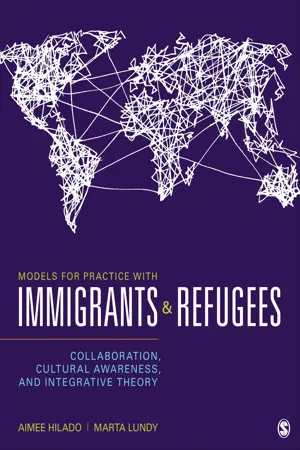
eBook - ePub
Models for Practice With Immigrants and Refugees
Collaboration, Cultural Awareness, and Integrative Theory
- 472 pages
- English
- ePUB (mobile friendly)
- Available on iOS & Android
eBook - ePub
Models for Practice With Immigrants and Refugees
Collaboration, Cultural Awareness, and Integrative Theory
About this book
Trusted by 375,005 students
Access to over 1.5 million titles for a fair monthly price.
Study more efficiently using our study tools.
Information
Chapter 1 Defining The Immigrant And Refugee Populations
Key Terms
nonimmigrants, immigrants, refugees, asylees, deportation, citizenship
Chapter Highlights
- Differences between immigrants, refugees, and asylees
- Reasons for deportation/removal
- Obtaining citizenship
Given current economic, social, and environmental trends, more and more people move across borders to escape persecution, find better employment, find better education for themselves or their children, or to join families already abroad. Once in the new country, social service providers may be providing housing, health, mental health, education supports, or other services. An understanding of legal policies and procedures and knowledge of key terms may help social workers, mental health practitioners, and other human service providers to ensure effective and culturally competent service.
This chapter will provide an understanding of differences between immigrants, refugees, and citizens but will focus on refugees as a particular vulnerable but resilient population. Throughout, the chapter will explore the role that social workers, mental health practitioners, and other providers can play along the way to ensure strong and resilient immigrant and refugee communities.
Key Terms
U.S. Immigration law defines individuals who live outside and come into the United States as “aliens.” This chapter will use the word newcomer, although the word is also not quite accurate. Some individuals have been in the United States for a long time and therefore are not quite “new.” Immigrant, as a legal term of art, refers to individuals who have lawfully immigrated to the United States and are now lawful, permanent residents or have their “green cards.”
Nonimmigrant and Immigrant.
Some individuals may have originally entered for a short term (e.g., to study, to work, to visit). They are called nonimmigrants. 1 There are over 22 categories of nonimmigrants, but reasons individuals typically enter the United States temporarily as nonimmigrants include to visit, to study, or to work temporarily. If later, the nonimmigrant wants to remain in the United States, there are two main avenues for permanent residency. The first is to be sponsored by a family member, and in this way she or he can then become a lawful permanent resident. 2 If an employer sponsors the individual, this too is an avenue toward a lawful permanent residency. 3 Absent family or employment sponsorship, individuals can sponsor themselves, if they can show that they deserve protection from persecution and should not be returned home. 4
1 Immigration and Nationality Act (INA); 8USC 1101 lays out the 22 various categories of non-immigrants—from students to visitors to temporary workers as examples
2 INA Section 203(e)
3 Ibid.
4 Immigration and Nationality Act, The Immigration and Nationality Act of 1952 (Pub. L. 82–414, 66 Stat. 163); Title 8 of the United States Code (8 U.S.C. ch. 12).
Given the dangerous situation of refugees if returned to the country of origin and the need for health and mental health supports in the new host country, this chapter will focus on this population of people who seek protection from persecution and ask that they not be deported.
Refugee and Asylee.
The definition of a refugee, as found in the UN Refugee treaty 5 and as mirrored by the U.S. government in the US Refugee Act 6 defines a refugee as a person who
5 UN 1951 Convention relating to the Status of Refugees, adopted by the United Nations General, Resolution 429(V) of 14 December 1950; amended by the 1967 Protocol relating to the Status of Refugees, Resolution 2198 on December 16, 1966
6 United States Refugee Act of 1980, Pub. L. 96-212; 8 U.S.C. Ch. 12, Sub Ch. I § 1101 et seq.
Owing to well-founded fear of persecution for reasons of race, religion, nationality, membership of a particular social group or political opinion, is outside the country of his nationality and is unable or, owing to such fear, is unwilling to avail himself of the protection of that country.
If the person is OUTSIDE of the United States trying to come in and succeeds, the person enters with the legal designation “refugee.” For example, an Iraqi crosses the border into Jordan and is interviewed by the U.S. authorities in a refugee camp or at the U.S. embassy in Amman, Jordan, applies for protection, meets all of the elements of the refugee definition above, and enters/is resettled to the United States as a “refugee.”
If the person entered the United States as a nonimmigrant—for example, as a visitor, student, temporary worker—or entered with documents and the documents expired, or entered without documents, the person can apply for protection as well. If the individual is already INSIDE the United States and applies for protection and meets all of the elements of the refugee definition above, the applicant gets the legal designation of “asylee.” For example, an Iraqi might enter the United States as a visitor or to study (without having gone through a second country like Jordan, as in the example above), then applies for protection in the United States, is recognized as a refugee, and gets asylum. In both cases, whether applying for protection outside the United States or already inside the United States, the standard is the same: The applicant has to prove “a well-founded fear of persecution on account of race, religion, nationality, or political opinion.” (See Footnote 6.)
In sum, refugee status is given to an individual before entering the United States. Asylum status is granted after someone enters the United States and formally applies for asylum. Many potential asylum seekers enter the United States on visas that do not show that they are fleeing persecution (e.g., short-term visitor visas or student visas) or with no documents at all. These individuals can apply for asylum upon entering the United States. However, as immigrant populations are often viewed with suspicion in the United States, asylum seekers remain at risk of being detained and/or threatened with deportation.
The service provider’s role in supporting an individual applying for asylum can greatly enhance the chances of obtaining asylum. Regardless of the stage in the asylum process— assessing eligibility stage, the application stage (telling the story), and after the interview or hearing—the social worker or mental health provider can make a meaningful difference.
Assessment/Eligibility Stage
Since newcomer individuals might have more contact with service providers than with lawyers (whether public interest or private attorneys), providers can help individuals engage in a first-level “self screening” to see if they are eligible for asylum and then refer to a legal expert. If after discussion the applicant feels she or he might be eligible, the service provider may then help with identifying and referring to attorneys with specialization in immigration and/or refugee law. 7
7 Immigration Advocates maintains a list of nonprofits around the United States that can assist a person in immigration matters. Search by state link: http://www.immigrationadvocates.org/probono/volunteer/
As described above, both international and U.S. law requires that all asylum seekers prove each of the following criteria in order to obtain protection and get asylum:
- Have a well-founded fear of persecution on account of race, religion, national origin, political opinion, or membership in a particular social group
- Must apply for asylum within one year of most recent arrival to the United States. If the applicant is applying AFTER the one-year deadline, service providers can help with applying for a waiver of the failure to meet the deadline (grounds for possible exemptions or waivers will be described below)
The applicant’s narrative, laying out the fear of persecution and on which ground(s) the fear is based is laid out on an immigration form, “Application for Asylum.” 8 This section will dissect each of the elements, so that service providers can help the individual assess whether they are even eligible to apply for asylum.
8 Form I-589, available at http://www.uscis.gov/sites/default/files/files/form/i-589.pdf
Fear.
The first element of the refugee definition that applicants must meet is “fear.” The element of fear is both subjective and objective. Subjective fear refers to the individual’s own fear of persecution. This can be established through the applicant’s candid, sincere, and truthful testimony. The service provider can help the applicant talk and later write about what happened to him- or herself, or to relatives (shootings, torture, dis...
Table of contents
- Cover
- Half Title
- Acknowledgements
- Publisher Note
- Title Page
- Copyright Page
- Contents
- Preface
- About the Editors
- Contributing Authors
- UNIT I Defining Immigrant And Refugee Populations
- Chapter 1 Defining The Immigrant And Refugee Populations
- Chapter 2 The Context Of Migration: Pre-Arrival, Migration, and Resettlement Experiences
- Chapter 3 Physical And Mental Health Stabilization: The Importance of Well-Being to the Adjustment of New Immigrants
- Unit II Theoretical Orientations and Reorientation
- Chapter 4 Transnational Practice as the Client’s Process: Reorienting Practice With an Integrative Theoretical Approach to Practice With Immigrants and Refugees
- Chapter 5 The Perception and Experience of Everyday Discrimination Among U.S. Immigrants
- Chapter 6 Postcolonial Feminist Social Work Perspective: Additional Considerations for Immigrant and Refugee Populations
- Unit III Intervention Modalities Using an Integrative Approach
- Chapter 7 Practice with Individuals
- Chapter 8 Practice With families
- Chapter 9 Support and Psychoeducational Groups for Immigrant Women: A Working Model
- Chapter 10 Community Practice
- Chapter 11 Organizational Practice
- Chapter 12 Preparing a Local and Volunteer Workforce
- UNIT IV Practice Applications With Vulnerable and Trauma-Exposed Immigrants and Refugees
- Chapter 13 Defining Trauma: Practice Applications With Vulnerable and Trauma-Exposed Immigrant Populations and Survivors of Torture
- Chapter 14 Practice Applications With Women
- Chapter 15 Practice Applications With LGBTQ Immigrants and Refugees
- Chapter 16 Practice Applications With Immigrant and Refugee Youth
- Unit V Consolidation
- Chapter 17 Maintaining Critical Consciousness, Collaborative Accompaniment, and Cultural Humility: The Common Denominators of Transnational Practice
- Chapter 18 Social Justice and Implications for the Field
- APPENDIX I Resource List: Working With Immigrants, Refugees, and Asylees
- APPENDIX II Universal Declaration of Human Rights
- APPENDIX III Sample Assessment Outline
- APPENDIX IV Warning! Protect Yourself From Immigration Raids!
- APPENDIX V Safety Planning for Survivors of Violence
- INDEX
Frequently asked questions
Yes, you can cancel anytime from the Subscription tab in your account settings on the Perlego website. Your subscription will stay active until the end of your current billing period. Learn how to cancel your subscription
No, books cannot be downloaded as external files, such as PDFs, for use outside of Perlego. However, you can download books within the Perlego app for offline reading on mobile or tablet. Learn how to download books offline
Perlego offers two plans: Essential and Complete
- Essential is ideal for learners and professionals who enjoy exploring a wide range of subjects. Access the Essential Library with 800,000+ trusted titles and best-sellers across business, personal growth, and the humanities. Includes unlimited reading time and Standard Read Aloud voice.
- Complete: Perfect for advanced learners and researchers needing full, unrestricted access. Unlock 1.5M+ books across hundreds of subjects, including academic and specialized titles. The Complete Plan also includes advanced features like Premium Read Aloud and Research Assistant.
We are an online textbook subscription service, where you can get access to an entire online library for less than the price of a single book per month. With over 1.5 million books across 990+ topics, we’ve got you covered! Learn about our mission
Look out for the read-aloud symbol on your next book to see if you can listen to it. The read-aloud tool reads text aloud for you, highlighting the text as it is being read. You can pause it, speed it up and slow it down. Learn more about Read Aloud
Yes! You can use the Perlego app on both iOS and Android devices to read anytime, anywhere — even offline. Perfect for commutes or when you’re on the go.
Please note we cannot support devices running on iOS 13 and Android 7 or earlier. Learn more about using the app
Please note we cannot support devices running on iOS 13 and Android 7 or earlier. Learn more about using the app
Yes, you can access Models for Practice With Immigrants and Refugees by Aimee Hilado,Marta Lundy, Aimee Hilado, Marta Lundy in PDF and/or ePUB format, as well as other popular books in Social Sciences & Social Work. We have over 1.5 million books available in our catalogue for you to explore.