This extensive reference volume presents the etymological history of thousands of English words.
The story of how words come to be is the story of how humans think, and how we fashion our civilizations. Words can be the product of long and intertwining histories, migrations from other languages, or new coinages of science or slang. This diversity of origins is part of what gives the English language its beauty and power.
In
Dictionary of Word Origins, etymologist Joseph T. Shipley provides a fascinating window into the evolution of modern English, from the onomatopoetic aspect of "abash" to the animalistic origins of "zodiac."
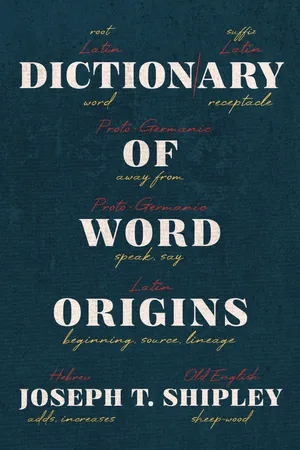
- 442 pages
- English
- ePUB (mobile friendly)
- Available on iOS & Android
eBook - ePub
Dictionary of Word Origins
About this book
Trusted by 375,005 students
Access to over 1.5 million titles for a fair monthly price.
Study more efficiently using our study tools.
Information
C
cab.
See taxi.
cabal.
The mystic element in this word is preserved in Eng. cabbala and cabbalistic. It is by way of LL., from Heb. qabbalah, the received lore, from qabal, to receive. The word was popularized in Eng. during the reign of Charles II, from the fact that the initials of his 1671 ministers spelled the word: Clifford, Arlington, Buckingham, Ashley, Lauderdale. From this Privy Council came the modern cabinet: Fr., from It gabinetto, diminutive of gabbia, cage, from L. cavea, cage, cave, from cavus, hollow. Hence cavity, cavern, excavated. Cp. calf. To cajole is to chatter (esp. to entice wild birds to be caught) like a bird in a cage, from OFr. cageoler; whence also gaol; from the 13th c. spelling gaiole comes Eng. jail. Cabinet is a diminutive of cabin, from ME. caban, perhaps taken directly from Welsh caban, hut, Instead of from the Fr. One suggestion connects gaberdine with this word, as the diminutive of Sp. gaban, great cloak, from cabana, cabin, shelter; cp. cloth.
cabbage.
If you speak of a head of cabbage, you are repeating yourself; for cabbage means head. The name of the vegetable is Fr. choux; it is from Fr. choux cabus, headed cabbage, shortened to cabus, cabbage. By way of OFr. cabuce, from It. capuccio, a little head, it is from L. caput, head. Caput, capit—gives us capital, etc.; cp. achieve. There is a word in heraldry, caboshed, which means with the head full front, high. To cabbage, meaning to filch, may be from this source, figuratively (you put the leaves into a bag to make the vegetable come to a head; and the objects into a bag to slip away with them); or. from OFr. cabasscr, to put into a basket, from OFr. cabas, basket—which may itself be from the same source.
cabin, cabinet
See cabal.
caboose.
This is not related to cab, q.v., but possibly (through the, German) to cabin, being a cabin aus, cr cabaus: originally a cook-room on the deck of a merchant ship (ca. 1760). It Was not applied to the last (trainmen’s) car of a train until ca. 1880, in the U. S.
The ending was perhaps fashioned as in vamoose, q.v., and hoosegow. This is from Mexican Sp. juzgado, huzgado, past participle of juagar, to judge: judged, therefore sentenced, therefore jailed.
cacao.
See vanilla.
cackle.
See laugh.
cad.
The military cadet was once the younger son, from Fr. cadet, from Gase. capdet, diminutive of cap, head; cp. achieve. From this came the use, as caddie (Sc), for errand boy; now limited to one that carries another’s clubs on a golf course. Shortened to cad, this represents the English University opinion of an errand boy, applied to anyone of whom the students disapproved.
caddie.
See cad.
cadence, cadenza.
See decay.
cadet.
See cad.
cadmium.
See element.
caduceus.
Hermes (Roman, Mercury) messenger of the gods, carried a herald’s wand, Gr. kodukion, kedukeion, from kedux, keduk-, herald (related? to L. dux, duc-, leader, ducere, to guide; cp. duke). This wand (an olive branch with two serpents twined) replaced the knotted staff, with one twined serpent, of Aesculapius, as the symbol of medicine: Eng., the caduceus. A snake brought Aesculapius an herb with healing powers; whereupon Pluto, lord of the underworld, asked Zeus to slay him. Far from being a spirit of evil (save to the gods; cp. sotem), the snake, shedding its skin to renew itself, was a symbol of healing. The daughter of Aesculapius was Hygeia (Gr. hygies, healthy), whence Eng. hygiene.
The caduceus must not be confused with Eng. caducty, from L. caducus, infirm, from cadere, to fall; cp. cheat.
Caesarean.
See shed.
cage.
See cabal.
caitiff.
See manoeuvre.
cajole.
See cabal.
cake.
See cheesecake.
calamity.
In late 19th c. England there was a “cult of the Calamus”; Swinburne, W. M. Rossetti and others, in admiration of the American poet Walt Whitman, whose best known work is Leaves of Grass. Various grasses or reeds are called calamus, from L. calamus, from Gr. kalamos, reed. It was long supposed that the damage to cornstalks from hail or mildew produced the word calamity. The ancients assumed this derivation; and Bacon tells that drouth, when the corn cannot come out of the stalk, turns calamus into calamitas (L. calamitas, calomitat—). Today etymologists prefer to guess at an early L. calamis, hurt, which does not exist and has no known ancestors, but which seems to be present in the L. incolumis, safe,
The zinc ore, calamine, may be from calamus, because of the shape of lines in it; but is perhaps corrupted by alchemists from L. cadmio, from Gr. kadmio Calamint was probably from LL. calamentum, —mentum the noun ending; but wa...
Table of contents
- Cover
- Title Page
- Preface
- Abbreviations
- A
- B
- C
- D
- E
- F
- G
- H
- I
- J
- K
- L
- M
- N
- O
- P
- Q
- R
- S
- T
- U
- V
- W
- X
- Y
- Z
- Appendix I
- Appendix II
- Appendix III
- About the Author
- copyright
Frequently asked questions
Yes, you can cancel anytime from the Subscription tab in your account settings on the Perlego website. Your subscription will stay active until the end of your current billing period. Learn how to cancel your subscription
No, books cannot be downloaded as external files, such as PDFs, for use outside of Perlego. However, you can download books within the Perlego app for offline reading on mobile or tablet. Learn how to download books offline
Perlego offers two plans: Essential and Complete
- Essential is ideal for learners and professionals who enjoy exploring a wide range of subjects. Access the Essential Library with 800,000+ trusted titles and best-sellers across business, personal growth, and the humanities. Includes unlimited reading time and Standard Read Aloud voice.
- Complete: Perfect for advanced learners and researchers needing full, unrestricted access. Unlock 1.5M+ books across hundreds of subjects, including academic and specialized titles. The Complete Plan also includes advanced features like Premium Read Aloud and Research Assistant.
We are an online textbook subscription service, where you can get access to an entire online library for less than the price of a single book per month. With over 1.5 million books across 990+ topics, we’ve got you covered! Learn about our mission
Look out for the read-aloud symbol on your next book to see if you can listen to it. The read-aloud tool reads text aloud for you, highlighting the text as it is being read. You can pause it, speed it up and slow it down. Learn more about Read Aloud
Yes! You can use the Perlego app on both iOS and Android devices to read anytime, anywhere — even offline. Perfect for commutes or when you’re on the go.
Please note we cannot support devices running on iOS 13 and Android 7 or earlier. Learn more about using the app
Please note we cannot support devices running on iOS 13 and Android 7 or earlier. Learn more about using the app
Yes, you can access Dictionary of Word Origins by Joseph T Shipley in PDF and/or ePUB format, as well as other popular books in Languages & Linguistics & Historical & Comparative Linguistics. We have over 1.5 million books available in our catalogue for you to explore.