The complaint of Catherine Morland in Jane Austen's Northanger Abbey, that history has 'hardly any women at all' is not an uncommon one. Yet there is evidence to suggest that women have engaged in historical writing since ancient times.
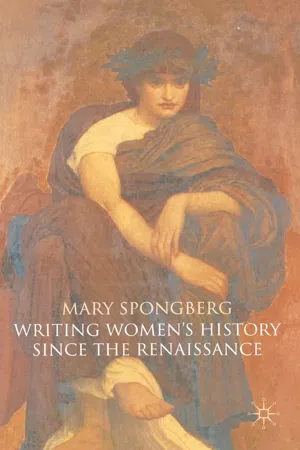
This study traces the history of women's historical writing, reclaiming the lives of individual women historians, recovering women's historical writings from the past and focusing on how gender has shaped the genre of history. Mary Spongberg brings together for the first time an extensive survey of the progress of women's historical writing from the Renaissance to the present, demonstrating the continuities between women's historical writings in the past and the development of a distinctly woman-centred historiography.
Writing Women's History since the Renaissance also examines the relationship between women's history and the development of feminist consciousness, suggesting that the study of history has alerted women to their unequal status and enabled them to use history to achieve women's rights. Whether feminist or anti-feminist, women who have had their historical writings published have served as role models for women seeking a voice in the public sphere and have been instrumental in encouraging the growth of a feminist discourse.
- 308 pages
- English
- ePUB (mobile friendly)
- Available on iOS & Android
eBook - ePub
Writing Women's History Since the Renaissance
About this book
Trusted by 375,005 students
Access to over 1.5 million titles for a fair monthly price.
Study more efficiently using our study tools.
Information
PART I
Men’s History
The object of history is, by nature, man. Let us say, rather, men.
Marc Bloch, Feudal Society, 1944
CHAPTER 1
The Classical Inheritance
There is no more significant pointer to the character of a society than the kind of history it writes or fails to write.
E. H. Carr, What is History, 1961
The cultural dominance of classical literature during the Renaissance established an exclusively masculinist cast to the study of history. Knowledge of a small corpus of classical texts created a cultural hegemony that regulated elite education and determined entrance into the law, the church and the civil service for 500 years. The ‘classical’ education saw women largely excluded from intellectual life, based as it was on an ideal of public life drawn from ancient Athens and Rome. This classical ideal was ideologically underpinned by a gendered notion of separate spheres. Not only were women denied the possibility of a classical education, but that very education reinforced the belief that the exclusion of women who from the public sphere was ‘morally correct’ and ‘in accordance with the whole tradition of western civilisation’.1 From the Renaissance onwards male scholars held a particular scorn for women who usurped the masculine privilege of a classical education and used the historical representation of women in classical texts to argue against the education of women and their entrance into the public sphere.
This chapter will examine how the ideals of the ancient world have shaped modern historiography, particularly in relation to gender. It will argue that gendered prescriptions from the ancient world have hardened into historiographical convention, naturalising the exclusion of women from both the public sphere and the annals of history. It will ask: Why have women been excluded from the masculinist historical tradition? In what ways did ancient historians represent women? How were such ideas taken up by Renaissance scholars, and has this led to a gendering of historical writing since the Renaissance?
The Classical Heritage
The study of ‘the Classics’ has been the preserve of ‘cultured manhood’. In the medieval period the study of classical texts took place in the entirely masculine and enclosed spaces of European monasteries. During the Renaissance it became the core of elite education designed to prepare men of rank for political and civic roles. Renaissance scholars devoted themselves to the studia humanitatis, which included the study of grammar, poetry, rhetoric, history and moral philosophy derived from ancient texts. The term humanitas was taken as meaning a combination of instruction ( paideia) and generosity of spirit ( philanthropia).2 This study of mankind, or ‘humanism’, as it became known, necessarily marginalised women as historical subjects. Although the term ‘humanism’ appears to be an inclusive one, suggesting a universal focus on all things human, its identification with the study of the classics promoted a gender blindness, that rendered ‘invisible all who do not fit the concept of “cultured manhood” ’.3 This gender-blindness would be adopted by the discipline of history that took ‘cultured man’ as the universal human subject.
A classical education was conceived of as an exclusively masculine endeavour, a lengthy and arduous process, which only the strong would survive. Walter J. Ong has likened it to a primitive initiation ritual, in which boys were ‘made to do many things that are hard . . . simply because they are hard’.4 Ancient Rome was the defining point of humanist educational ideology and practice.5 Humanist teachers believed they were replicating the educatio experienced by the male citizens of Rome during the great days of the Roman Republic. This education was supposed to produce ‘the man who can really perform his function as a citizen, who is fitted to the demands both of private and public business, who can guide a state by his counsel, ground it in law and correct it by his judicial decisions’.6 Such an education had come to the Romans from the Greeks, who based their pedagogy around a programme of literature and rhetoric. Greek and Roman teachers maintained that this literary training would provide the young man with ‘a secure foundation for full and active life in the service of the community’.7
This system of education was not practical, rather it served to establish a class of educated literati who operated the network of power relations of the Renaissance state. Learning Latin was the quintessential element of a classical education. The study of ‘dead languages’ – Latin, Greek and Hebrew, would remain the critical core of a classical education.8 This involved detailed readings of Greek or Latin texts, and the composition of prose and verse in these languages. These skills would define a classical education into the twentieth century. The poet T. S. Eliot has suggested that it was important that these languages were ‘dead’, ‘because through their death’ they became an ‘inheritance’.9 Renaissance scholars envisaged the relationship between the ancients and moderns as that of father and son.10
Renaissance humanism was defined by a conscious return to the literary genres of antiquity. Knowledge of history became critical to the Renaissance scholar wanting to interpret ‘their newly recovered literary treasures’.11 The ‘art of history’ was central to humanist studies and was linked to the study of grammar, rhetoric and moral philosophy.12 Renaissance historiography sought to distinguish itself from earlier traditions by its dedication to the ‘truth’.13 The ‘rediscovery’ of these ancient texts provided the Renaissance historian with valuable new source material, and looking to ‘evidence’ from these texts allowed him to distance himself from his medieval predecessors. The emergence of a science of philology during this period brought with it a new sense of historical criticism. Renaissance historians came to see themselves as extracting fact from fiction, putting an end to myths and corrupt traditions of the past and creating ‘an authentic modern history’.14 This involved an attack on anachronism, which until this period had been largely overlooked. The shift away from the monastic scholarship brought with it a new sense of historical time, that ‘assigned a new importance to the transitory material life of this world’.15 It was no longer possible to refer to classical or biblical figures as ‘knights’ or ‘nuns’, as historians had done in the past. Renaissance scholars avoided anachronism and recognised that the past was genuinely different from the present. This new ‘historical sense’ was enhanced by developments and discoveries in archaeology and topography.17 With these changes came a desire to seek only the authentic artefacts of the past and to banish anachronism from historical writing.
The study of history was integral to the success of the classical education, because it allowed scholars to interpret and contextualise ancient texts. While the desire to master classical languages first led Renaissance scholars to the historical writings of the ancients, the study of these historians soon came to be seen as the key to understanding philosophy and political science. The wisdom of ancient historians such as Thucydides and Tacitus became a fundamental guide to ethics and morality. As Thomas Hobbes wrote in the introduction to his translation of Thucydides’s Peloponnesian War in 1625, the ‘principal and proper work of history’ was ‘to instruct and enable men [sic], by knowledge of actions past, to bear themselves prudently in the present and providently in the future’.18 The incorporation of ancient ideals into Renaissance scholarship gendered the writing of history, re-establishing historical study as an exercise in masculine pedagogy and depicting the feminine as somehow ahistorical or outside history. Although few historians would follow the Greek historian Thucydides in his elision of women from history, the conscious return to the literary genres of antiquity saw women polarised as historical subjects. This dualistic representation of women saw them caught between hagiography and misogyny, personifying male attitudes and male interests, Madonna or whore, femme fatale or saint.
The number of people reading history increased exponentially during this period due to the new industry of printing. The writings of ancient historians were extremely popular with the new reader-ship created by the printing press. Peter Burke has estimated that some two and a half million copies of works written by ‘the ancients’ circulated throughout Europe between 1450 and 1700.19 Many of these works appeared in vernacular translations, suggesting an elite and non-elite readership.20 Burke has argued that most of this readership ‘was a captive audience’, that is, ‘schoolboys and university students’. As his language suggests, the audience was predominantly male.21
Humanist historians borrowed their evidence and historical mode from surviving authors of antiquity and adapted them to contemporary conditions and needs. According to Donald R. Kelley, most Renaissance scholars were ‘inclined to accept the moral, pedagogical, political and even philosophical benefits of historical studies and to look to history not only for lessons, but also, increasingly, for legitimacy; imitation (mimesis) was a constant companion of historical curiosity’.22 Most Renaissance histories were modelled upon ancient texts. Leonardo Bruni’s History of the People of Florence (1449), the first humanist history, was patterned in language, style and exterior form on Livy’s History of Rome and Thucydides’s History of the Peloponnesian War.23 Other historians borrowed plots, characters and speeches from ancient writers. ‘[N]obody would simply be a second Livy or Tacitus’24: rather Renaissance historians imitated the literary style of the ancients, often simply substituting modern names for ancient ones.
This imitation went beyond the stylistic. Renaissance scholars looked to history to provide examples ‘to inculcate morality in youth and political wisdom in statesmen’.25 This aspect of historical study became an integral feature of the humanist education. As the French humanist Matthieu Coignet wrote in 1586: ‘We do gain more by reading [histories] in our youth; then by whatsoever is either attributed to sence, or the experience of old men, or to such as have been in farre voyages [sic].’26 The view of history as ‘philosophy teaching by example’ originated in the writings of Dionysius of Halicarnassus (c. 100 BCE) but it came to represent the standard view of history during the Renaissance. The study of history provided ‘a storehouse of examples for imitation and avoidance in the realms of both private and public life’.27
Ancient Historians and the Gendering of History
The valorisation of the moral and political values of the ancient world found in Renaissance scholarship gendered the writing of history. To understand how this retrospection gendered the writing of history it is first necessary to understand how gender featured in the histories of the ancients. Classical learning was deeply imbued with ideas regarding gender relations. During the Renaissance these ideas about women, femininity and m...
Table of contents
- Cover
- Title Page
- Copyright
- Dedication
- Contents
- Acknowledgements
- Introduction: ‘Hardly Any Women At All?’? Women Writers and the Gender of History
- Part I: Men’s History
- Part II: Women’s History
- Conclusion: Dealing with Difference
- Notes
- Index
Frequently asked questions
Yes, you can cancel anytime from the Subscription tab in your account settings on the Perlego website. Your subscription will stay active until the end of your current billing period. Learn how to cancel your subscription
No, books cannot be downloaded as external files, such as PDFs, for use outside of Perlego. However, you can download books within the Perlego app for offline reading on mobile or tablet. Learn how to download books offline
Perlego offers two plans: Essential and Complete
- Essential is ideal for learners and professionals who enjoy exploring a wide range of subjects. Access the Essential Library with 800,000+ trusted titles and best-sellers across business, personal growth, and the humanities. Includes unlimited reading time and Standard Read Aloud voice.
- Complete: Perfect for advanced learners and researchers needing full, unrestricted access. Unlock 1.5M+ books across hundreds of subjects, including academic and specialized titles. The Complete Plan also includes advanced features like Premium Read Aloud and Research Assistant.
We are an online textbook subscription service, where you can get access to an entire online library for less than the price of a single book per month. With over 1.5 million books across 990+ topics, we’ve got you covered! Learn about our mission
Look out for the read-aloud symbol on your next book to see if you can listen to it. The read-aloud tool reads text aloud for you, highlighting the text as it is being read. You can pause it, speed it up and slow it down. Learn more about Read Aloud
Yes! You can use the Perlego app on both iOS and Android devices to read anytime, anywhere — even offline. Perfect for commutes or when you’re on the go.
Please note we cannot support devices running on iOS 13 and Android 7 or earlier. Learn more about using the app
Please note we cannot support devices running on iOS 13 and Android 7 or earlier. Learn more about using the app
Yes, you can access Writing Women's History Since the Renaissance by Mary Spongberg in PDF and/or ePUB format, as well as other popular books in History & Historiography. We have over 1.5 million books available in our catalogue for you to explore.