By utilizing the contributions of a variety of scholars – theologians, historians, and biblical scholars – this book makes the complex and sometimes disparate Anabaptist movement more easily accessible. It does this by outlining Anabaptism's early history during the Reformation of the sixteenth century, its varied and distinctive theological convictions, and its ongoing challenges to and influence on contemporary Christianity.
T&T Clark Handbook of Anabaptism comprises four sections: 1) Origins, 2) Doctrine, 3) Influences on Anabaptism, and 4) Contemporary Anabaptism and Relationship to Others. The volume concludes with a chapter on how contemporary Anabaptists interact with the wider Church in all its variety.
While some of the authorities within the volume will disagree even with one another regarding Anabaptist origins, emphases on doctrine, and influence in the contemporary world, such differences represent the diversity that constitutes the history of this movement.
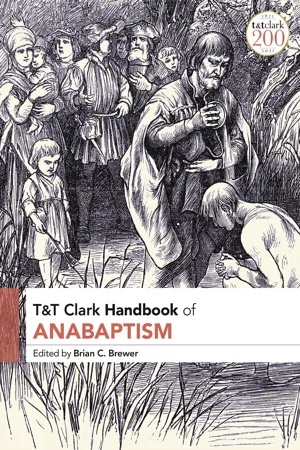
- 648 pages
- English
- ePUB (mobile friendly)
- Available on iOS & Android
eBook - ePub
T&T Clark Handbook of Anabaptism
About this book
Trusted by 375,005 students
Access to over 1.5 million titles for a fair monthly price.
Study more efficiently using our study tools.
Information
PART 1
Origins
Chapter 1
The Polygenesis of the Anabaptists
ANDREA STRÜBIND
TRANSLATED BY JAMES M. STAYER
TRANSLATED BY JAMES M. STAYER
From beginning on, sixteenth-century Anabaptism was a many-sided reality. There were several regional centers with which independent theological ideas were connected that came into existence in distinct ways. These pluriform Anabaptist movements were, however, interconnected with one another in various ways, to which the rigorous persecution by governmental authorities after 1525 made a decisive contribution. In almost all cases the Anabaptist movements were compelled to develop a survival strategy, either as a church or as a network of underground congregations, as well as continuing forced migration.
Presently we distinguish Anabaptists in Switzerland from central and south German Anabaptists, as well as from Low German Anabaptists. Common to all groups is the practice of believer’s baptism and the connected rejection of infant baptism, even when they base their baptismal practice on various theological justifications. A further distinctive characteristic is division from the Reformation movements that cooperated with the magistracies. These Anabaptist groups had various ecclesiological and eschatological conceptions.1
This understanding of Reformation Anabaptism as a plural and internally differentiated movement, encompassing various points of origin and contexts of development, stands in contrast to the distorted unified conception accepted over the centuries that had been pronounced by various reformers (Luther and Bullinger among them). For Luther, the Anabaptists belonged to the “Schwärmer,” a totally pejorative notion he constructed from the beehive of groups that he claimed had a deficiency of “inner and outer” order, which, in his opinion, was the reason for their permanent incitement to rebellion.2 Without making any differentiation among the several groups, he attributed to the Anabaptists an anti-magisterial position and a distortion of Christian teaching.
Heinrich Bullinger, the successor to Zwingli in Zurich, sketched in anti-Anabaptist polemical writings, which were read throughout Europe, the picture of a unified Anabaptism upon which Thomas Müntzer had put his stamp and which culminated in the Anabaptist kingdom at Münster.3 The intensive research of the mid-nineteenth century first illuminated the various Anabaptist movements in their specific characteristics and their regional peculiarities.4 Important impulses of this sort came from Anglo-American scholarship. The free churches associated with Anabaptism, above all the Mennonites, produced a great number of fundamental studies on the history of Anabaptism.5 Here arose once again a unified picture of Anabaptism, whose origin and pacifist orientation in Switzerland was interpreted as normative and consequently distanced from other apocalyptically oriented Anabaptist movements.6 With the “revisionist” scholarship beginning with the 1970s the “polygenetic” origin of Anabaptism, based on extensive published research, has emerged as the consensus in the field.7
In what follows, the history of the origins of the various Anabaptist movements will be described, with reference to chronology and region, with emphasis on the German-speaking lands. The presentation consists of representative examples an d does not claim to be complete. For the further spread of the movements in Europe, reference should be made to the standard work of George H. Williams.8
Anabaptism in Switzerland
An initial Anabaptist movement, which contained numerous impulses for further development, can be identified in Switzerland. That version of Anabaptism resulted from an internal pluralization of the Reformation beginnings in Zurich and its hinterland that began relatively early.9
In many recent publications, groups or individual persons in the early stages of the Reformation who turned against infant baptism were labeled as impulse-givers for the later Swiss Anabaptist movement. That was the case with the lay movement surrounding Nikolaus Storch in Zwickau (c. 1520–2), who from the end of 1521 brought their Reformation concerns to Wittenberg.10 However, with the exception of persons who later had a connection with the Anabaptist movement (e.g., Gerhard Westerburg, Hans Hut) no direct connection can be shown with Anabaptism in Switzerland. In the case of Thomas Müntzer, to whom the later Anabaptist movement in Zurich wrote letters in 1524, and who also criticized infant baptism in his writings, it was a matter of literary reception and their drawing parallels between his fate as a persecuted reformer and their own.11 However, it cannot be denied that impulses for discussion of a Scripture-based practice of baptism were shared between Müntzer and the proto-Anabaptists in Switzerland. Continuing research would be desirable about discourse on baptism in Reformation-oriented humanism, among anti-sacramentalists, and in the early Reformation movements, because these were ultimately at the root of the later Anabaptist movements.
The later Swiss Anabaptist circles had a close connection with Andreas Bodenstein von Karlstadt, with whom they came in direct contact through the printer Andreas Castelberger, and whose writings they circulated among themselves. That applies particularly to his “Dialogus von Tauff der kinder,” from which they drew important arguments in support of believer’s baptism.12 Besides, as will be noted, Karlstadt influenced the early Anabaptist movement in the Low German region. Other critics of infant baptism can be mentioned such as Jakob Strauβ, but also Huldrych Zwingli, who demonstrate that, in the course of the discussion of the scriptural principle by reformers and future reformers, the biblical foundations of infant baptism were questioned, so that in various regions there was a discourse about baptism. This was long before the first believers’ baptisms in Zurich. However, the events connected with the formation of the first Anabaptist congregations through the performance of believers’ baptisms in Zurich and surrounding territories should continue to be regarded as the foundation point of Reformation Anabaptism. That applies also when we take into account the interior differentiation of the Anabaptist movements and various phases of their beginnings.
Conscious of their new authority as laypersons versed in Scripture, from 1523 onward a group of followers of Zwingli pressing for consistent reform opposed the city clergy and members of the governing Council, whom they viewed as hindering the progress of the Reformation through false compromises and inconsistent application of scriptural authority. In Zurich alone there were three lay Bible study circles;13 these lay-initiated groups were of major importance for the development of the early Anabaptist movement and the shaping of its ecclesiology.14 Laypeople recognized the necessity of biblical instruction, which was independent of the traditional and institutionalized practices of the church. The authority of Scripture and the principle of the “priesthood of all believers” as proclaimed by the reformers found their distinctive structures and communicative spheres in these Bible study circles.
As is shown in their collective letters of 1524 to Thomas Müntzer, these proto-Anabaptists understood the true church as a visible community of believers. They pressed for concrete reforms in church practice. The outcome was that these former followers increasingly distanced themselves from their teacher, Zwingli, who was working for an evolutionary process of reform closely coordinated with Zurich’s governing Council.
The first believers’ baptisms took place in Zurich on January 21, 1525, and the first Anabaptist congregation was formed in the village of Zollikon, just outside Zurich. In the following months Anabaptism developed into a mass movement, which, however, was confronted from beginning on with ruthless magisterial persecution.15 Expanding from Zurich and Zollikon in the spring of 1525, the Anabaptist movement was carried by its exiled representatives to Basel, Bern, St. Gallen, Hallau in the canton of Schaffhausen, and Appenzell.16
The Swiss Anabaptist movement remained tightly entwined afterward, transcending cantonal boundaries and connecting its geographical regions, due above all to its early and rigorous persecution. Continued research is called for that follows this complex transregional development. As will be noted in subsequent sections of this survey, the Anabaptist movement spread from Switzerland to Württemberg and the south German cities.
Balthasar Hubmaier
Balthas ar Hubmaier (1480/5–1528), a renowned Anabaptist theologian and reformer in Waldshut and later in Nikolsburg,17 had a close connection to the Swiss Anabaptist movement. Through his foundational writings and his recognized theological competence, he exercised great influence on the Anabaptist movement when it was in its formative phase. A former priest and university theologian, he turned to the Reformation through a protracted process in Waldshut (1521–3). Since Waldshut was a fortified south German city on the border with Switzerland, Hubmaier played an active role in the events of the Zurich Reformation. Beginning in spring 1525 he established himself as a leading Anabaptist theologian, publishing numerous writings in defense of believer’s baptism, while carrying through a short-lived church reform in Waldshut in harmony with the Waldshut Council and the majority of the population.
The Anabaptist church reform, which Hubmaier implemented in Waldshut after April 1525, began with his reception of believer’s baptism in connection with the mission of Wilhelm Reublin, one of the leade...
Table of contents
- Cover
- Half-Title
- Series
- Dedication
- Title
- Contents
- Preface
- Introduction
- Part I Origins
- Part II Doctrine
- Part III Influences
- Part IV Anabaptism Today
- Notes on Contributors
- Index
- Copyright
Frequently asked questions
Yes, you can cancel anytime from the Subscription tab in your account settings on the Perlego website. Your subscription will stay active until the end of your current billing period. Learn how to cancel your subscription
No, books cannot be downloaded as external files, such as PDFs, for use outside of Perlego. However, you can download books within the Perlego app for offline reading on mobile or tablet. Learn how to download books offline
Perlego offers two plans: Essential and Complete
- Essential is ideal for learners and professionals who enjoy exploring a wide range of subjects. Access the Essential Library with 800,000+ trusted titles and best-sellers across business, personal growth, and the humanities. Includes unlimited reading time and Standard Read Aloud voice.
- Complete: Perfect for advanced learners and researchers needing full, unrestricted access. Unlock 1.5M+ books across hundreds of subjects, including academic and specialized titles. The Complete Plan also includes advanced features like Premium Read Aloud and Research Assistant.
We are an online textbook subscription service, where you can get access to an entire online library for less than the price of a single book per month. With over 1.5 million books across 990+ topics, we’ve got you covered! Learn about our mission
Look out for the read-aloud symbol on your next book to see if you can listen to it. The read-aloud tool reads text aloud for you, highlighting the text as it is being read. You can pause it, speed it up and slow it down. Learn more about Read Aloud
Yes! You can use the Perlego app on both iOS and Android devices to read anytime, anywhere — even offline. Perfect for commutes or when you’re on the go.
Please note we cannot support devices running on iOS 13 and Android 7 or earlier. Learn more about using the app
Please note we cannot support devices running on iOS 13 and Android 7 or earlier. Learn more about using the app
Yes, you can access T&T Clark Handbook of Anabaptism by Brian C. Brewer in PDF and/or ePUB format, as well as other popular books in Theology & Religion & Christian Denominations. We have over 1.5 million books available in our catalogue for you to explore.