![]()
Apple’s MacBook range of laptop computers is stylish and user-friendly. This chapter introduces the MacBook range so that you can choose the best one for your mobile computing needs.
About MacBooks
MacBook Models
MacBook Jargon Explained
Getting Comfortable
Input Devices
MacBook Power Cable
Cleaning a MacBook
Spares and Accessories
About MacBooks
When Apple Computer, Inc. (renamed Apple Inc. in 1997) introduced its iMac range of desktop computers in 1998 it was a major breakthrough. To try to match the success of the iMac, Apple began working on a new range of notebook computers. It first entered this market seriously with the Macintosh Portable in 1989. In 1991, Apple introduced the PowerBook range of laptops, which was the forerunner to the MacBook range.
In 1999, a new range of Apple laptops was introduced. This was the iBook range, aimed firmly at the consumer market. In May 2006, the MacBook range first appeared. The two main reasons for this consolidation were:
•Simplifying Apple’s laptop range under one banner.
•It was during this period that Apple Inc. was moving from PowerPC processors for its computers, to Intel processors.
The MacBook range now consists of:
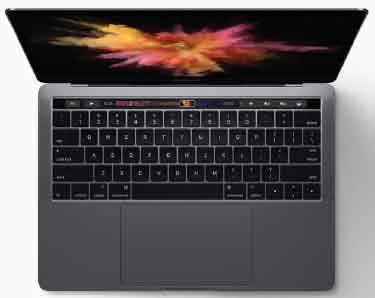
•MacBook Pro 13-inch. The latest MacBook Pro modes come with two different display screen sizes (measured diagonally). One is a 13-inch Retina display screen model and is designed to be as thin and as light as possible. It also has an innovative trackpad with Force Touch technology that provides extra functionality.
•MacBook Pro 16-inch. This is the most powerful version of the MacBook, and like the 13-inch models contains the Touch Bar, for a range of added functionality from the keyboard.
•MacBook Air. This range was designed to be the thinnest and lightest on the market, and it is still an ultraportable laptop and ideal for mobile computing.
The New icon indicates a new or enhanced feature introduced with the latest version of macOS Big Sur on the MacBook.
The MacBook Pro 13-inch and the MacBook Air are the first models to use Apple’s own M1 processor chip, as opposed to Intel ones.
MacBook Models
Specifications for all computers change rapidly, and for the current MacBook range they are (at the time of printing):
MacBook Pro 13-inch
The specifications for this model are:
•Processor: Apple M1 chip, or 2.0GHZ quad-core Intel Core i5 with 6MB shared L3 cache.
•Storage: 256 gigabytes (GB) or 512GB, both configurable up to 2 terabytes (TB).
•Memory: 8GB, configurable to 16GB.
•Ports: Two Thunderbolt/USB 4 ports, with support for USB 3.1.
•Battery: Up to 17 hours of wireless web use.
All MacBooks have a range of energy-saving and environmental features.
The storage and memory on the MacBook range can both be configured to higher levels.
MacBook Pro 16-inch
The specifications for this model are:
•Processor: 2.6GHZ 6-core Intel Core i7, or 2.3GHz 8-core Intel Core i9, with 12MB/16MB shared L3 cache.
•Storage: 512GB or 1TB.
•Memory: 16GB, configurable to 32GB or 64GB.
•Ports: Four Thunderbolt 3/USB-C ports, with support for USB 3.1.
•Battery: Up to 11 hours of wireless web use.
MacBook Air
The specifications for this model are:
•Processor: Apple M1 chip.
•Storage: 256GB or 512GB.
•Memory: 8GB, configurable to 16GB.
•Ports: Two Thunderbolt/USB 4 ports, with support for USB 3.1.
•Battery: Up to 15 hours of wireless web use.
The MacBook Air and the MacBook Pro both have flash storage. This is similar in some ways to traditional ROM (read-only memory) storage, but it generally works faster and results in improved performance.
MacBook Jargon Explained
Since MacBooks are essentially portable computers, a lot of the jargon is the same as for other computers. However, it is worth looking at some of this jargon and the significance it has in terms of MacBooks.
•Processor. Also known as the central processing unit, or CPU, this refers to the processing of digital dat...