- 37 pages
- English
- ePUB (mobile friendly)
- Available on iOS & Android
eBook - ePub
Seedtime and Harvest
About this book
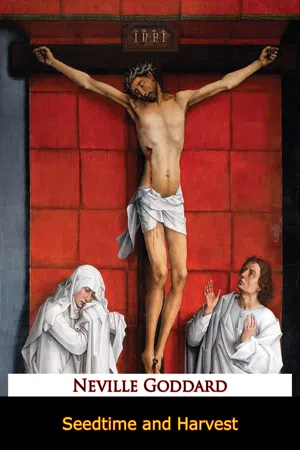
Originally published in 1956, Seedtime and Harvest focuses on key mystical messages that run through Biblical Scripture, showing how familiar Biblical stories and passages provide insight into the metaphysical principles that form the foundation of physical experience. The tale of Cain and Abel, Jacob's ladder dream, and many other passages are explored to spark deeper understanding of consciousness and empowerment. Neville intersperses his interpretive insights into scripture with real-life examples of the workings of spiritual law, helping to show how the Bible can provide important guidance to students no longer comfortable with a literal reading and offering insight to those who seek to reconcile their love of the Christian Bible with non-sectarian truths about being and self-hood.
Tools to learn more effectively

Saving Books

Keyword Search

Annotating Text

Listen to it instead
Information
Topic
Theology & ReligionSubtopic
ReligionTHE FOUR MIGHTY ONES
“And a river went out of Eden to water the garden; and from thence it was parted, and became into four heads.”—Genesis 2:10
“And every one had four faces:...”—Ezekiel 10:14
“I see four men loose, walking in the midst of the fire, and they have no hurt; and the form of the fourth is like the Son of God.”—Daniel 3:25
“Four Mighty Ones are in every man.”—Blake
The “Four Mighty Ones” constitute the selfhood of man, or God in man. There are “Four Mighty Ones” in every man, but these “Four Mighty Ones” are not four separate beings, separated one from the other as are the fingers of his hand. The “Four Mighty Ones” are four different aspects of his mind, and differ from one another in function and character without being four separate selves inhabiting one man’s body.
The “Four Mighty Ones” may be equated with the four Hebrew characters: (characters here) which form the four-lettered mystery-name of the Creative Power from and combining within itself the past, present and future forms of the verb “to be.” The Tetragrammaton is revered as the symbol of the Creative Power in man—I AM—the creative four functions in man reaching forth to realize in actual material phenomena qualities latent in Itself.
We can best understand the “Four Mighty Ones” by comparing them to the four most important characters in the production of a play.
“All the world’s a stage, And all the men and women merely players; They have their exits and their entrances; And one man in his time plays many parts...”—As You Like It: Act II, Scene VII
The producer, the author, the director and the actor are the four most important characters in the production of a play. In the drama of life, the producer’s function is to suggest the theme of a play. This he does in the form of a wish, such as, “I wish I were successful”; “I wish I could take a trip”; “I wish I were married:, and so on. But to appear on the world’s stage, these general themes must somehow be specified and worked out in detail. It is not enough to say, “I wish I were successful” that is too vague. Successful at what? However, the first “Mighty One” only suggests a theme.
The dramatization of the theme is left to the originality of the second “Might One”, the author. In dramatizing the theme, the author writes only the last scene of the play—but this scene he writes in detail. The scene must dramatize the wish fulfilled. He mentally constructs as life-like a scene as possible of what he would experience had he realized his wish. When the scene is clearly visualized, the author’s work is done.
The third “Mighty One” in the production of life’s play is the director. The director’s tasks are to see that the actor remains faithful to the script and to rehearse him over and over again until he is natural in the part. This function may be likened to a controlled and consciously directed attention—an attention focused exclusively on the action which implies that the wish is already realized.
“The form of the Fourth is like the Son of God”—human imagination, the actor. This fourth “Mighty One” performs within himself, in imagination, the pre-determined action which implies the fulfillment of the wish. This function does not visualize or observe the action. This function actually enacts the drama, and does it over and over again until it takes on the tones of reality. Without the dramatized vision of fulfilled desire, the theme remains a mere theme and sleeps forever in the vast chambers of unborn themes. Nor without the co-operant attention, obedient to the dramatized vision of fulfilled desire, will the vision perceived attain objective reality.
The “Four Mighty Ones” are the four quarters of the human soul. The first is Jehovah’s King, who suggests the theme; the second is Jehovah’s servant, who faithfully works out the theme in a dramatic vision; the third is Jehovah’s man, who was attentive and obedient to the vision of fulfilled desire, who brings the wandering imagination back to the script “seventy times seven”. The “Form of the Fourth” is Jehovah himself, who enacts the dramatized theme on the stage of the mind.
“Let this mind be in you, which was also in Christ Jesus: Who, being in the form of God, thought it not robbery to be equal with God:...”—Philippians 2:5, 6
The drama of life is a joint effort of the four quarters of the human soul.
“All that you behold, tho’ it appears without, it is within, in your imagination, of which this world of mortality is but a shadow.”—Blake
All that we behold is a visual construction contrived to express a theme—a theme which has been dramatized, rehearsed and performed elsewhere. What we are witnessing on the stage of the world is an optical construction devised to express the themes which have been dramatized, rehearsed and performed in the imagination of men.
The “Four Mighty Ones” constitute the Selfhood of man, or God in man: and all that man beholds, tho’ it appears without, are but shadows cast upon the screen of space-optical constructions contrived by Selfhood to inform him in regard to the themes which he has conceived, dramatized, rehearsed and performed within himself.
“The creature was made subject unto vanity” that he may become conscious of Selfhood and its functions, for with consciousness of Selfhood and its functions, he can act to a purpose; he can have a consciously self-determined history. Without consciousness, he acts unconsciously, and cries to an objective God to save him from his own creation.
“O Lord, how long shall I cry, and Thou wilt not hear! Even cry out unto Thee of violence, and Thou wilt not save!”—Habakkuk 1:2
When man discovers that life is a play which he, himself, is consciously or unconsciously writing, he will cease from the blind, self-torture of executing judgment upon others. Instead, he will rewrite the play to conform to his ideal, for he will realize that all changes in the play must come from the co-operation of the “Four Mighty Ones” within himself. They alone can alter the script and produce the change.
All the men and women in his world are merely players and are as helpless to change his play as are the players on the screen of the theatre to change the picture. The desired change must be conceived, dramatized, rehearsed and performed in the theatre of his mind. When the fourth function, the imagination, has completed its task of rehearsing the revised version of the play until it is natural,...
Table of contents
- Title page
- TABLE OF CONTENTS
- DEDICATION
- THE END OF A GOLDEN STRING
- THE FOUR MIGHTY ONES
- THE GIFT OF FAITH
- THE SCALE OF BEING
- THE GAME OF LIFE
- “TIME, TIMES, AND AN HALF”
- BE YE WISE AS SERPENTS
- REQUEST FROM THE PUBLISHER
Frequently asked questions
Yes, you can cancel anytime from the Subscription tab in your account settings on the Perlego website. Your subscription will stay active until the end of your current billing period. Learn how to cancel your subscription
No, books cannot be downloaded as external files, such as PDFs, for use outside of Perlego. However, you can download books within the Perlego app for offline reading on mobile or tablet. Learn how to download books offline
Perlego offers two plans: Essential and Complete
- Essential is ideal for learners and professionals who enjoy exploring a wide range of subjects. Access the Essential Library with 800,000+ trusted titles and best-sellers across business, personal growth, and the humanities. Includes unlimited reading time and Standard Read Aloud voice.
- Complete: Perfect for advanced learners and researchers needing full, unrestricted access. Unlock 1.4M+ books across hundreds of subjects, including academic and specialized titles. The Complete Plan also includes advanced features like Premium Read Aloud and Research Assistant.
We are an online textbook subscription service, where you can get access to an entire online library for less than the price of a single book per month. With over 1 million books across 990+ topics, we’ve got you covered! Learn about our mission
Look out for the read-aloud symbol on your next book to see if you can listen to it. The read-aloud tool reads text aloud for you, highlighting the text as it is being read. You can pause it, speed it up and slow it down. Learn more about Read Aloud
Yes! You can use the Perlego app on both iOS and Android devices to read anytime, anywhere — even offline. Perfect for commutes or when you’re on the go.
Please note we cannot support devices running on iOS 13 and Android 7 or earlier. Learn more about using the app
Please note we cannot support devices running on iOS 13 and Android 7 or earlier. Learn more about using the app
Yes, you can access Seedtime and Harvest by Neville Goddard in PDF and/or ePUB format, as well as other popular books in Theology & Religion & Religion. We have over one million books available in our catalogue for you to explore.