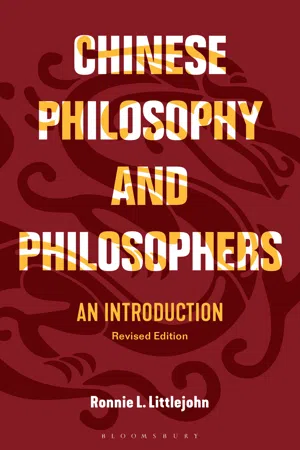
For anyone looking to understand Chinese philosophy, here is the place to start. Introducing this vast and far-reaching tradition, Ronnie L. Littlejohn tells you everything you need to know about the Chinese thinkers who have made the biggest contributions to the conversation of philosophy, from the Han dynasty to the present. He covers:
· The six classical schools of Chinese philosophy (Yin-Yang, Ru, Mo, Ming, Fa, and Dao-De)
· The arrival of Buddhism in China and its distinctive development
· The central figures and movements from the end of the Tang dynasty to the introduction into China of Western thought
· The impact of Chinese philosophers ranging from Confucius and Laozi to Tu Weiming and some of the Western counterparts who addressed similar issues.
Weaving together key subjects, thinkers, and texts, we see how Chinese traditions have profoundly shaped the institutions, social practices, and psychological character of not only East and Southeast Asia, but the world we are living in. Praised for its completely original and illuminating thematic approach, this new edition includes updated reading lists, a comparative chronology of Western and Chinese philosophers, and additional translated extracts.
- 376 pages
- English
- ePUB (mobile friendly)
- Available on iOS & Android
eBook - ePub
About this book
Trusted by 375,005 students
Access to over 1.5 million titles for a fair monthly price.
Study more efficiently using our study tools.
Information
1 Ontology—Questions about the Nature of Reality
哲学
Introduction
This chapter deals with a set of philosophical questions in the category known as ontology. Ontology is not a term that derives from Chinese thought. It comes from two Greek words ontis, meaning “being” or “reality,” “that which is,” and logos, meaning “the study of” or “the knowledge of.” Although ontology is sometimes called “metaphysics,” referring to what can be known about reality beyond what physics or science can tell us, I choose not to employ this term because its use may imply already that there is something beyond what can be known through science or empirical data. Metaphysics is often taken to deal with that which transcends or is beyond natural phenomenon. While we shall see that some Chinese philosophers do include in their ontologies aspects of reality that lie beyond the way things appear to our five senses, generally speaking, all Chinese ontologies start and finish with what they regard as natural, even if sometimes the objects and phenomena produced by natural forces are not accessible by the limited range of human sensory powers (i.e., sight, hearing, touch, etc.).
We should also make a distinction between ontology and cosmology:
• Ontology is the set of philosophical positions concerned with the addressing fundamental questions.
• Cosmology is focused more specifically on the observable movements and processes of the phenomena of the universe.
While ontology concerns itself with the general nature of the entities, qualities, and relationships that compose and constitute reality, cosmology occupies itself with making empirical assertions about existence. Having said this, we may note that the contemporary Chinese philosopher Chung-ying Cheng prefers using the term onto-cosmology of Chinese thought about the nature of reality because he feels it is more accurate than the division of these two approaches, as is done in the West.1 However, for our purposes, we will continue to refer to Chinese ontology, even if as we work our way through the texts and views of Chinese philosophers, we will notice that Cheng’s term does indeed capture much of the Chinese approach to questions of reality. This chapter deals with the following questions of ontology:
• What is reality composed of/made of?
• Is reality of a single type of thing (monism), two types of things (i.e., “dualism”: minds and bodies; matter and spirit; nature and supernature), or many types of things (pluralism)?
• Is reality composed of only constantly changing and transient, impermanent things, or are there enduring, or even eternal and universal components in its composition?
• Is reality actually as it appears to us or is it something different in its true nature from what we are most directly aware of?
• Does reality have a meaning, is it “purposing,” or is it guided by a mind or intelligence to process as it does?
• Does reality follow some internal pattern of its own nature, or is it the case that humans attach and invent meaning and impose it on reality, although it is devoid of purpose in itself?
The Basic Vocabulary of the Chinese Theory of Reality: The “Great Commentary” to the Classic of Changes (Yijing)
The ontology of early Chinese thought comes down to us through a number of philosophical texts that are not traceable to any single author. One of the most important of these texts is the “Great Commentary” (Dazhuan) to the Classic of Changes (Yijing). The Classic of Changes is the name for a complete work that includes two parts. One section is a quite ancient manual of divination known simply as the Changes (Yi) or, more correctly, as the Zhouyi, or the “method of studying the changes of reality developed in the Zhou Dynasty” (Cheng and Ng 2010). Important and usable translations of this text into English include Rutt (2002) and Shaughnessy (1997). It is a handbook traceable to the period and practices of the Western Zhou dynasty as is indicated, among other features, by its use of language expressions found on the bronzes of that period (c. 1046–771 bce). The other section of the Classic of Changes is a set of seven commentaries attached to the Zhouyi. Three of the commentaries are composed of two parts each. Accordingly, taken as a whole, the commentary set making up this second section of the Classic of Changes is known as “The Ten Wings” (Shiyi).
One of these ten commentaries to the Classic of Changes (Yijing) is known by various titles, including the “Great Commentary” (Dazhuan) and “Appended Statements” (Xici). The “Great Commentary” is arguably the most important single text available to us for an understanding of the earliest Chinese ontology. The divination section of the Classic of Changes is much less valuable to us as philosophers.
The “Great Commentary” sketches out the early Chinese worldview that was basic to all of China’s philosophical systems for over two millennia. Just whether it represents a period dating to c. 1500 bce is still a subject of scholarly debate (Liu 2004). It also introduces the fundamental philosophical vocabulary of Chinese ontology that has been employed by Chinese thinkers up to the Modern period. In this case, we are mining out philosophical understandings from a text whose author or authors are unknown to us. However, the editor(s) of this text created what became one of the lasting “Classics” in Chinese intellectual culture.
What Western philosophy calls reality, the philosophers who created the “Great Commentary” generally called by the compound “heaven and earth” (tiandi). As for the process of reality’s change, they used the term dao (道). While there are many uses of the term dao in classical Chinese, Western English-language translators have most often used “way.” This text frequently employs the term Dao as a nominative “the Way” and portrays it as operating according to “heavenly patterns (tian wen)” or Principles (li 理).
The “Great Commentary” speaks of both change and continuity in reality. Reality is composed of one sort of fundamental indestructible substance that may be thought of as a kind of pure energy which Chinese thinkers called qi (氣). Here is how the “Great Commentary” uses several fundamental ontological concepts in relation to each other:
The Yi [i.e., the Classic of Changes] being aligned with heaven and earth, can wholly set forth the Dao of heaven and earth. The Yi looks up to observe the patterns of heaven (tianwen 天文), and looks down to examine the Principles (li 理) of earth. Thus, it knows the causes of darkness and light, origin and ends; it comprehends the meaning of birth and death, it perceives how seminal qi forms into things. Now yin 陰, now yang 陽 move and this is Dao. (“Great Commentary,” Part One, IV and V, Rutt 2002: 411)
In this passage, the author makes use of a robust philosophical vocabulary. Reality (heaven and earth) is qi substance in constant process, but its changes are not arbitrary, chaotic, or haphazard. The term used to capture this order is Dao, which is used for “the Way” that the changing processes of reality follow. This path reveals Principles (li 理) that are evident to one who reflects on the Dao process. The Dao of qi gives rise of itself to forces that move it: it is self-moving and auto-generative (i.e., it is its own cause), according to its internal dynamics of yin and yang.
The “Great Commentary” makes the philosophical claim that not only all reality is in process but also there are patterns to its changes. By tradition, a legendary thinker of antiquity named Fu Xi originally developed a system of eight symbols called trigrams to express these patterns. These trigrams had three lines or rows. An unbroken line was used to indicate the yang forces operative in change and a broken line represented yin forces. According to one interpretation of the trigram figure itself, the first two lines represent yin and yang, and the third represents the relation of the previous two lines standing for reality’s creative advance. Taken in this way, there are eight possible figures. Thus, in Chinese, this set of eight is called the Eight Trigrams (bagua).
In a commentary appended to the Classic of Changes entitled “Discussion of the Trigrams” (shuogua), the trigrams are also used as explanatory devices for the emergence of prominent families, the natural seasons, diverse colors, and varieties of animals. There is no philosophical justification offered in the commentary for these explanatory associations, and we should attribute them to the practitioners who sought to provide more concrete interpretations for the use of the trigrams for the purpose of divination of the future. What is worth noting philosophically is that this elaborate system is rooted in the belief that as qi is in process, it moves according to patterns and not by mere randomness.
If we look in the Zhouyi section, that is, the actual divination or future-telling section of the text of the Classic of Changes, we notice not merely Eight Trigrams, but sixty-four hexagrams (Figure 1).

Figure 1 Classic of Changes trigram and hexagram.
There are various traditions about how the hexagrams emerged. One is that when it came to applying the Eight Trigrams to human experiences and decisions, practitioners ran into the problem that they could not distinguish the inner and outer aspects of changing human events or what we might think of as the subjective inner feeling and the objective outer act with respect to persons’ activities in history and the purpose and event in nature (Cheng 2009b: 76). In order to talk about these aspects of change, the practitioners who were the source of the Zhouyi stacked the Eight Trigrams, typical...
Table of contents
- Cover
- Half-title Page
- Dedication Page
- Series Page
- Title Page
- Contents
- List of Focus Windows
- Preface
- Acknowledgments
- Note on Translations
- Introduction
- 1 Ontology—Questions about the Nature of Reality
- 2 Epistemology—Questions about the Nature and Scope of Knowledge
- 3 Moral Theory—Questions about the Nature and Application of Morality
- 4 Political Philosophy—Questions about the Nature and Purpose of Government
- A Quick Guide to Pronunciation
- Comparative Chronology of Philosophers
- Notes
- Glossary
- References
- Index
- Copyright Page
Frequently asked questions
Yes, you can cancel anytime from the Subscription tab in your account settings on the Perlego website. Your subscription will stay active until the end of your current billing period. Learn how to cancel your subscription
No, books cannot be downloaded as external files, such as PDFs, for use outside of Perlego. However, you can download books within the Perlego app for offline reading on mobile or tablet. Learn how to download books offline
Perlego offers two plans: Essential and Complete
- Essential is ideal for learners and professionals who enjoy exploring a wide range of subjects. Access the Essential Library with 800,000+ trusted titles and best-sellers across business, personal growth, and the humanities. Includes unlimited reading time and Standard Read Aloud voice.
- Complete: Perfect for advanced learners and researchers needing full, unrestricted access. Unlock 1.5M+ books across hundreds of subjects, including academic and specialized titles. The Complete Plan also includes advanced features like Premium Read Aloud and Research Assistant.
We are an online textbook subscription service, where you can get access to an entire online library for less than the price of a single book per month. With over 1.5 million books across 990+ topics, we’ve got you covered! Learn about our mission
Look out for the read-aloud symbol on your next book to see if you can listen to it. The read-aloud tool reads text aloud for you, highlighting the text as it is being read. You can pause it, speed it up and slow it down. Learn more about Read Aloud
Yes! You can use the Perlego app on both iOS and Android devices to read anytime, anywhere — even offline. Perfect for commutes or when you’re on the go.
Please note we cannot support devices running on iOS 13 and Android 7 or earlier. Learn more about using the app
Please note we cannot support devices running on iOS 13 and Android 7 or earlier. Learn more about using the app
Yes, you can access Chinese Philosophy and Philosophers by Ronnie L. Littlejohn in PDF and/or ePUB format, as well as other popular books in Philosophy & Eastern Philosophy. We have over 1.5 million books available in our catalogue for you to explore.