- English
- ePUB (mobile friendly)
- Available on iOS & Android
eBook - ePub
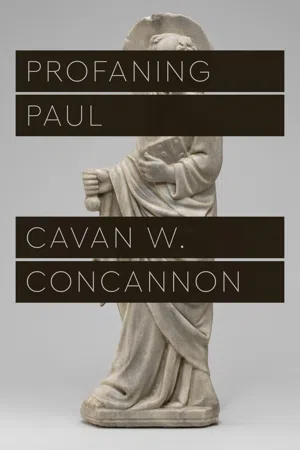
Profaning Paul
About this book
A critical reconsideration of the repeated use of the biblical letters of Paul.
The letters of Paul have been used to support and condone a host of evils over the span of more than two millennia: racism, slavery, imperialism, misogyny, and anti-Semitism, to name a few. Despite, or in some cases because of, this history, readers of Paul have felt compelled to reappropriate his letters to fit liberal or radical politics, seeking to set right the evils done in Paul's name. Starting with the language of excrement, refuse, and waste in Paul's letters, Profaning Paul looks at how Paul's "shit" is recycled and reconfigured. It asks why readers, from liberal Christians to academic biblical scholars to political theorists and philosophers, feel compelled to make Paul into a hero, mining his words for wisdom. Following the lead of feminist, queer, and minoritized scholarship, Profaning Paul asks what would happen if we stopped recycling Paul's writings. By profaning the status of his letters as sacred texts, we might open up new avenues for imagining political figurations to meet our current and coming political, economic, and ecological challenges.
The letters of Paul have been used to support and condone a host of evils over the span of more than two millennia: racism, slavery, imperialism, misogyny, and anti-Semitism, to name a few. Despite, or in some cases because of, this history, readers of Paul have felt compelled to reappropriate his letters to fit liberal or radical politics, seeking to set right the evils done in Paul's name. Starting with the language of excrement, refuse, and waste in Paul's letters, Profaning Paul looks at how Paul's "shit" is recycled and reconfigured. It asks why readers, from liberal Christians to academic biblical scholars to political theorists and philosophers, feel compelled to make Paul into a hero, mining his words for wisdom. Following the lead of feminist, queer, and minoritized scholarship, Profaning Paul asks what would happen if we stopped recycling Paul's writings. By profaning the status of his letters as sacred texts, we might open up new avenues for imagining political figurations to meet our current and coming political, economic, and ecological challenges.
Tools to learn more effectively

Saving Books

Keyword Search

Annotating Text

Listen to it instead
Information
Notes
Except where indicated, all quotations of Bible verses are my own translation.
Searching for Paul in the Bathroom
1. In his important study of the Bible in early modernity, Vincent Wimbush points to how it is not just naïve to believe that the Bible transcends the vagaries of politics: “In point of fact, such an assumption, which aims to make us believe ‘religion’ is above and beyond the usual dynamics of power relations, is itself the most profound effect of the power dynamics.” Wimbush, White Men’s Magic: Scripturalization as Slavery (Oxford: Oxford University Press, 2012), 111.
2. It is not the case that slavery was universally accepted in Paul’s world. Philo of Alexandria tells us that the Jewish sect he knows as the Therapeutae rejected the ownership of slaves as contrary to nature (De vita contemplativa, §70).
3. Taubes’s seminar was published as Jacob Taubes, The Political Theology of Paul, trans. Dana Hollander (Palo Alto, CA: Stanford University Press, 2004); originally published as Die Politische Theologie des Paulus (Munich: Wilhelm Fink Verlag, 1993). Stanislas Breton, A Radical Philosophy of Saint Paul, trans. Joseph N. Ballan (New York: Columbia University Press, 2011); originally published in French as Saint Paul (Paris: Presses universitaires de France, 1988).
4. Ward Blanton has shown that the philosophical engagement with Paul has a much longer history, even if Taubes and Breton can be credited with starting up the conversation anew in particular ways. See his Displacing Christian Origins: Philosophy, Secularity, and the New Testament (Chicago: University of Chicago Press, 2007) and A Materialism for the Masses: Saint Paul and the Philosophy of Undying Life (New York: Columbia University Press, 2014).
5. Alain Badiou, Greece and the Reinvention of Politics, trans. David Broder (London: Verso, 2018), 2–4.
6. See also on this point Jacques Rancière, Moments Politiques: Interventions 1977–2009 (New York: Seven Stories Press, 2014), 189–202.
7. One of the earliest and best formulations of this project is Neil Elliott’s Liberating Paul: The Justice of God and the Politics of the Apostle (Maryknoll, NY: Orbis, 1994). For a critical summary and methodological reevaluation of these studies, which are too many to list, see Christoph Heilig, Hidden Criticism? The Methodology and Plausibility of the Search for a Counter-Imperial Subtext in Paul (WUNT, 392. Tübingen: Mohr Siebeck, 2015; reprint, Minneapolis: Fortress Press, 2017).
8. I am reflecting here on the work of Elisabeth Schüssler Fiorenza, Rhetoric and Ethic: The Politics of Biblical Studies (Minneapolis: Fortress Press, 1999); and Elizabeth A. Castelli, Imitating Paul: A Discourse of Power (Louisville, KY: Westminster/John Knox Press, 1991).
9. Clarice J. Martin, “The Haustafeln (Household Codes) in African American Biblical Interpretation: ‘Free Slaves’ and ‘Subordinate Women,’” in Stony the Road We Trod: African American Biblical Interpretation, ed. Cain Hope Felder (Minneapolis: Fortress Press, 1991), 218–27.
10. Bernadette J. Brooten, “Paul’s Views on the Nature of Women and Female Homoeroticism,” in Immaculate and Powerful: The Female in Sacred Image and Social Reality, ed. Clarissa W. Atkinson, Constance H. Buchanan, and Margaret R. Miles (Boston: Beacon, 1985), 61–87. See also Dale B. Martin, “Heterosexism and the Interpretation of Romans 1:18–32,” Biblical Interpretation 3 (1995): 332–55; and “Arsenokoites and Malakos: Meanings and Consequences,” in Biblical Ethics and Homosexuality: Listening to Scripture, ed. Robert L. Brawley (Louisville, KY: Westminster/John Knox Press, 1996), 115–36.
11. Michel Foucault, “What Is an Author?,” in Language, Counter-Memory, Practice: Selected Essays and Interviews by Michel Foucault, ed. Donald Bouchard (Ithaca, NY: Cornell University Press, 1977), 113–38.
12. Elizabeth A. Castelli, “The Philosophers’ Paul in the Frame of the Global: Some Reflections,” South Atlantic Quarterly 109, no. 4 (2010): 653–76.
13. Brian Thill, Waste (New York: Bloomsbury Academic, 2015), 8. For a similar project linking waste to temporality, see William Varney, Waste: A Philosophy of Things (New York: Bloomsbury, 2014).
14. Melanie Johnson-DeBaufre and Laura S. Nasrallah, “Beyond the Heroic Paul: Toward a Feminist and Decolonizing Approach to the Letters of Paul,” in The Colonized Apostle: Paul through Postcolonial Eyes, ed. Christopher D. Stanley (Minneapolis: Fortress, 2007), 161–74.
15. Timothy Morton, Hyperobjects: Philosophy and Ecology after the End of the World (Minneapolis: University of Minnesota Press, 2013), 112.
16. Thill, Waste, 28.
17. Zygmunt Bauman, Wasted Lives: Modernity and Its Outcasts (Cambridge: Polity, 2004).
18. I do not claim to speak for or to have done justice to all minoritized and marginalized readers and readings of the Pauline archive. My specific focus on garbage and excrement in the Pauline archive has limited the range of scholarly exegetical work to those who have worked particularly on the passages in Philippians and 1 Corinthians where these images occur. For many marginalized communities, Pauline texts have not always been central to their theological and exegetical work. As such, my curation of voices is limited to authors who have directly engaged Paul and his archive.
19. Though they are not the only texts that purport to speak for and about Paul to survive from antiquity, they are the only ones, along with the canonical Acts of the Apostles, that are treated as canon by ...
Table of contents
- Cover
- Title Page
- Copyright Page
- Dedication
- Contents
- Searching for Paul in the Bathroom
- Staying with the Shit
- interlude: feeling like shit
- interlude: owning my shit
- interlude: back to the dump
- Acknowledgments
- Notes
- Index
Frequently asked questions
Yes, you can cancel anytime from the Subscription tab in your account settings on the Perlego website. Your subscription will stay active until the end of your current billing period. Learn how to cancel your subscription
No, books cannot be downloaded as external files, such as PDFs, for use outside of Perlego. However, you can download books within the Perlego app for offline reading on mobile or tablet. Learn how to download books offline
Perlego offers two plans: Essential and Complete
- Essential is ideal for learners and professionals who enjoy exploring a wide range of subjects. Access the Essential Library with 800,000+ trusted titles and best-sellers across business, personal growth, and the humanities. Includes unlimited reading time and Standard Read Aloud voice.
- Complete: Perfect for advanced learners and researchers needing full, unrestricted access. Unlock 1.4M+ books across hundreds of subjects, including academic and specialized titles. The Complete Plan also includes advanced features like Premium Read Aloud and Research Assistant.
We are an online textbook subscription service, where you can get access to an entire online library for less than the price of a single book per month. With over 1 million books across 990+ topics, we’ve got you covered! Learn about our mission
Look out for the read-aloud symbol on your next book to see if you can listen to it. The read-aloud tool reads text aloud for you, highlighting the text as it is being read. You can pause it, speed it up and slow it down. Learn more about Read Aloud
Yes! You can use the Perlego app on both iOS and Android devices to read anytime, anywhere — even offline. Perfect for commutes or when you’re on the go.
Please note we cannot support devices running on iOS 13 and Android 7 or earlier. Learn more about using the app
Please note we cannot support devices running on iOS 13 and Android 7 or earlier. Learn more about using the app
Yes, you can access Profaning Paul by Cavan W. Concannon in PDF and/or ePUB format, as well as other popular books in Theology & Religion & Biblical Criticism & Interpretation. We have over one million books available in our catalogue for you to explore.