- 240 pages
- English
- ePUB (mobile friendly)
- Available on iOS & Android
eBook - ePub
About this book
'If Steve Biko were alive today, we would have a country that gladly embraces African culture as the dominant driving force for how society is organised ...'
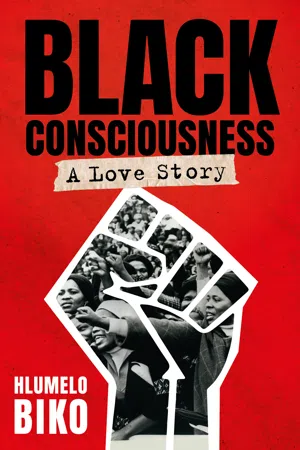
In 1968, two young medical students, Steve Biko and Mamphela Ramphele, fell in love while dreaming of a life free from oppression and racial discrimination. Their love story is also the story of the founding of the Black Consciousness Movement (BCM) by a group of 15 principled and ambitious students at the University of Natal in Durban in the early 1970s.
In this deeply personal book, Hlumelo Biko, who was born of Steve and Mamphela's union, movingly recounts his parents' love story and how the BCM's message of black self-love and self-reliance helped to change the course of South African history.
Based on interviews with some of the BCM's founding members, Black Consciousness describes the early years of the movement in vivid detail and sets out its guiding principles around a positive black identity, black theology and the practice of Ubuntu through community-based programmes.
In spiritual conversation with his father, Hlumelo re-examines what it takes to live a Black Consciousness life in today's South Africa. He also explains why he believes his father – who was brutally murdered by the apartheid police in 1977 – would have supported true radical economic transformation if he were alive today.
Trusted by 375,005 students
Access to over 1.5 million titles for a fair monthly price.
Study more efficiently using our study tools.
Information
HLUMELO BIKO
BLACK
CONSCIOUSNESS
A Love Story
Jonathan Ball Publishers
Johannesburg • Cape Town • London
This book is dedicated to those who, as children,
sacrificed their lives in the Soweto protests on 16 June 1976. None of us would be free without you.
Contents
Title page
Dedication
Introduction
1 Living with loss
2 An oasis of excellence
3 A lioness at the foot of the Soutpansberg
4 The ‘Durban Moment’
5 A movement is born
6 Faith and faithlessness
7 Harnessing the power of ubuntu
8 An unjust trial and unjustifiable murders
9 Sprout
10 Born at the right time
11 Pale skin, white masks
12 The BCM within the ANC
Endnotes
Sources
Acknowledgements
About the Book
Imprint page
Introduction
I often think about how I am going to tell my children the story of their grandparents, the ups and downs of their relationship, and the tragic circumstances surrounding the death of the Black Consciousness Movement (BCM) and the birth of their father. At some point, all children learn that death is an abrupt conclusion to the journey of life, yet I dread the prospect of describing to them the mortifying details of the death of Steve Bantu Biko.
For Luthando Bantu Biko and Imani Mamphela Biko, the 1970s will probably seem like the distant past. Naturally, at their young age, they don’t have a sense of who their grandfather really was and what it was about his life that made it well lived. However, in six years for Luthando and 18 years for newborn Imani, they will reach adulthood and no doubt begin to ask some of the questions that led me to write this book.
Why didn’t their grandparents get an opportunity to enjoy the freedom they fought so very hard for? What impulses caused their grandfather and his many colleagues to launch the BCM? What did he originally mean by the term ‘Black Consciousness’?
I suspect they will also want to know what happened to Black Consciousness in the 21st century. Why are relationships between people still colour-coded in South Africa? Is this colour-coding the reason why social relationships seem to be deteriorating so badly? Furthermore, why is their grandparents’ original vision for this country so radically different from the country we live in today? Given the socio-economic circumstances that most South Africans face, was their grandfather’s death worthwhile?
These are questions that all South Africans should be asking.
In some way or another, we are all beneficiaries of the BCM. Without Black Consciousness, we would still refer to black people in South Africa as ‘non-whites’. We would have neither the language nor the inclination to articulate the patronising behaviour some whites display in their feeble attempts to help black people living in material poverty. We might also have agreed to a post-apartheid dispensation that retained the demeaning concept of ‘homelands’. Most importantly, black people would find it even more difficult than they currently do to express and harness their self-love.
I am a child of the Black Consciousness Movement in both a physical and a spiritual sense. I am privileged to be the product of my parents’ uncompleted union. As with all South Africans born in the 1970s, I have been both blessed and cursed to grow up in the dusk of the movement, when its light shone the brightest and then rapidly faded into the violent darkness of the 1980s. I grew up in a family that has always tried to live the principles of Black Consciousness, and, like my siblings, I have been conscientised through the presence in my life of many of the founding members of the BCM. I am fortunate that I can rely on the wisdom and working memories of these individuals to help answer the challenging questions raised above.
Anyone who has met one of these extraordinary Black Consciousness leaders – for all of them were (and are) leaders in their own right – will feel they have interacted with spiritually and emotionally complete people who share a secret. In speaking to these heroes and heroines over the years, I have discovered that their shared secret was an intense love of self, and of others. This self-love was a source of energy that was used to propel a movement towards the goal of building a free nation. To have loved as they loved, despite the apartheid government’s attempts to humiliate, demean and intimidate them, is one of the greatest achievements one can hope for in life.
We tend to equate love with soft emotions and intangible actions. This is not the type of love I am referring to. This love, or self-love, was an emotional and intuitive construct directly the opposite of what apartheid attempted to create among black South Africans. The architect of apartheid, Hendrik Verwoerd, imagined an outcome that would see black people hate themselves and what they saw of themselves in each other. In Verwoerd’s vision, this self-hate would translate into a future where indigenous people would enslave themselves to the idea of white superiority. For Verwoerd to be successful, indigenous South Africans had to imprison themselves, to be forever classified within a racial category laced with the idea of inferiority.
Black Consciousness challenged Verwoerd’s vision of the basis for white superiority over indigenous South Africans. In fact, the BCM argued that given the moral deficiencies of white right-wing racists and the moral complicity of white liberals, only black people held the moral high ground necessary to set the tone for what the new South Africa should look like.
The founders of the BCM had an indomitable spirit that rejected any restrictions on its right to full expression. Central to the BCM leaders’ experience of self-love was an aversion to the oppression of any individual South African’s spirit. This instinct was embedded in them at a young age when each of them answered, separately at first, the call to fight against apartheid oppression in both its petty and its grand manifestations.
They found the courage to start the fight against discrimination in their own communities and at institutions of learning. This enabled them to espouse a moral standard that many South Africans felt compelled to meet. They built up what Malcolm X described as an ‘internal restraint’ against the learnt instinct to submit to white people. Popularising this internal restraint is the ultimate legacy of the BCM; without it, we would be living in a very different country.
All countries have citizens who love one another and their nation. What Black Consciousness gave its adherents was a deep sense of human connectedness and the awareness of the individual’s capacity for change based on self-knowledge and pride in the preservation of the dignity of all men and women. This gift is one that still helps people today to find a way to live in peace in a country where so many have so little in the midst of abundant material wealth for a few.
Self-worth is what many South Africans have continued to bank on despite the attempts by some, in both business and government, to bankrupt their country. That this sense of self-worth survived the brutal psychosocial onslaught of the apartheid era is part of the legacy of Black Consciousness.
South Africans, like people all over the world, tend to idealise people who commit great acts of courage. We attribute to our heroes and heroines traits that we convince ourselves are unavailable to us. Our heroes therefore seem larger than life, and it is easy to turn them into legends.
The problem with this is that it creates distance between us and those we admire, which can make us think that it must be difficult to follow their lead. This distance can create an excuse for us not to live courageously.
We may not all have access to the examples set by some of the most courageous people walking this planet, but we can overcome the distance between us and them every time we share in their documented wisdom. This will allow us to internalise the spirit of freedom, expressed most loudly on 16 June 1976.
There is an obligation on all of us to make their story part of our and our children’s consciousness. When we do this, we will discover that these Black Consciousness leaders are just like us. The young people behind the BCM were ordinary people, most of whom came from humble beginnings. They were not perfect, and had faults, weaknesses and personal struggles, as we all do.
In their struggle to free their country, these young men and women were driven by the courage of their convictions and their sense of what was right and what was wrong. They were hardened by the pressure they felt to fight a form of tyranny that was as much psychological as it was physical.
They distinguished themselves by creating lasting human connections in communities where they previously didn’t have any direct relationships. They were shaped by these human connections and were guided by them to fight to the bitter end for the material freedom they knew had to accompany the spiritual freedom they had attained.
I hope that you will learn as much from their story as I have. It is one of the greatest untold love stories. It is a love story not only of two individuals – Steve Biko and Mamphela Ramphele – but also of thousands of young South Africans who, by learning how to love themselves, set a new standard for how to love each other. This love story starts in townships and villages scattered around the country and climaxes, in tragic Shakespearean fashion, at a funeral held in eQonce (formerly King William’s Town) on 25 September 1977.
My wish is that when you put this book down, you will understand how self-love and a love for your fellow human beings are like super powers that will allow you to invert what is scarce and what is abundant in life. As it did for the BCM leaders, time will teach us to cherish the abundant things that are nonmaterial in nature. We need to recognise the spiritual poverty suffered by many South Africans today who live with excess material abundance, which often manifests in the abuse of power, in the abuse of drugs and alcohol, or in an intense sense of loneliness. This is the price of pursuing money at all costs.
I hope you will appreciate how some of those who are born into difficult life circumstances compound their difficulties by embracing the narrative that they are poor. Being materially poor should not be a permanent state of being. I trust that the emotional and psychological tools used by the 15 young people at the heart of this love story will be useful in helping those who feel overwhelmed by material poverty. Benchmarking our lives against material wealth obscures the abundance of nonmaterial social capital that we can all freely tap into.
It is critical to create a shared understanding that this inversion of what is scarce and what is abundant can only take place in an environment in which we embrace self-love and self-reliance, value the importance of family – beyond the construct of the nuclear family – and try to restore complementary Black Consciousness programmes in our own communities.
If I succeed in my job as an author and as a parent, my son and daughter will grow up knowing what a powerful tool self-love is in releasing our natural capacity for empathy. As citizens of South Africa we need to use this empathy to build a nation that embraces the knowledge of how trivial the differences are between us as human beings, while recognising the cr...
Table of contents
- 9781776190454
Frequently asked questions
Yes, you can cancel anytime from the Subscription tab in your account settings on the Perlego website. Your subscription will stay active until the end of your current billing period. Learn how to cancel your subscription
No, books cannot be downloaded as external files, such as PDFs, for use outside of Perlego. However, you can download books within the Perlego app for offline reading on mobile or tablet. Learn how to download books offline
Perlego offers two plans: Essential and Complete
- Essential is ideal for learners and professionals who enjoy exploring a wide range of subjects. Access the Essential Library with 800,000+ trusted titles and best-sellers across business, personal growth, and the humanities. Includes unlimited reading time and Standard Read Aloud voice.
- Complete: Perfect for advanced learners and researchers needing full, unrestricted access. Unlock 1.5M+ books across hundreds of subjects, including academic and specialized titles. The Complete Plan also includes advanced features like Premium Read Aloud and Research Assistant.
We are an online textbook subscription service, where you can get access to an entire online library for less than the price of a single book per month. With over 1.5 million books across 990+ topics, we’ve got you covered! Learn about our mission
Look out for the read-aloud symbol on your next book to see if you can listen to it. The read-aloud tool reads text aloud for you, highlighting the text as it is being read. You can pause it, speed it up and slow it down. Learn more about Read Aloud
Yes! You can use the Perlego app on both iOS and Android devices to read anytime, anywhere — even offline. Perfect for commutes or when you’re on the go.
Please note we cannot support devices running on iOS 13 and Android 7 or earlier. Learn more about using the app
Please note we cannot support devices running on iOS 13 and Android 7 or earlier. Learn more about using the app
Yes, you can access Black Consciousness by Hlumelo Biko in PDF and/or ePUB format, as well as other popular books in Politics & International Relations & African Politics. We have over 1.5 million books available in our catalogue for you to explore.