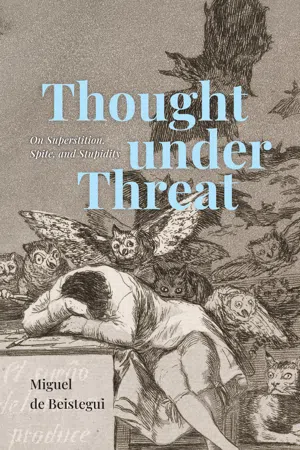
Thought under Threat reveals and combats the forces diminishing the power and role of critical thinking, whether in our individual lives or collectively.
Thought under Threat is an attempt to understand the tendencies that threaten thinking from within. These tendencies have always existed. But today they are on the rise and frequently encouraged, even in our democracies. People "disagree" with science and distrust experts. Political leaders appeal to the hearts and guts of "the people," rather than their critical faculties. Stupidity has become a right, if not a badge of honor; superstition is on the rise; and spite is a major political force. Thinking is considered "elitist."
To see those obstacles as vices of thought, Miguel de Beistegui argues, we need to understand stupidity not as a lack of intelligence or judgment, but as the tendency to raise false problems and trivial questions. Similarly, we need to see spite not as a moral vice, but as a poison that blurs and distorts our critical faculties. Finally, superstition is best described not as a set of false beliefs, but as a system that neutralizes one's ability to think for oneself.
For de Beistegui, thinking is intrinsically democratic and a necessary condition for the exercise of freedom. Thought under Threat shows how a training of thought itself can be used to ward off those vices, lead to productive deliberation, and, ultimately, create a thinking community.
- English
- ePUB (mobile friendly)
- Available on iOS & Android
eBook - ePub
About this book
Trusted by 375,005 students
Access to over 1.5 million titles for a fair monthly price.
Study more efficiently using our study tools.
Information
Topic
PhilosophySubtopic
Epistemology in PhilosophyNotes
Introduction
1. Spinoza, Ethics 5, Prop. 42, Schol.
2. I borrow the term “transcendental delusion” from Linda Martín Alcoff, “Philosophy and Philosophical Practice: Eurocentrism as an Epistemology of Ignorance,” in The Routledge Handbook of Epistemic Injustice, ed. Ian James Kidd, José Medina, and Gaile Pohlhaus Jr. (London: Routledge, 2017), 397–400.
3. In his drama De Beneficiis, Seneca consistently opposes the sapiens and the stultus, the wise man and the stupid or foolish man. See Gerard B. Lavery, “The Adversarius in Seneca’s De Beneficiis,” Mnemosyne, 4th ser., 40, nos. 1/2 (1987): 97–106.
4. T. Adorno and M. Horkheimer, Dialectic of Enlightenment, trans. E. F. N. Jephcott (Stanford, CA: Stanford University Press, 2002), 214; T. Adorno, Minima Moralia: Reflections on a Damaged Life, trans. E. F. N. Jephcott (London: Verso, 2005), § 79.
5. A. Smith, The Glasgow Edition of the Works and Correspondence of Adam Smith, vol. 1, The Theory of Moral Sentiments, ed. D. D. Raphael and A. L. Macfie (Oxford: Oxford University Press, 1976), I.ii.3.7.
6. F. Nietzsche, On the Genealogy of Morality, ed. Keith Ansell-Pearson, trans. Carol Diethe (Cambridge: Cambridge University Press, 1994), 3, § 11.
7. F. Nietzsche, “Mixed Opinions and Maxims,” in Human, All Too Human II, trans. Gary Handwerk (Stanford, CA: Stanford University Press, 2013), 62. Hereafter cited as HH2.
8. Quassim Cassam, Vices of the Mind: From the Intellectual to the Political (Oxford: Oxford University Press, 2019), 2.
9. Cassam, 2.
10. Cassam, 56.
11. Cassam, 3.
12. The relatively new field of epistemic vices, concerned with how we can fail to know certain things, is expanding rapidly. In addition to Cassam’s Vices of the Mind, the following books and articles are particularly relevant for the vices (and some of the virtues) I will be discussing: Heather Battaly, “Varieties of Epistemic Vice,” in The Ethics of Belief: Individual and Social, ed. Jonathan Matheson and Rico Vitz (Oxford: Oxford University Press), 51–76; Quassim Cassam, “Vice Ontology,” Social Epistemology Review and Reply Collective 6 (2017): 20–27; Ian Kidd, “Capital Epistemic Vices,” Social Epistemology Review and Reply Collective 6 (2017): 11–16; Brent J. C. Madison, “On the Nature of Intellectual Vice,” Social Epistemology Review and Reply Collective 6 (2017): 1–6; José Medina, The Epistemology of Resistance: Gender and Racial Oppression, Epistemic Injustice, and Resistant Imaginations (Oxford: Oxford University Press, 2013); Kevin Mulligan, “Foolishness, Stupidity, and Cognitive Value,” The Monist 97, no. 1 (1994): 65–85.
13. Cassam, Vices of the Mind, 2. I have to agree with Cassam that if we define stupidity as “foolishness or lack of common sense” (4), then it can be seen as an intellectual vice. But I will try to argue for stupidity as a force that blocks or inhibits the power of thought; and I will resist the temptation to identify thought with common sense. In the end, what matters is not whether we identify those vices as intellectual (spite, rancor, and resentment are certainly not intellectual, at least not in any obvious way), but how we define them, and we think of the faculty we call “intellect.”
14. M. Foucault, Wrong-Doing, Truth-Telling: the Function of Avowal in Justice, ed. Fabienne Brion and Bernard E. Harcourt, trans. Stephen W. Sawyer (Chicago: University of Chicago Press, 2014), 21.
15. F. Nietzsche, “Schopenhauer as Educator,” in Untimely Meditations, trans. R. J. Hollingdale (Cambridge: Cambridge University Press, 1982), 137. Volume cited hereafter as UM.
16. M. Foucault, “Society Must Be Defended.” Lectures at the Collège de France, 1975–1976, trans. David Macey (London: Penguin Books, 2004), 25.
17. M. Foucault, “Truth and Juridical Forms,” in Essential Works of Michel Foucault, vol. 3, Power, ed. James. D. Faubion (New York: The New Press, 2000), 13; Foucault, “Truth and Power,” in Essential Works: Power, 131.
18. Foucault, “Truth and Power,” in Essential Works: Power, 133.
19. Miranda Fricker, Epistemic Injustice: Power and the Ethics of Knowing (Oxford and New York: Oxford University Press, 2007); Medina, Epistemology of Resistance.
20. Gayatri Chakravorty Spivak, “Can the Subaltern Speak?” in Marxism and the Interpretation of Culture, ed. C. Nelson and L. Grossberg (Champaign: University of Illinois Press, 1988).
21. See Georg Lukács, History and Class Consciousness, trans. Rodney Livingstone (Cambridge, MA: MIT Press, 1971). The concept of hegemony is the unifying thread of Antonio Gramsci’s four-volume Prison Notebooks, or Quaderni del carcere (Turin: Einaudi, 2014). Louis Althusser, “Ideology and Ideological State Apparatuses,”...
Table of contents
- Cover
- Title Page
- Copyright Page
- Contents
- Introduction
- one / On Stupidity
- two / On Superstition
- three / On Spite
- Conclusion
- Acknowledgments
- Notes
- Bibliography
- Index
Frequently asked questions
Yes, you can cancel anytime from the Subscription tab in your account settings on the Perlego website. Your subscription will stay active until the end of your current billing period. Learn how to cancel your subscription
No, books cannot be downloaded as external files, such as PDFs, for use outside of Perlego. However, you can download books within the Perlego app for offline reading on mobile or tablet. Learn how to download books offline
Perlego offers two plans: Essential and Complete
- Essential is ideal for learners and professionals who enjoy exploring a wide range of subjects. Access the Essential Library with 800,000+ trusted titles and best-sellers across business, personal growth, and the humanities. Includes unlimited reading time and Standard Read Aloud voice.
- Complete: Perfect for advanced learners and researchers needing full, unrestricted access. Unlock 1.5M+ books across hundreds of subjects, including academic and specialized titles. The Complete Plan also includes advanced features like Premium Read Aloud and Research Assistant.
We are an online textbook subscription service, where you can get access to an entire online library for less than the price of a single book per month. With over 1.5 million books across 990+ topics, we’ve got you covered! Learn about our mission
Look out for the read-aloud symbol on your next book to see if you can listen to it. The read-aloud tool reads text aloud for you, highlighting the text as it is being read. You can pause it, speed it up and slow it down. Learn more about Read Aloud
Yes! You can use the Perlego app on both iOS and Android devices to read anytime, anywhere — even offline. Perfect for commutes or when you’re on the go.
Please note we cannot support devices running on iOS 13 and Android 7 or earlier. Learn more about using the app
Please note we cannot support devices running on iOS 13 and Android 7 or earlier. Learn more about using the app
Yes, you can access Thought under Threat by Miguel de Beistegui in PDF and/or ePUB format, as well as other popular books in Philosophy & Epistemology in Philosophy. We have over 1.5 million books available in our catalogue for you to explore.