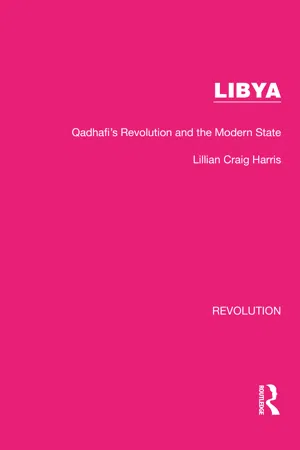
This book, first published in 1986, provides a comprehensive look at the social, cultural, political and economic forces that shaped Libya following the 1969 revolution. Libya's political system under Qadhafi's Third Universal Theory is examined, as are the power structures – military, tribal, economic and religious.
- 172 pages
- English
- ePUB (mobile friendly)
- Available on iOS & Android
eBook - ePub
About this book
Trusted by 375,005 students
Access to over 1.5 million titles for a fair monthly price.
Study more efficiently using our study tools.
Information
1 Libya Through History: Crossroads and Conquest
The story of Libya is one of successive invasions, of armies marching through sand from the east and arriving by ship from the north. Even the Berbers, usually regarded as the original Libyans, were invaders who probably arrived from Southwest Asia around 3,000 B.C. The earliest evidence of human life on the Libyan coastal plain—and in the areas to the south, which were eventually to become the great Saharan Desert—dates from around 8,000 B.C. Prehistoric rock art, painted and carved in profusion in some areas of Fessen and the Tibesti Mountains, illustrates the daily life of the Neolithic hunter, who sought animals now found only in tropical Africa.
The predominant themes of Libyan history are simple: repeated conquest from outside, followed by long periods of foreign dominance, and a lack of internal unity that rendered the region vulnerable to foreign attackers and exploiters. By the early years of this century Libyan nationalism had begun to emerge, but great differences of philosophy and aspiration, much of it based on regionalism, continued to divide the areas that would eventually be unified as Libya. The region of Tripolitania, including the important city of Tripoli and the surrounding areas under its control, looked seaward and, for long periods of history, toward the west for trade and cultural ties. Cyrenaica looked east and eventually came most deeply under Egyptian and eastern Arab influence. Fezzen looked south to black Africa.
In addition to successive invasions by outsiders and lack of regional unity, a dominant feature throughout Libyan history has been the contest for power—usually won by urban dwellers— between coastal towns and hinterland tribes. The aspirations of the nomadic tribes of the hinterland were vastly different from those of the urban elites. This conflict between “the desert and the sown” has not been entirely resolved even today. Regionalism as well as the tensions between rural peoples and urban authority centers remain a feature of modern Libyan life.
An understanding of modern Libya would be impossible without some comprehension of the impact on today’s Libyans of this history of domination by invaders and of the region’s inability to unify. Their history of exploitation is held ever before their eyes by Mu’ammar Abu Minyar al-Qadhafi, who seeks to develop in the Libyan people a sense of colossal historical injustice for which they must be revenged—a sense probably deepened by the bedouin culture that infuses Libyan society. A great part of Qadhafi’s original appeal to the Libyans was his stated determination to throw off the vestiges of colonialism and to replace those Libyan leaders who, through continued subservience to outsiders, had suppressed the country’s free development. Qadhafi’s desire to change the Libyans into actors, rather than those who are constantly acted upon, is a significant motivating factor in his international and domestic policy.
From the Phoenicians to the Turks
The history of the region that eventually came to be known as Libya was determined by its position as a crossroads between Europe, Africa, and the Middle East. Even before the twelfth century b.c., the Phoenicians had established ties with the three Punic towns of Oea (Tripoli), Labdah (Leptis Magna), and Sabratah. From that time as well dates the beginning of the two great trade routes that, until the early part of this century, funneled slaves and merchandise from Central Africa through Libya to the Mediterranean.
The earliest known documentation of Libyan history comes from the time of the Egyptian Old Kingdom (2700-2200 b.c.). In that era Berber tribes known as Lebu, from which the modern name of Libya derived, raided east into the Nile Valley. During the time of the Middle Kingdom (2200-1700 b.c.), the Lebu were eventually subjugated by the Egyptians. In 950 b.c., however, a Berber officer in the Egyptian army seized power and ruled Egypt as Pharoah Shishonk I. His successors in the twenty-second and twenty-third dynasties (950-720) were probably also Libyan Berbers.
By the fifth century b.c. Carthage had extended its control over much of the region of the three cities (Tripolis), holding a position of dominance until it was defeated by Rome in the Punic Wars (264-241 and 218-201 b.c.). Within a century following the final destruction of Carthage in 146 b.c., Tripoli had become a Roman colony. Cyrenaica, however, maintained ties with Greece and was colonized by the Greek states from the seventh century b.c. until the sixth century a.d. Within 200 years, Cyrene and four other city-states (the Pentopolis) were established. Among them was Berenice, later known as Banghazi. Fezzen, the third region of what was to become modern Libya, was loosely controlled by tribal people known as Garamentes from about 1000 b.c. The Garamentes conducted desert caravan trade from Ghadamis to the Niger River in the south, to Egypt in the east, and to Mauritania in the west.
Cyrenaica was subjugated by the Persians under Cambyses in 525 b.c. Following Alexander’s death in 323, it was willed to Ptolemy and ruled from Egypt. Rome annexed the region in 74 b.c., and Cyrene continued its development into one of the intellectual and artistic centers of the ancient world. Septimus Severus, a native of Leptis Magna, rose to become emperor of Rome. He ruled from 193 to 211 during the 400-year period in which both Cyrenaica and Tripolitania remained Roman provinces.
In 429 the Vandals entered North Africa from Spain, establishing a kingdom with its capital at Carthage. The fall of the Vandal kingdom to the Byzantine general Belisarius in 533 led into a brief interlude of Byzantine rule. But political decay exacerbated by religious unrest—both Christianity and Judaism had been major religious forces in North Africa since the second century—presaged the coming change. The door to Arab invasion was left ajar.
Of all Libya’s invaders the Arabs have had the most lasting impact, having grafted their religion and culture firmly onto the hardy Berber stock. In 642 Arab Muslims under Omar Ibn al-As conquered Cyrenaica and continued their sweep across North Africa. Germa, the capital of Garamentes, fell to the Arabs in 663. Conversions and cultural transmission followed as the conquerors settled in the area. But the impact of this first Arab group was not as great as that of the several even larger Arab waves that were to follow.
The Fatimid dynasty established in Egypt in 910 extended its control to Tripolitania. In 1049, however, the Berbers of Tripolitania revolted against the Shia Fatimids in order to restore Sunni orthodoxy. In a move that was to change the face of North Africa, the Fatimid caliph invited two large tribal groups from the Arabian Peninsula—the Beni Hilal and the Beni Salim— to quell his rebellious province. This time it was not warriors alone who moved, but entire tribes—up to 200,000 families entering North Africa via Egypt within a few months time. The eventual Arab character of Libya was thus ensured.
Meanwhile, the rival Berber dynasties known as the Almoravids and the Almohads had risen to power in Morocco in the eleventh and twelfth centuries. Tripolitania came under Almohad control in 1160, but Cyrenaica maintained ties with Egypt—sometimes lax, sometimes strict—for the next several centuries. Egypt was ruled by the Mamluks from 1171, when Saladin conquered the region, until the Turkish conquest of Egypt in 1510, when Cyrenaica, too, passed under Ottoman control. In that same year, however, Spain captured Tripoli, eventually turning it over to the Knights of St. John of Malta. Tripoli did not pass to Ottoman control until 1551, when the Turks drove out the Knights.
North Africa was never a central province of the Turkish Empire, and Ottoman control through the next three centuries was generally quite lax. Tripoli, Algiers, and Tunis—the three regencies in the Ottoman Maghrib—were subjects of periodic revolt and reextension of control. In 1711 a Libyan cavalry officer established the Karamanli dynasty in Tripoli—a manifestation of local autonomy that lasted until 1835, when direct Ottoman rule was restored. It took another twenty years to passify the northern regions definitively. Hinterland revolts continued into the 1860s, with some parts of the south escaping permanent Ottoman control altogether. By the middle of the nineteenth century, the Ottoman Empire was already in serious decline and, within a few years, would become popularly known as “the sick man of Europe.”
The French occupied Algiers in 1830, and their eventual establishment of a protectorate in Tunisia (1881) was beyond the power of the Sublime Porte to counter. Meanwhile, with the opening of the Suez Canal in 1869, British interest in Egypt continued to grow. The Anglo-French convention that defined the British and Turkish spheres of influence in North Africa in 1890 in effect also established Libya—which had little to commend it where foreign colonization was concerned—as a sort of buffer between British and French spheres of influence. The stage was now set for Italy to grab a long-coveted piece of real estate.
The Fourth Shore
Italy had been too weak and too disunited to join the European land rush between the sixteenth and nineteenth centuries. During the nineteenth century, waves of Italian emigrants, propelled by endemic problems of unemployment and overpopulation, left Italy, particularly for the United States. In 1896 the Italians’ attempt to annex Ethiopia failed disastrously. The annexation of Libya, which at its closest point is only 350 miles from the tip of Italy’s boot, seemed an attractive next step.
From 1907 on, the government of Italy adopted a conscious policy of “peaceful penetration” of the economic and social structures of Ottoman Libya. Having ascertained that the other European powers would not stop them, the Italians mounted an outright invasion in October 1911. Under the terms of a peace treaty with Turkey that allowed the Sublime Porte certain rights, including religious supervision, Ottoman troops were withdrawn from Libya in 1912. Yet, although Italy now had a free hand in Libya, the pacification process would take twenty years to complete.
By 1913 Tripolitania had largely fallen to the Italians, but this was to be the only immediate victory. An Italian invasion of Fezzen in the summer of 1913 led to capture of the major oases by early 1914, but at the end of that year Italian forces were driven out by bedouin resistance. Serious obstacles remained between the Italians and achievement of their aspirations. In April 1915 Ramadan Suwayhili, who was to become an anti-colonial hero, stopped cooperating with Italy and instead attacked, annihilating an Italian column near Sirte. By late 1915 the Italians held only a small coastal strip, and Suwayhili had established an independent republic with its capital at Misratah.
More important, there existed in Cyrenaica a popularly supported religious organization—the Sanusiyyah—that would effectively rally and lead the resistance for the next two decades. The impact of the Sanusi religious movement on modern Libya is difficult t...
Table of contents
- Cover
- Half Title
- Title Page
- Copyright Page
- Original Title Page
- Original Copyright Page
- Dedication
- Table of Contents
- List of Tables, Maps, and Photographs
- Preface
- Acknowledgments
- 1 Libya Through History: Crossroads and Conquest
- 2 The Land and the People
- 3 Qadhafi: The Man and the Leader
- 4 Internal Political Dynamics
- 5 Foreign Policy of the Jamahiriyya
- 6 Libya’s Economy: The Troubled Superstructure
- 7 Prospects for the Future
- Chronology
- Annotated Bibliography
- Index
Frequently asked questions
Yes, you can cancel anytime from the Subscription tab in your account settings on the Perlego website. Your subscription will stay active until the end of your current billing period. Learn how to cancel your subscription
No, books cannot be downloaded as external files, such as PDFs, for use outside of Perlego. However, you can download books within the Perlego app for offline reading on mobile or tablet. Learn how to download books offline
Perlego offers two plans: Essential and Complete
- Essential is ideal for learners and professionals who enjoy exploring a wide range of subjects. Access the Essential Library with 800,000+ trusted titles and best-sellers across business, personal growth, and the humanities. Includes unlimited reading time and Standard Read Aloud voice.
- Complete: Perfect for advanced learners and researchers needing full, unrestricted access. Unlock 1.5M+ books across hundreds of subjects, including academic and specialized titles. The Complete Plan also includes advanced features like Premium Read Aloud and Research Assistant.
We are an online textbook subscription service, where you can get access to an entire online library for less than the price of a single book per month. With over 1.5 million books across 990+ topics, we’ve got you covered! Learn about our mission
Look out for the read-aloud symbol on your next book to see if you can listen to it. The read-aloud tool reads text aloud for you, highlighting the text as it is being read. You can pause it, speed it up and slow it down. Learn more about Read Aloud
Yes! You can use the Perlego app on both iOS and Android devices to read anytime, anywhere — even offline. Perfect for commutes or when you’re on the go.
Please note we cannot support devices running on iOS 13 and Android 7 or earlier. Learn more about using the app
Please note we cannot support devices running on iOS 13 and Android 7 or earlier. Learn more about using the app
Yes, you can access Libya by Lillian Craig Harris in PDF and/or ePUB format, as well as other popular books in Politics & International Relations & Politics. We have over 1.5 million books available in our catalogue for you to explore.