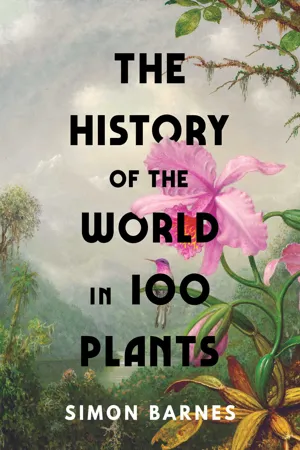
From the author of The History of the World in 100 Animals, a BBC Radio Four Book of the Week, comes an inspirational new book that looks at the 100 plants that have had the greatest impact on humanity, stunningly illustrated throughout.
As humans, we hold the planet in the palms of ours hands. But we still consume the energy of the sun in the form of food. The sun is available for consumption because of plants. Plants make food from the sun by the process of photosynthesis; nothing else in the world can do this. We eat plants, or we do so at second hand, by eating the eaters of plants.
Plants give us food. Plants take in carbon dioxide and push out oxygen: they give us the air we breathe, direct the rain that falls and moderate the climate. Plants also give us shelter, beauty, comfort, meaning, buildings, boats, containers, musical instruments, medicines and religious symbols. We use flowers for love, we use flowers for death. The fossils of plants power our industries and our transport. Across history we have used plants to store knowledge, to kill, to fuel wars, to change our state of consciousness, to indicate our status. The first gun was a plant, we got fire from plants, we have enslaved people for the sake of plants.
We humans like to see ourselves as a species that has risen above the animal kingdom, doing what we will with the world. But we couldn’t live for a day without plants. Our past is all about plants, our present is all tied up with plants; and without plants there is no future.
From the mighty oak to algae, from cotton to coca here are a hundred reasons why.
- 400 pages
- English
- ePUB (mobile friendly)
- Available on iOS & Android
eBook - ePub
The History of the World in 100 Plants
About this book
Trusted by 375,005 students
Access to over 1.5 million titles for a fair monthly price.
Study more efficiently using our study tools.
Information
Table of contents
- Cover
- Title Page
- Foreword
- Chapter One: Strangler Fig
- Chapter Two: Wheat
- Chapter Three: Rose
- Chapter Four: Pea
- Chapter Five: Willow
- Chapter Six: Grass
- Chapter Seven: Cinchona
- Chapter Eight: Sunflower
- Chapter Nine: Oak
- Chapter Ten: Daisy
- Chapter Eleven: Yeast
- Chapter Twelve: Cannabis
- Chapter Thirteen: Orchid
- Chapter Fourteen: Brazil Nut Tree
- Chapter Fifteen: Oil Palm
- Chapter Sixteen: Calamites
- Chapter Seventeen: Rice
- Chapter Eighteen: Bindweed
- Chapter Nineteen: Field Poppy
- Chapter Twenty: Papyrus
- Chapter Twenty-One: ‘Penicillium’
- Chapter Twenty-Two: Kigelia
- Chapter Twenty-Three: Daffodil
- Chapter Twenty-Four: Apple
- Chapter Twenty-Five: Redwood
- Chapter Twenty-Six: Christmas Tree
- Chapter Twenty-Seven: Venus Fly-Trap
- Chapter Twenty-Eight: Yew
- Chapter Twenty-Nine: Barley
- Chapter Thirty: Bodhi Tree
- Chapter Thirty-One: Magic Mushrooms
- Chapter Thirty-Two: Potato
- Chapter Thirty-Three: Toadflax
- Chapter Thirty-Four: ‘Cinnamomum’
- Chapter Thirty-Five: Kudzu
- Chapter Thirty-Six: American Grass
- Chapter Thirty-Seven: Tobacco
- Chapter Thirty-Eight: Lotus
- Chapter Thirty-Nine: Marigold
- Chapter Forty: Chilli
- Chapter Forty-One: Truffle
- Chapter Forty-Two: Marula
- Chapter Forty-Three: Cherry
- Chapter Forty-Four: Flax
- Chapter Forty-Five: Indigo
- Chapter Forty-Six: Ginseng
- Chapter Forty-Seven: Rubber
- Chapter Forty-Eight: Garlic
- Chapter Forty-Nine: Foxglove
- Chapter Fifty: Grape
- Chapter Fifty-One: Edible Mushroom
- Chapter Fifty-Two: Japanese Knotweed
- Chapter Fifty-Three: Bamboo
- Chapter Fifty-Four: Tea
- Chapter Fifty-Five: Gourd
- Chapter Fifty-Six: Virginia Creeper
- Chapter Fifty-Seven: Opium Poppy
- Chapter Fifty-Eight: Banana
- Chapter Fifty-Nine: Aspidistra
- Chapter Sixty: Bean
- Chapter Sixty-One: Toadstool
- Chapter Sixty-Two: Teak
- Chapter Sixty-Three: Pine
- Chapter Sixty-Four: Mulberry
- Chapter Sixty-Five: Lily
- Chapter Sixty-Six: Waterlily
- Chapter Sixty-Seven: Orange
- Chapter Sixty-Eight: Saffron Crocus
- Chapter Sixty-Nine: Cucumber
- Chapter Seventy: Stinging Nettle
- Chapter Seventy-One: ‘Candida Albicans’
- Chapter Seventy-Two: Cacao
- Chapter Seventy-Three: Strawberry
- Chapter Seventy-Four: Cotton
- Chapter Seventy-Five: Soybean
- Chapter Seventy-Six: ‘Arabidopsis Thaliana’
- Chapter Seventy-Seven: Tulip
- Chapter Seventy-Eight: Coffee
- Chapter Seventy-Nine: Sugarcane
- Chapter Eighty: Holly
- Chapter Eighty-One: Dry Rot
- Chapter Eighty-Two: Olive
- Chapter Eighty-Three: ‘Rafflesia’
- Chapter Eighty-Four: Tomato
- Chapter Eighty-Five: Almond
- Chapter Eighty-Six: Hemlock
- Chapter Eighty-Seven: Cabbage
- Chapter Eighty-Eight: Cassava
- Chapter Eighty-Nine: Ordeal Tree
- Chapter Ninety: Chrysanthemum
- Chapter Ninety-One: Mycorrhiza
- Chapter Ninety-Two: Eucalyptus
- Chapter Ninety-Three: Coca
- Chapter Ninety-Four: Maize
- Chapter Ninety-Five: Rape
- Chapter Ninety-Six: Algae
- Chapter Ninety-Seven: Phytoplankton
- Chapter Ninety-Eight: Baobab
- Chapter Ninety-Nine: Rosy Periwinkle
- Chapter One Hundred: Dipterocarp
- Epilogue
- Acknowledgments
- About the Author
- Index
- Picture Credits
- Copyright
Frequently asked questions
Yes, you can cancel anytime from the Subscription tab in your account settings on the Perlego website. Your subscription will stay active until the end of your current billing period. Learn how to cancel your subscription
No, books cannot be downloaded as external files, such as PDFs, for use outside of Perlego. However, you can download books within the Perlego app for offline reading on mobile or tablet. Learn how to download books offline
Perlego offers two plans: Essential and Complete
- Essential is ideal for learners and professionals who enjoy exploring a wide range of subjects. Access the Essential Library with 800,000+ trusted titles and best-sellers across business, personal growth, and the humanities. Includes unlimited reading time and Standard Read Aloud voice.
- Complete: Perfect for advanced learners and researchers needing full, unrestricted access. Unlock 1.5M+ books across hundreds of subjects, including academic and specialized titles. The Complete Plan also includes advanced features like Premium Read Aloud and Research Assistant.
We are an online textbook subscription service, where you can get access to an entire online library for less than the price of a single book per month. With over 1.5 million books across 990+ topics, we’ve got you covered! Learn about our mission
Look out for the read-aloud symbol on your next book to see if you can listen to it. The read-aloud tool reads text aloud for you, highlighting the text as it is being read. You can pause it, speed it up and slow it down. Learn more about Read Aloud
Yes! You can use the Perlego app on both iOS and Android devices to read anytime, anywhere — even offline. Perfect for commutes or when you’re on the go.
Please note we cannot support devices running on iOS 13 and Android 7 or earlier. Learn more about using the app
Please note we cannot support devices running on iOS 13 and Android 7 or earlier. Learn more about using the app
Yes, you can access The History of the World in 100 Plants by Simon Barnes in PDF and/or ePUB format, as well as other popular books in Biological Sciences & Botany. We have over 1.5 million books available in our catalogue for you to explore.