![]()
Tour 1: The Heart of York
This walk focuses on the Gothic heart of York – the Minster. At under 3km (2 miles) long, it could be completed in half a day, but there’s so much of interest you’ll want a full day
The Minster
St William’s College
Minster Library
Treasurer’s House
Monk Bar
Bootham Bar
York Art Gallery
This tour covers just a small corner of the city, but encompasses almost 2,000 years of history, giving you the opportunity to see everything from Roman remains to 20th-century artworks. Not bad for one day.
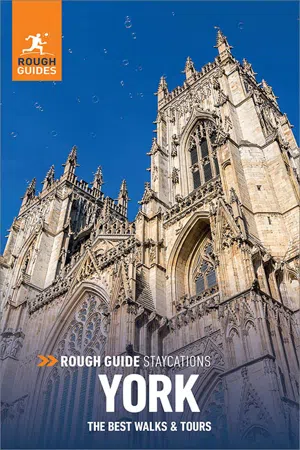
The Minster’s Gothic towers.
William Shaw/Apa Publications
It starts at York’s fabulous Gothic cathedral, the mother church for England’s ‘Northern Province’, erected on a site once occupied by a Roman fort. It has many treasures, most notably its fine stained glass. The walk then takes you around the environs of the Minster, including St William’s College and Treasurer’s House, before climbing up onto the medieval walls at Monk Bar for a picturesque walk along the ramparts and a semi-aerial view of the Old City. The walk ends at the city’s Art Gallery, whose paintings span 600 years.
The Minster
The Minster 1 [map] (tel: 01904 557 200; www.yorkminster.org; Mon–Sat 9.30am–3.45pm, Sun 12.45–2.45pm; at least four services throughout the day; guided tours Mon–Sat 10am–3pm, plus specialist tours of the Minster’s medieval stained glass each weekday at 1.30pm) is the largest Gothic cathedral north of the Alps and is both a cathedral and a minster – a cathedral because of its Archbishop’s Throne and a minster because it has been served since Saxon times by a team of clergy. It has the widest nave in England; it stands 60m (197ft) high, is 158m (518ft) long and 76m (249ft) wide across the transepts. Despite its size, restorations and cleaning give the visitor an impression of airy lightness. Its dimensions may make an immediate impression, but its ornate detail makes it an attraction worth spending an entire day exploring.
The Minster’s east door.
Fotolia
A long-spanning history
The history of the Minster is the history of England. A Roman legion’s headquarters stood here from AD71 before the first wooden church was founded in 627; it was named for St Peter (as the cathedral still is today) and was built for the baptism of the Anglo-Saxon King Edwin of Northumbria. It was almost immediately rebuilt in stone, but this was damaged by fire in 1069, when the Normans came to York. Between 1080 and 1100, work was carried out on a new Minster, which was much altered and enlarged over the years. In 1295 work began on the Nave – and continued for 70 years. The word ‘nave’ comes from the Latin for ship, navis, and likens the cathedral to a vessel of salvation. The present Gothic cathedral was finally completed in 1472, taking more than 250 years to build.
There was major restoration after two serious 19th-century fires. In 1829 a religious fanatic, Jonathan Martin, set fire to the choir (quire) area, destroying its stalls and roof. A workman’s candle set fire to the South West Tower in 1840 and severely damaged the nave. A third fire – thought to have been caused by lightning in 1984 – destroyed the South Transept roof. It occurred just three days after controversial clergyman David Jenkins had been consecrated Bishop of Durham and it was seen by some as divine retribution (others preferred to blame a UFO). The fire raged for over three hours, causing damage to the famous Rose Window, as well as the roof. It cost £2.25 million to carry out all the repairs. The restored transept was finally rededicated by the Queen in 1988. Major restoration work was also carried out between 1967 and 1972 when cracks were found in the Central Tower and other parts of the cathedral were found to be unstable. Repairs involved giving the tower new steel-reinforced concrete ‘feet’, which can be seen in the Minster’s Undercroft Museum. An ongoing programme of work continues with the restoration of the South Quire Aisle, expected to cost around £11 million and take 11 years to complete.
This is still a living church, and regular pauses for prayer are announced over a speaker system. It is also the site for the enthronement of the Archbishop of York. The Archbishop, John Sentamu, enthroned in 2005 and in office until 2020, was the first black archbishop in the Church of England.
Visitors enter via ticket barriers in the South Transept. Anger at the introduction of an entry fee made it all the way to Parliament, where one MP described the imposition as ‘tacky’. Nevertheless, claimed Church officials, the money for ongoing restorations must be found somewhere, especially as the Minster costs £23,000 a day to maintain.
York Minster – a source of wonder.
William Shaw/Apa Publications
The Five Sisters’ Window at the North Transept in York Minster.
Bigstock
Navigating the Minster
Begin your tour in the Nave A [map] to the west (left as you enter). The main body of the Minster is Decorated Gothic in style and was completed in the 1350s. The 14th-century West Window B [map] painted in 1338 has become known as the ‘Heart of Yorkshire’ because of the heart shape in the ornate tracery. The stonework became badly eroded and was replaced and rededicated in 1989. Beneath the window you can see a statue of St Peter, the patron saint of York.
The Central Tower is large enough to house the Leaning Tower of Pisa.
One of only seven cathedra...